
Rocky Branch Savanna
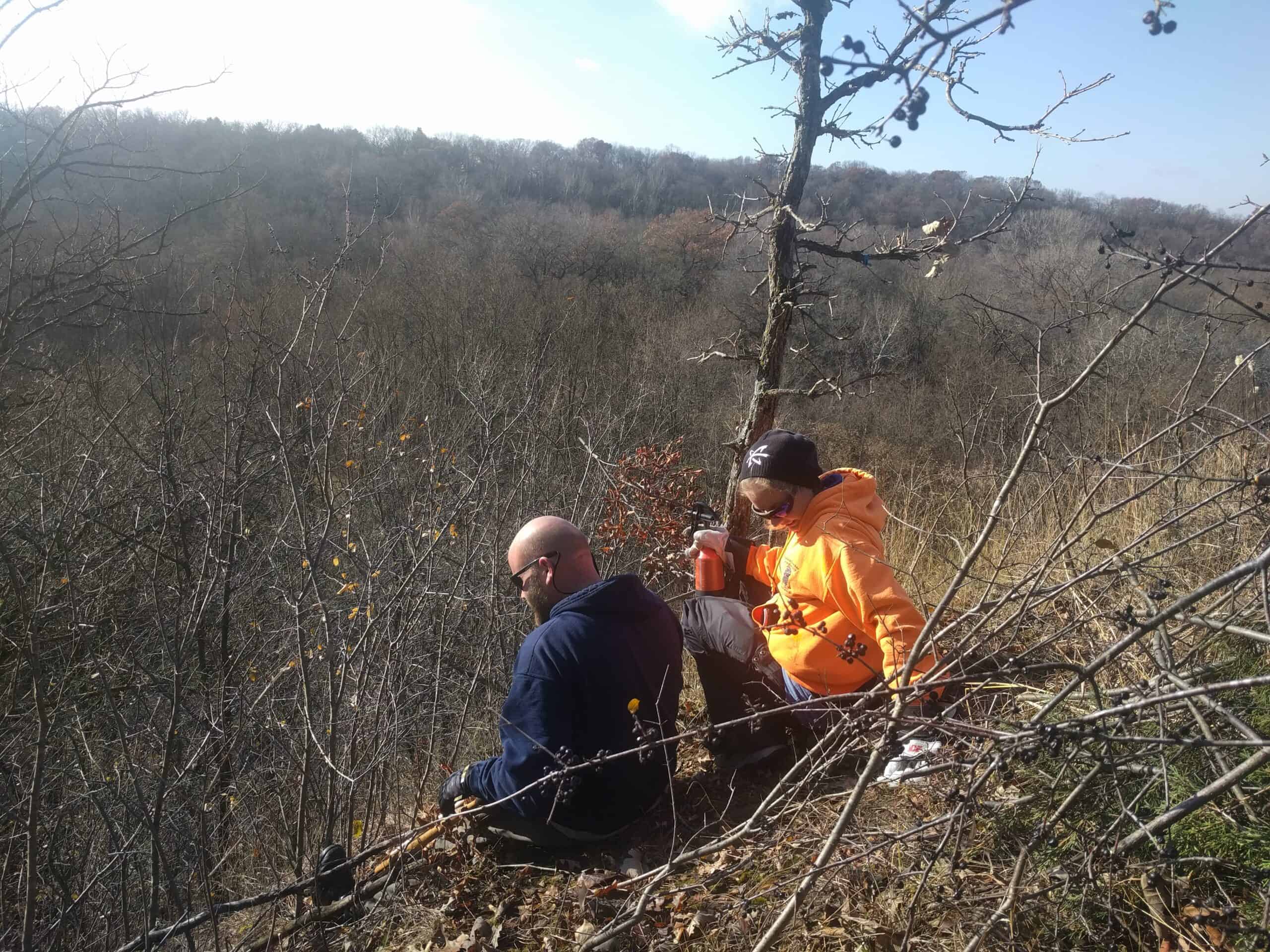
This three-acre oak savanna overlooks the Rocky Branch tributary to the Kinnickinnic River. The Prairie Enthusiasts has an informal agreement with the City of River Falls to remove invasive trees and brush.
SITE STEWARDS
Robert Marquis
Robert_Marquis@umsl.edu
ACCESS & DIRECTIONS
The savanna is accessed from an easement trail (#12) between 1371 and 1401 River Ridge Road, River Falls, WI.
.
Google Map
Description & Significance
The majority of the preserve consists of oak savanna and prairie sitting on top of a dolostone bluff.
To the West, the bluff drops off sharply, 50% of the boundary of which terminates in a vertical cliff. To the north, the savanna slopes more gently into mesic forest. The eastern and southern boundaries are mesic forest heavily invaded by European buckthorn (Rhamnus cathartica).
Current habitat types: Oak savanna, dry hillside prairie, limestone cliff, riparian (Rocky Branch Creek), and surrounding mesic forest.
Primary Soils: Dunnbot 23.9% (fine sandy loam), Spillville 23.7% (silt loam), Dorerton 19.6% (very stony-Boone-Whalan) (Source???)
Geology: The underlying formation is dolomite of the Prairie du Chien Group, of Early Ordovician origin (Appendix, Figure 2).
Conservation Significance
Rocky Branch Oak Savanna is one of a few protected prairie bluff habitats in the Kinnickinnic River watershed. Although small, it contains rare bluff prairie and oak savanna, the latter of which dominated the region when Europeans first arrived. Ground plum (Astragalus crassicarpus) (endangered in Wisconsin) was listed as present in the 2018 management plan for the site, but has not been recorded since. A thriving population of kittentails (Bessya bullii) (threatened in Wisconsin) is present. A total of 180 vascular plant species have been found at the location over the past five years (Appendix). Sixteen percent of those species (29 total) are weedy or invasive.
The most common of the invasive species are crown vetch, dame’s rocket, buckthorn, wild parsnip, white sweet clover, black locust, black medic, bush honeysuckle, timothy, and brome grass.
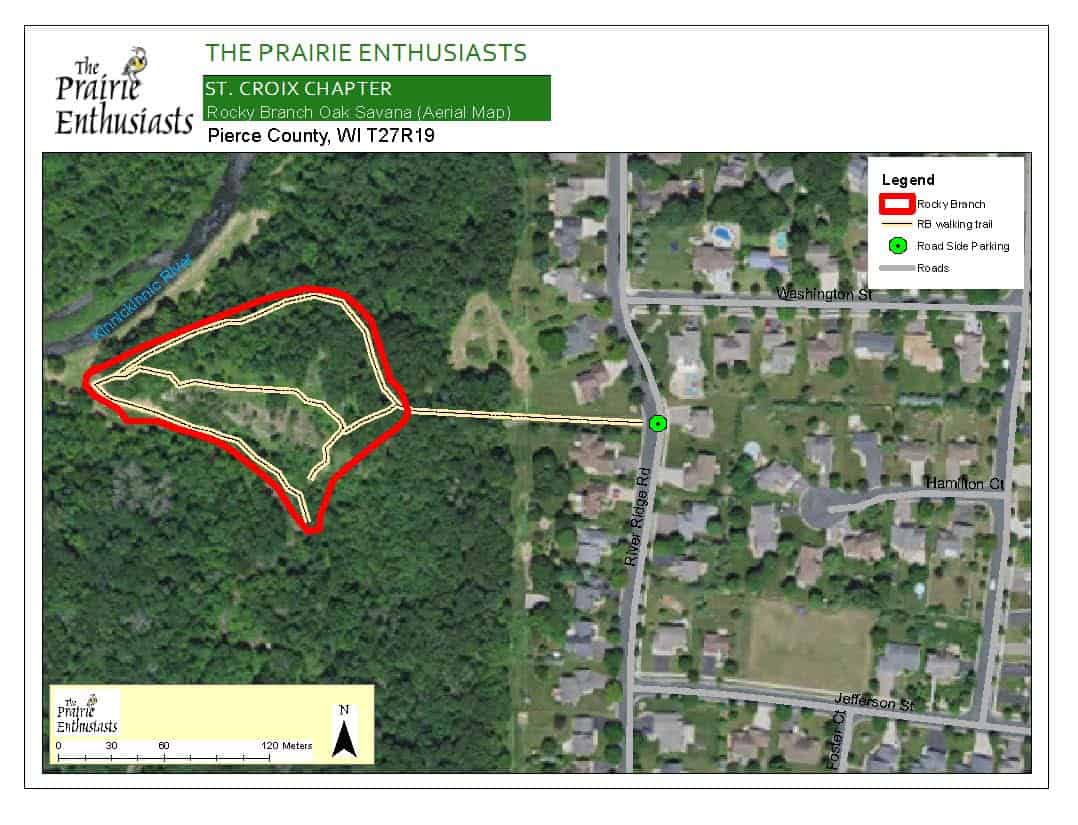
Rocky Branch Aerial
Volunteers
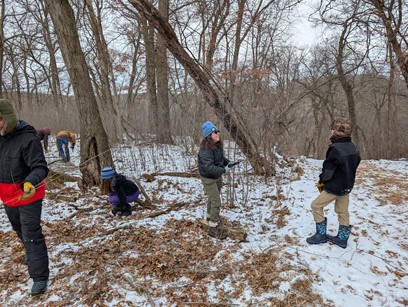
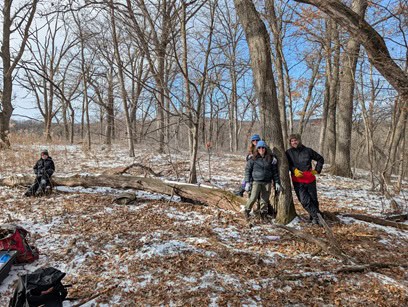
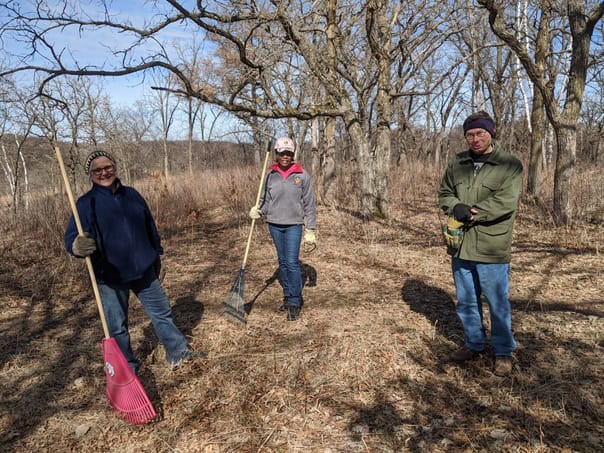
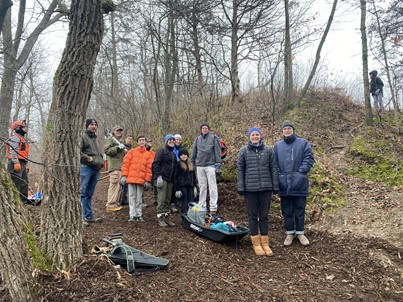
All work days are listed on our chapter page under Events. Reminders are sent to everyone on the St Croix Valley eNews list.
Ownership History
The site is owned by the City of River Falls.
There is no evidence that the site has been plowed. The site was surveyed in 1848 as burr oak savanna (Appendix, Figure 3). Aerial photos show the location intact since 1939 (Appendix, Figure 4). The open prairie portion of the site is clearly visible in all photos. River Hills Park, a park of the City of River Hills, of which Rocky Branch Savanna is part, was established in 1976. The savanna has been under the management of The Prairie Enthusiasts since 1995. At that time, the site was surrounded most immediately by mixed mesic forest and oak savannah associated with the Kinnickinnic River watershed. Agricultural lands still surrounded the watershed. The current nearby housing development was established in 2000. Much of the forest surrounding the location has been invaded by buckthorn. Invasion by buckthorn apparently began in the early to mid 1970’s based on tree ring analysis of large buckthorn plants occurring along the Kinnickinnic River in River Hills Park.
Previous management consisted of controlled burning and removal of invasive plant species (mostly buckthorn, crown vetch, and sweet clover), using mowing, lopping, some foliar spraying, and/or lopping and stump treatment with triclopyr. Contractors, using climbing equipment, removed red cedar trees and buckthorn from the steep cliff. Sowing of seeds seems to have been minimal although records are not complete. Little bluestem seed was sown on the steep portions of the slopes where buckthorn was removed in March 2025 to increase fuel load for subsequent fires to control buckthorn regrowth.
Management
Our goals for 2026 are to
- Provide a native prairie and oak savanna community representative of historic flora and fauna to provide habitat for mammals, amphibians, reptiles, birds, insects, and any prairie or savanna dependent species
- Maintain and expand populations of endangered and rare plant species
- Decrease cover of invading exotic plant species
- Preserve this location for current and future generations to experience, study, and enjoy
All work days are listed on our chapter page under Events. Reminders are sent to everyone on the St Croix Valley eNews list
.