
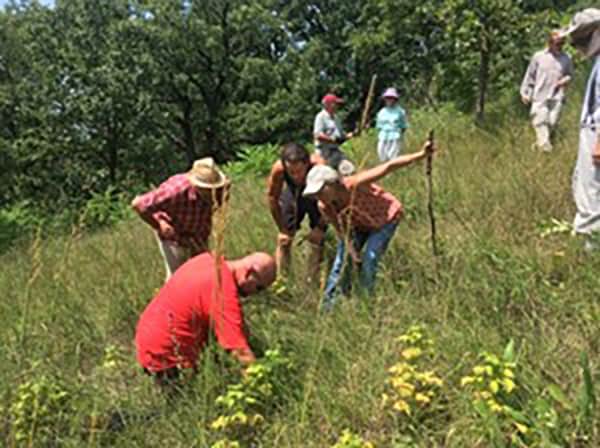
Alexander Oak Savanna
This site is located within the Kinnickinnic River watershed and the Western Prairie Ecological Landscape (a Wisconsin DNR designation).
The dry prairie and oak savanna remnants found on the site are some of the best examples of these habitat types in the Western Prairie Ecological Landscape. We have identified 120 native species on the site, including buffalo bean (Astragalus crassicarpus), kittentails (Besseya bullii), and prairie turnip (Pediomelum esculentum), all threatened or special concern in Wisconsin. Previously documented but yet to be rediscovered at the site are the endangered species Carolina anemone (Anemone caroliniana) and prairie bushclover (Lespedeza leptostachya). The prairie turnip was a new discovery in 2018, showing promise for the possible rediscovery of the prairie bushclover and Carolina anemone with further site management.
SITE STEWARDS
Alex Bouthilet
alex.bouthilet@gmail.com
Wayne Huhnke
whuhnke@gmail.com
ACCESS & DIRECTIONS
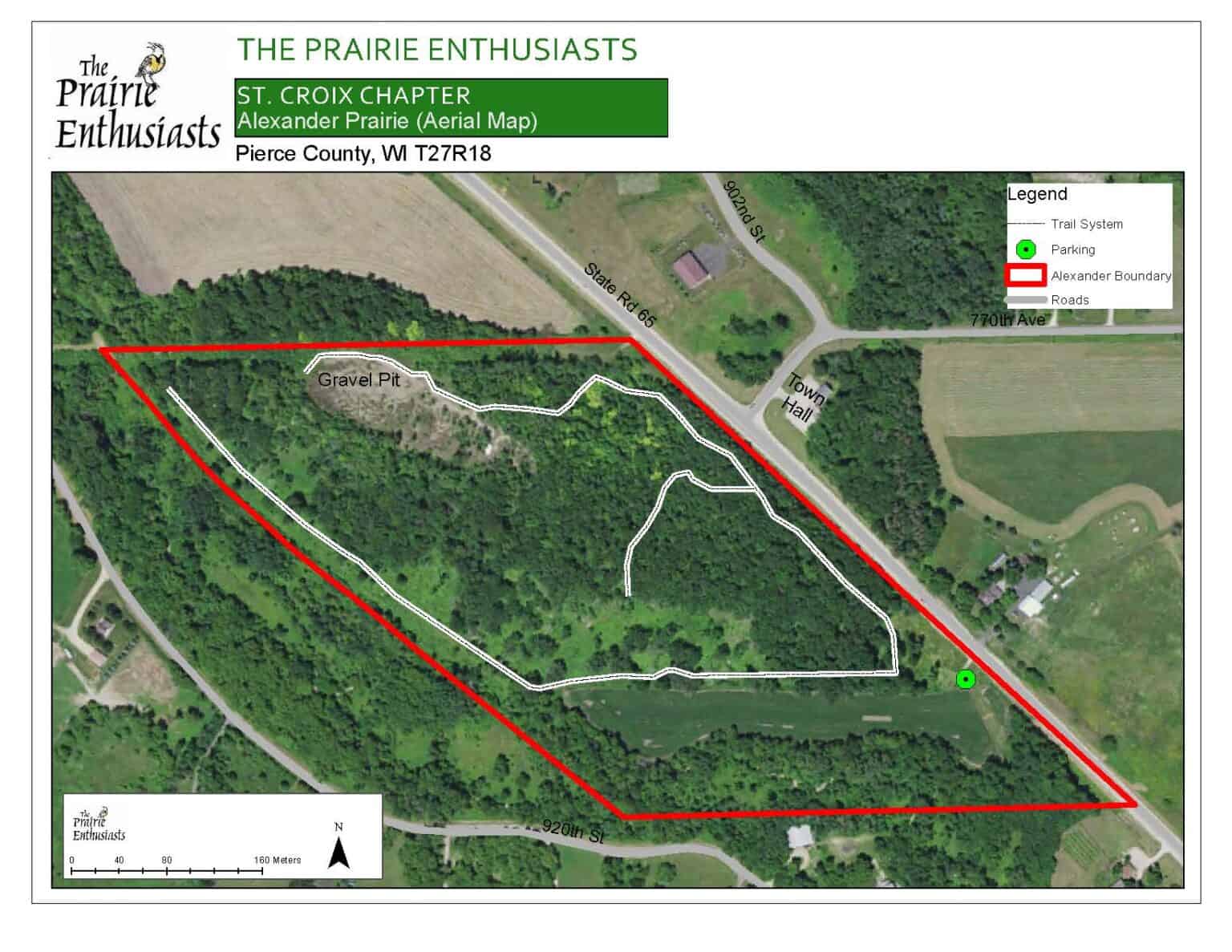
The site is located in Pierce County, approximately four miles south of River Falls on state highway 65 and 0.2 miles south of the Town of River Falls Town Hall. There is a parking area access at the south end of the property.
Google Map
Prescribed Burning


When we burn
Alexander oak savanna is burned every year exclusively during the plants’ dormant season.
The Prairie Enthusiasts staff ecologist Dan Carter writes, “fire is an integral part of Upper Midwestern prairie and oak ecosystems. Fire is their primary stabilizing agent and was probably the greatest single consumer of their plant production in the past (Wendt et al. 2023[4]).
“The more frequently contemporary Midwestern prairie and oak ecosystems burn in the dormant season, the more they retain historical or old-growth composition over time (Towne and Owensby 1984[5], seasonality of fire; Milbauer and Leach 2007[6], Bowles and Jones 2013[7] and Alstad et al. 2016[8], frequency of burns mostly in early spring or fall).”
Join us!
All burn crew members are required to attend training. Our Burn School is offered each year in conjunction with our annual conference for those interested in becoming a crew member.
If you have attended the classroom portion of Burn School and would like to pursue in-field training and in-person apprenticeships to complete your prescribed burn certification, you can learn more about that process and who to contact in this form.
A variety of courses, including NWCG certified classes, are listing by the WI Prescribed Fire Council (course listing) and meet our requirements.
Oak Habitat

Why oak savanna?
Doug Tallamy writes In the Nature of Oaks:
There are 435 species of oaks worldwide, and 91 of them are found in the United States. Oaks support more caterpillar species than any other genus of plants in North America — not to mention all the animals that eat acorns. That’s why Doug calls oaks “keystone plants.” If you take the keystone plant out of the local food web, the food web collapses.
In his research, Doug has found that in 84 percent of the counties in North America, oaks are the most productive trees when it comes to producing food. Additionally, about 5% of North America’s native plants make 75% of the food.
Land Management


Managing invasive plants
Oak savannas and prairies that are not managed will be taken over by nonnative invasive and aggressive species. To manage Alexander, volunteers annually burn management units and cut, pull, and treat buckthorn and spotted knapweed. Cleared areas are overseeded with species native to the site.
Join us!
Late fall and winter in the savanna begins the season of woody invasive eradication. Removal will involve a variety of methods: pulling, snipping, cutting, sawing, herbicide application, and the building of brush piles.
Every work party has a leader. They will explain why this site is important, what we hope to accomplish on that day, and how you can contribute.
Join us when you can for as long as you can! While most work parties are scheduled from 10am until 2pm, you can come for 1, 2, 3, or 4 hours; whatever you can contribute is welcome!
No experience needed (except to use a chainsaw). We will instruct you on what buckthorn, black locust, cedar, and pines look like, how to cut and how to apply herbicide.
WHAT TO BRING:
The chapter has loppers, herbicide, and herbicide applicators. You are welcome to bring you own equipment if you prefer.
If you bring your chainsaw, you must have all personal protection equipment (PPE).
Native Plants

Species present
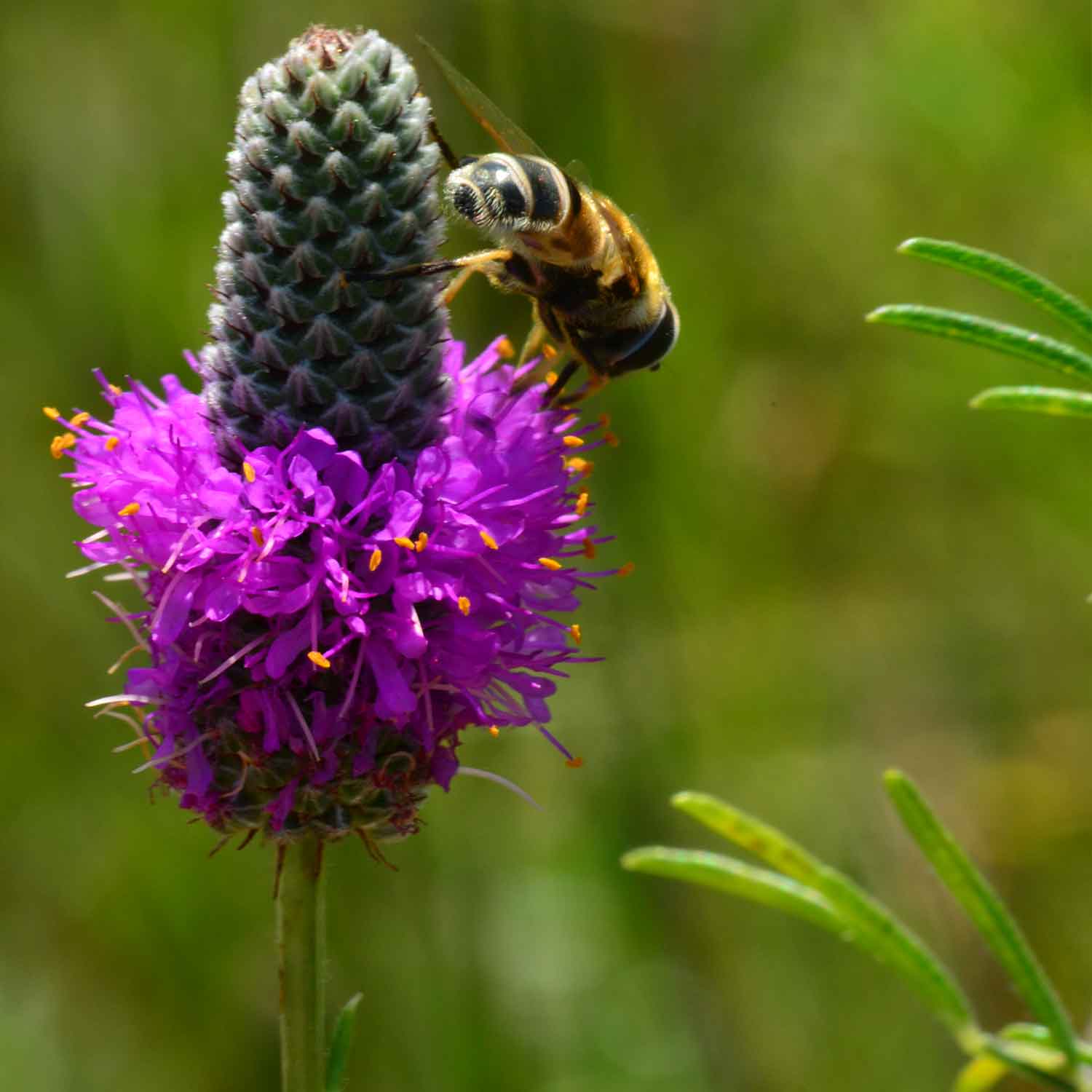
Over 120 species of plants call the preserve home. The procession of wildflowers starts in spring with violets and puccoon. Bergamot and prairie clover beckon in summer, greeting bumblebees. And fall stuns visitors with asters and goldenrods. Come often to see what’s blooming.
Some of the notable plants include
- Agastache scrophulariaefolia (Giant Purple Hyssop)
- Ageratina altissima (White Snakeroot)
- Amorpha canescens (Leadplant)
- Anemone cylindrica (Thimbleweed)
- Anemone quinquefolia (Wood Anemone)
- Antenneria sp. (Pussytoes)
- Aquilegia canadensis (Columbine)
- Asarum canadense (Wild Ginger)
- Astragalus crassicarpus (Ground Plum)
- Many, many sedges!
Insects


Butterflies, moths, flies, bees
Volunteers have documented over 30 species of butterflies at the savanna. The diverse plant life here provides food and shelter for a great variety of bees, butterflies, and other insects. Caterpillars and other larvae find shelter and food in bark and leaves. Flowers provide pollen and nectar.
Notable species include:
- Papilio glaucus (Eastern Tiger Swallowtail)
- Papilio cresphontes (Giant Swallowtail)
- Papilio polyxenes (Black Swallowtail)
- Satyrium edwardsii (Edward’s Hairstreak)
- Everes comyntas (Eastern Tailed-Blue)
- Speyeria cybele (Great Spangled Fritillary)
- Boloria bellona (Meadow Fritillary)
Birds


So many birds!
The savanna’s diverse habitats attract both migrating and nesting birds. Watch for cavity nesters like northern flickers and canopy dwellers like flycatchers and orioles.
While you explore, download the eBird app and record what you see and hear! Search for the Alexander Savanna hotspot. Visitors have recorded 66 species. What will you find or hear?
Description & Significance
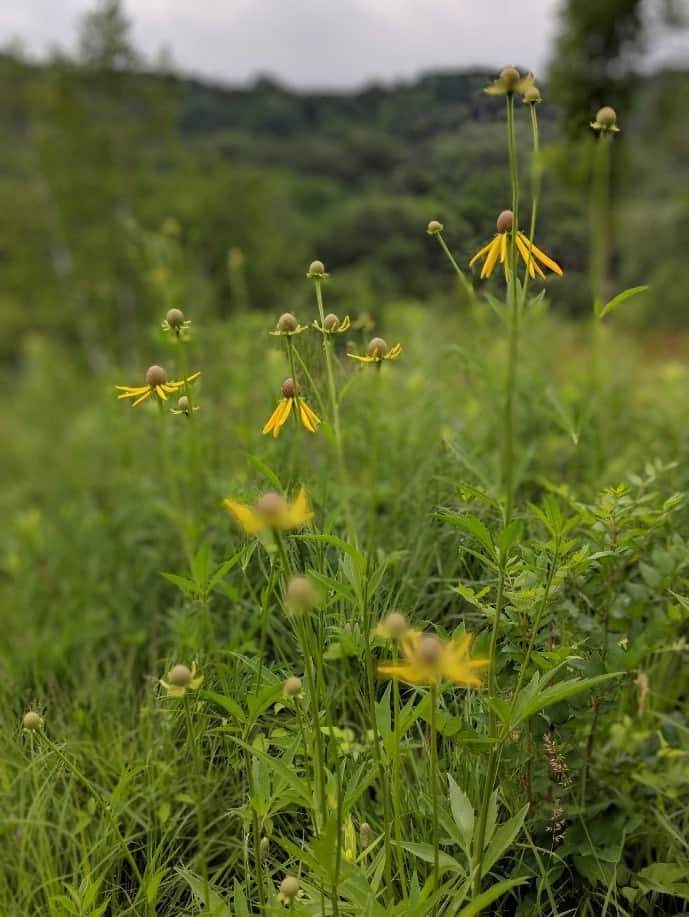
Alexander Oak Savanna falls within the Western Prairie ecological landscape and supports dry prairie/very open oak savanna on south to southwest-facing slopes, which grade to mesic and even isolated wet prairie/savanna in scattered areas at the toe of the hillslopes. There is a high-quality remnant open oak woodland (not open oak savanna) on the hilltop immediately north of the easterly prairie / open savanna remnant, which grades into more degraded oak woodland and undifferentiated forest northward, eastward, and westward. Additional historical open oak savanna is generally degraded and occupies mostly south, west, and southeast slope positions. An old railroad right of way runs from northwest to southeast in the western part of the property and supports some remnant populations of native plants. A quarry in the northern part of the property also supports some populations of native plants. A field in the southern part of the property has been planted to prairie, and an intermittent stream corridor runs just south of that field and west of the old railroad right of way. See Attachment A, Map 3for plant community areas.
Attachment C shows the intermittent stream, topographic contours, and hillshade from LIDAR. Elevation ranges from below 960 feet along the intermittent stream in the far northwest corner of the property to above 1060 feet on the hilltop in the central part of the property. The hillshade map shows that much of the western part of the hilltop was removed and is now surrounded by a rim of piled material, and the area just to the east was disturbed by quarry activity. The old railroad right of way in the western part of the property and former cultivated field in the southern part of the property are also clearly visible. Wisconsin Geological and Natural History Survey mapping (Attachment D) indicates that Alexander oak savanna is underlain by quaternary deposits consisting of River Falls formation (sandy till with some meltwater stream sediment) and Middle Ordovician bedrock of the Ancell Group (St. Peter and Glenwood formations). The United States Department of Agriculture Web Soil Survey maps prairie / open savanna areas to Dorerton, very stony-Boone-Whalan complex soils, and the hilltops Whalan silt loams. These indicate Sinnippee Group bedrock underlying the hill that is not mapped in Attachment D. Two similar hill features with similar elevation directly to the north are mapped to Sinnippee Group bedrock and were likewise quarried for shale (Decorah Formation). Elsewhere soils are fine sandy loam and silt loam (Attachment E).
CONSERVATION SIGNIFICANCE
Dry prairie and savanna at Alexander Oak Savanna support ground plum (Astragalus crassicarpus, WI Endangered), kittentails (Besseya bullii, WI Threatened), prairie turnip (Pediomelum esculentum, WI Special Concern), prairie ragwort (Packera plattensis, WI Special Concern), and rock stitchwort (Minuartia dawsoniensis, WI Special Concern). Prairie bushclover (Lespedeza leptostachya, WI Endangered, Federally Threatened) and Carolina anemone (Anemone carolina) are historical to the site but have not been observed since before 2000. Many other prairie species are present, including hoary puccoon (Lithospermum canescens), porcupine grass (Hesperostipa spartea), and silky aster (Symphyotrichum sericeum). In the oak woodland, an old-growth sod containing veiny pea (Lathyrus venosus), northern bedstraw (Galium boreale), grove sandwort (Moehringia lateriflora), and Pennsylvania sedge (Carex pensylvanica) remains. Oak woodland / closed savanna old-growth sods are exceptionally rare, because most have been destroyed by grazing, shading, or the build-up of oak litter in the absence of fire. Here wind export of litter from the convex landform has likely allowed this sod to persist on the hilltop through a period of fire exclusion. The property also supports rusty patched bumble bee (Bombus affinis, WI Special Concern, Federally Endangered) and falls within a United States Fish and Wildlife Service-mapped high potential zone, which means there has been a recent observation of the species in the immediate vicinity. See Attachment F for a rare species table, biotic inventories (vascular plants, butterflies and moths), and list of species used in the prairie planting. See Attachment G for recent site photographs.
Usage Policies
Allowed:
- Outdoor Recreation
- Hunting (for all species, no permit or reservation required)
- Trapping (for all species, no permit or reservation required)
Not Allowed:
- Collecting Plants, Seeds, Rocks or Animals without permission from The Prairie Enthusiasts
Ownership History

Dick and Joan Alexander purchased the property in 1965, and used it for decades as a resource for family activities, hunting and firewood gathering.
The WI chapter of The Nature Conservancy recognized the conservation significance of the site and secured first right of refusal in 1985, which was transferred to The Prairie Enthusiasts in 2003. The Saint Croix Valley Chapter of The Prairie Enthusiasts worked on the site since the 1990s in cooperation with the former owners, Dick and Joan Alexander. This work has included brush and tree removal, invasive species control, addition of local genotype seed (including a prairie planting in the formerly cultivated field) and prescribed burns.
In 2018, the Alexanders generously accepted an offer from TPE for the purchase of the property, ensuring its continued resource recovery through TPE management.
Management
Our goals for the site are to:
- Restore and maintain historical prairie, oak savanna, and oak woodland on the site.
- Maintain and improve habitat for rusty patched bumble bee and other invertebrates.
- Restore and maintain habitat for savanna bird species.


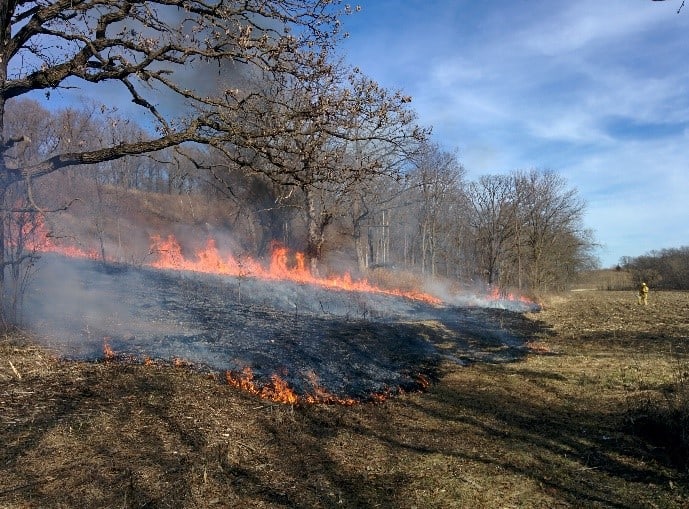
Prior to 2000, the site was managed by The Nature Conservancy through their volunteer site steward program. Since assuming management responsibility in 2000, TPE’s efforts have focused on the removal of such invasive species as buckthorn, Siberian elm, and red cedar. Regular prescribed burns are conducted in late winter or early spring. TPE has also re-introduced appropriate species native to this area by overseeding portions of the site with locally collected seed.
The restoration work has been done mainly by TPE volunteers, but the chapter has also received land management grants from the U.S. Fish and Wildlife Service and the Wisconsin Department of Natural Resources to hire contractors to assist with this work. We have also been fortunate to have the assistance of many University of Wisconsin River Falls students who have participated in a variety of site management activities. Throughout TPE’s management history of the site.
All work days are listed on our chapter page under Events. Reminders are sent to everyone on the St Croix Valley eNews list.