Karrikins & Soil Health: Emerging Tools for Accelerating Prairie Succession

Karrikins & Soil Health: Emerging Tools for Accelerating Prairie Succession

Karrikins and Soil Health: Emerging Tools for Accelerating Prairie Succession

Article and photo by Brent J. Anderson, Minnesota Oak Savanna Chapter member 

January 26, 2026

Prairie restorations often fall short of public expectations, not because of a lack of planning or care, but because the soil itself isn’t yet ready to support the species people hope to see in the first few years. “Patience is a virtue” reminders too often aren’t heard when the photos and plans suggest immediate gratification and beautiful outcomes. Early successional plants like black-eyed Susan and wild bergamot are always encouraging, but most audiences want richer diversity sooner than the traditional restoration timeline allows. Standard practices emphasize soil preparation, planting and weed management – then we wait for nutrient cycling, soil structure and mycorrhizal networks to mature enough for late-successional species to thrive. Depending on conditions and disturbance, that process can take 10 to 25 years. 

Over the past four years, my interest in soil ecology has deepened, leading me to explore natural, largely native amendments that might promote earlier germination of a wider range of species. As I learned more about the chemical and biological signals within soil, I became especially intrigued by compounds associated with fire—particularly karrikins. 

Karrikins were first identified in 2004 when Australian researchers isolated karrikinolide from the smoke of burned vegetation. These small organic molecules help explain why “smoke water” can stimulate dormant seeds and why fire-dependent species emerge so dramatically after wildfires or prescribed burns. In many ecosystems – including Midwestern prairies – certain species germinate only when fire releases karrikins that bind to soil particles and are later washed into the seed bank by rainfall. This is why plants like sundial lupine (Lupinus perennis) often appear only after several burns, and why some late-successional species remain hidden in restorations for a decade or more. 

Plants that rely on this cue – often called fire-followers or fire-ephemerals – germinate rapidly after fire, grow, flower and set seed within a short window, leaving behind a new generation of dormant seeds in the seed bank. Rain alone cannot activate them. Without the chemical signature of fire, they remain dormant through many cycles of wetting and drying and may persist in the soil for decades. 

However, emerging research also shows that karrikins are not a universal or unlimited solution. Concentration matters. While low levels of smoke-derived compounds can stimulate germination in some species, higher concentrations may actually delay or suppress germination in others. This variability suggests that prairie species respond differently to smoke cues, reinforcing the need for species-specific research rather than blanket applications. In other words, what “wakes up” one plant may tell another to remain dormant. Understanding these thresholds is critical if smoke-derived treatments are to be used responsibly and effectively in larger restorations or even small-scale projects. 

For the “pocket prairie enthusiast,” smoke water is relatively simple to conceptualize, though it should be approached thoughtfully. Smoke water is typically made by capturing smoke from burning native plant material and dissolving those smoke compounds into water – essentially transferring fire’s chemical signal without applying heat to the soil. Importantly, any burned material should consist only of locally native grasses and wildflowers, free from treated lumber, invasive species or other contaminants. Using inappropriate plant material risks introducing unfamiliar chemical signals or residues that don’t belong in the ecosystem being restored. As with fire itself, restraint and ecological context matter. 

Understanding these processes has meaningful implications for prairie restoration. If we can ethically and ecologically mimic or supplement natural fire cues – while respecting species-specific responses – we may be able to stimulate the emergence of plants that would otherwise take much longer to appear. Done carefully, this approach has the potential to advance prairie maturity without bypassing the natural checks that make these systems resilient. 

Additional Research & Reading

About The Prairie Enthusiasts and the Minnesota Oak Savanna Chapter

Established in 2024, this new Chapter covers the counties of Anoka, Carver, Dakota, Hennepin, Isanti, Ramsey, Scott, Sherburne and Wright Counties in Minnesota. We’re actively seeking passionate new members committed to the protection of prairie remnants, restoring degraded prairies, building new prairies and/or excited to learn more about prairie projects in their own communities. We invite you to subscribe to our Chapter updates and become a member. Learn more about the Minnesota Oak Savanna Chapter here.

Springtime Magic

Springtime Magic

Springtime Magic

Story and Art by Joe Maurer, Multimedia Artist, Chippewa Savannas Chapter Member

Dower Prairie Shooting Stars

Two springs ago, I got a call from Steve Hubner from the Prairie Bluff chapter. Joe you gotta get down here and see the blooms of these shooting stars.Steve specifically wanted me to create videos that would showcase the extravagant floral displays found in Butenhoff Prairie, Dower’s and Muralt Prairies, all of which had recently been burned earlier in spring of 2022.As is typical for me when I go to these landscapes, I tend to be a tad drifty. I am either hyper-focused on something or I want to see it all.A Prairie Enthusiast knows there really is no way to properly capture the life of the prairie. Its a highly personal experience.You just have to be there and let the landscape direct you.

Shooting with high frame rates to capture slow motion, I spent a lot of my time chasing queen bumblebees.With my camera on a long stick, I looked a bit like somebody with a metal detector obsession searching for treasures.Steve noticed my odd behavior and more than once remarked that I get overview shots to make sure people see and understand the expansiveness of the floral displays.”

When I got back home, I edited together footage that captured some of what I felt.The videos were good, but there was still another feeling I was trying to get to. In my restlessness to find that feeling, I printed out frames from the videos and taped them together on the walls of my art studio. I spent the next year and a half working on a dozen five-to-six-foot paintings derived from the film stills.I wanted that feeling of being at ground level where queen bees collect spring pollen and badgers forage.I am happy to share some of the outcomes of these efforts.   

My gratitude to Steve Hubner and Mary Zimmerman for the support during this project. Prairie Bluff and Southwest Chapters: thank you for keeping the magic alive in these landscape jewels we call prairies!   

Check out the videos mentioned in this article here:

Dower Prairie

Butenhoff Prairie

Muralt Prairie

To experience the magic of prairies firsthand, visit one of our protected sites.

This article appeared in the Summer 2024 edition of The Prairie Promoter, a publication of news, art and writing from The Prairie Enthusiasts community. Explore the full collection and learn how to submit your work here.

Dower’s Prairie

Nederland

Butenhoff Prairie 

Gentians of Eau Claire 

Moths, Caterpillars, and Restoration of Remnants

Moths, Caterpillars, and Restoration of Remnants

Moths, Caterpillars, and Restoration of Remnants 

By Robert J. Marquis

October 1, 2023

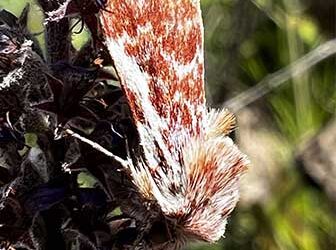
Schinia lucens adult on leadplant, Blueberry Hill Prairie, photograph by Christopher Smith. 

The goal of The Prairie Enthusiasts is to preserve and restore prairies and savannas in the Upper Midwest.  By this we mean the protection of the entire ecosystem, not only the plants but also the animals and microbes and all their intricate interactions with those plants and each other. It has long been feared that conservation efforts might result in “empty forests” (or in our case, “empty prairies”) in which the landscape appears to be intact but close-up, many if not all the once known animal inhabitants are missing. A major challenge is to document the effects of prairie and savanna management on the animal participants and their place in prairie food webs.  


The St. Croix Valley chapter in conjunction with Minnesota Department of Transportation (MNDOT) has managed a small remnant prairie (15 acres) for 18 years. This prairie, known as the Blueberry Hill Prairie, lies on the western bluff  (Minnesota side) of the St. Croix River, just opposite Hudson, Wisconsin. Beginning in 2013, volunteers of the chapter began to convert 11 acres of adjacent agricultural land into prairie. In 2023, the chapter initiated efforts to document the interactions between insects and plants that occur in the Blueberry Hill Prairie.  

One particular interaction of interest is that between leadplant (Amorpha canescens (Fabaceae)) and the Leadplant Flower Moth (Schinia lucens (Noctuidae)) (Swengel and Swengel 2006). The Leadplant Flower Moth occurs from western Michigan to eastern Montana, south to Illinois, Iowa, Nebraska, and Oklahoma, and then again in Florida and South Carolina in the East, and in California and Arizona in the West (http://mothphotographersgroup.msstate.edu/species.php?hodges=11174). On July 6, 2023, Christopher Smith of MNDOT and Wayne Huhnke, a member of The Prairie Enthusiasts and steward of Blueberry Hill Prairie, searched the local population of leadplant on the prairie remnant for the Leadplant Flower Moth. After searching some over 500 plants, they found a single moth, which they photographed (Fig. 1). Surveys of lead plant at the Rocky Branch Prairie and the Foster Cemetery Conservation Area, both in the City of River Falls, Wisconsin, revealed no adults this year. The moth is bright mottled pink (Hess and Hatfield 2015, Henderson 2017), and therefore not easily missed 

Black light setup before sunset (left) and after in the dark (right). Photographs by R. Marquis

The Leadplant Flower Moth is endangered in Michigan (Michigan DNR 2023) and Indiana (Indiana DNR 2023), of special concern in Minnesota (Minnesota DNR 2023), and of greatest conservation need in Wisconsin (Wisconsin DNR 2023a). It is highly specialized in habitat, food plant, and phenology, and it is this combination of characteristics that makes it vulnerable. In the Upper Midwest, it is found only on prairie, caterpillars feed only on leadplant, and then only on the flowers and developing fruits of the plant. This lifestyle forces it into a very narrow time window of activity. In the Upper Midwest, we might suspect that caterpillars of this species could also survive and mature on fruits of Amorpha fruticosa (indigo bush), given that even highly specialized species often can feed on more than one member of the same plant genus. But there are no feeding records for A. fruticosa (Robinson et al. 2002), perhaps because that plant in Wisconsin and Minnesota grows in moist woodlands, along streams, and in floodplains. The moth does occur outside of the range of A. canescens, meaning that it must feed on additional host plant species.

Late instar caterpillar of Schinia lucens, collected on leadplant at Blueberry Hill Prairie. Photo by R. Marquis
After finding the moth adult, the chapter held its first black-lighting event at Blueberry Hill Prairie on July 25, 2023 (Fig. 2). One goal was to attract more adults of this species to get a better sense of the population size. Schinia lucens adults are attracted to ultraviolet lights, establishing that they do fly at night (The Lepidopterist’s Society 1983, 1984). The other goal of black lighting was to more broadly survey the moth species that occur at that prairie. No Leadplant Flower Moths came to the lights that night, perhaps because it was past the flying date of adults. Using a beating sheet placed under lead plants, however, and gently shaking the plants, we were able to find two caterpillars suspected to be of the species. We reared one to a late instar, photographed it (Fig. 3), and then returned it to Blueberry Hill Prairie. The photos match those published online (identification by J. Sorgaard, pers. comm.). The caterpillar ate only developing fruits even though stems and leaves of leadplant were made available. At this time, seven other species of Lepidoptera are known to feed on leadplant parts (Hess and Hatfield 2015, R. Henderson, pers. comm.). None of them are sufficiently similar enough to confuse them with members of the genus Schinia 

Given the decimation of North American prairie, it is not surprising to learn that five of seven species of Lepidoptera (moths and butterflies) listed as endangered or threatened in Wisconsin are prairie and savanna species (Wisconsin DRN 2023b), and all nine endangered or threatened Lepidoptera species in Minnesota are of prairie or savanna (Minnesota DNR 2023). A twelve-year survey of prairie and savanna sites in the Chicago area never or rarely encountered 44% of the insect species that are considered prairie/savanna specialists for the region (Panzer et al. 2010). All is not without hope, however. Even small prairie remnants, if of high quality, are not “empty, as they can harbor prairie specialists (Panzer et al. 2010). In addition, restoration of prairie can be effective in augmenting species diversity and abundance. In Iowa, restored prairie begins to approach remnant prairies in moth diversity after seven years (Summerville et al. 2007). Restoration of prairie in Wisconsin, resulting in increased abundance of leadplant and the leadplant flower moth, further suggests that management can be an effective tool to recovering interactions (Henderson 2017). We will continue to monitor the status of Schinia lucens at Blueberry Hill Prairie, and at the other sites managed by the St. Croix Valley Chapter 

Citations 

Henderson, R. 2017. Of checks, balances & seed production. The Prairie Promoter 30:6,8. 

Hess, M., and M.J. Hatfield. 2015. One plant at a time. The Prairie Promoter 28:1,4. 

Indiana DNR. 2023. Indiana county endangered, threatened and rare species list. https://www.in.gov/dnr/nature-preserves/files/np-Indiana-County-Endangered-Threatened-Rare-Species-List.pdf. Accessed 30 August 2023.  

Michigan DNR. 2023. Threatened and endangered species list. https://www.michigan.gov/dnr/managing-resources/wildlife/wildlife-permits/threatened-endangered-species/threatened-and-endangered-species-list. Accessed 30 August 2023.  

Minnesota DNR. 2023. Minnesota’s endangered, threatened, and special concern species. https://www.dnr.state.mn.us/ets/index.html. Accessed 31 August 2023. 

Robinson G.S., Ackery P.R., Kitching I.J., Beccaloni G.W., Hernández L.M. 2002.  

Hostplants of the moth and butterfly caterpillars of America north of Mexico. Memoirs of the American Entomological Institute, v. 69, 824 p. 

Summerville, K.S., Bonte, A.C. and Fox, L.C., 2007. Short‐term temporal effects on community structure of lepidoptera in restored and remnant tallgrass prairies. Restoration Ecology, 15(2), pp.179-188. 

Swengel, A.B. and Swengel, S.R., 2006. Variation in detecting Schinia indiana and Schinia lucens (Lepidoptera: Noctuidae) in Wisconsin. The Great Lakes Entomologist, 39(3 & 4), p.6. 

The Lepidopterists’ Society. 1983. Season summary. News Lepidoptera Society, no. 2. 

The Lepidopterists’ Society. 1984. Season summary. News Lepidoptera Society, no. 2. 

Wisconsin DNR. 2023a. Species of great conservation need. Wisconsin wildlife action plan. https://dnr.wisconsin.gov/topic/WildlifeHabitat/actionPlanSGCN. Accessed 30 August 2023.  

Wisconsin DNR. 2023b. Wisconsin’s endangered and threatened species list. https://dnr.wisconsin.gov/topic/EndangeredResources/ETList . Accessed 30 August 2023.  

This article appeared in the Fall 2023 edition of the Prairie Promoter, a publication of news, art and writing from the Prairie Enthusiasts community. Explore the full collection and learn how to submit your work here

Want to stay up-to-date on events like this happening in the St. Croix Region? Send us an email to make sure you’re on their chapter email list.

Change & Persistence Among Prairie Grasses

Change & Persistence Among Prairie Grasses

Change & Persistence Among Prairie Grasses

Story and Photos by Dan Carter

There are many misconceptions about prairies that cloud restoration, reconstruction, and management. Prominent among these is the tallgrass prairie “big four,” a concept that situates big bluestem (Andropogon gerardii), Indiangrass (Sorghastrum nutans), switchgrass (Panicum virgatum), and little bluestem (Schizachyrium scoparium) atop the dominant hierarchy of plants on tallgrass prairie. The “big four” has far-reaching influence on grassland management, scientific study, and seed mix design. It’s Tallgrass prairie after all!  

The “big four” are indeed co-dominant in many places where prairie vegetation occurs today. But, except for little bluestem, they were not historically the most dominant grasses on much of the prairie landscape, nor are they most dominant on many of the best remaining old-growth prairies.  

John Curtis (1959)1 described the composition of the least disturbed old-growth prairies in Wisconsin. Big bluestem was present on all studied mesic prairies, but porcupine grass (Hesperostipa spartea), Leiberg’s panic grass (Dichanthelium leibergii), and prairie dropseed (Sporobolus heterolepis) were the most frequent grasses. Frequencies from Curtis are the percentage of square meter quadrats a species occurs within for a given community type — basically how likely the species is to be at your feet if you are  walking in the prairie. porcupine grass was twice as frequent on mesic prairie as big bluestem! Big bluestem was the fifth most frequent grass on dry prairies behind little bluestem, side-oats grama (Bouteloua curtipendula), long-stalked panic-grass (Dichanthelium perlongum), and prairie dropseed; and third most frequent on dry-mesic prairie behind little bluestem and side oats grama. Only on wet-mesic prairie was big bluestem the most frequent among the grasses. Still, on wet-mesic prairie little bluestem’s frequency was about three quarters that of big bluestem. Prairie cordgrass (Spartina pectinata) and Canada blue-joint grass (Calamagrostis canadensis) were the species most often present (frequency data lacking) on wet prairie.  

In Iowa, The only grasses noted by Ada Hayden (1919)2 among the “principal” species of prairie remaining on the gently rolling uplands (mesic) immediately north of Ames, Iowa were porcupine grass and prairie dropseed. Later, Brotherson (1969)3, Kennedy (1969)4, and Glenn-Lewin (1976)5 studied composition on three old growth prairies in northern and western Iowa and found prairie dropseed, Leiberg’s panic grass, and porcupine grass to be the most common on uplands at the respective sites.  

In the Red River Valley of NW Minnesota, Dziadyk and Clambey (1980)6 described old growth prairie communities dominated by blue grama (Bouteloua gracilis) and porcupine grass on dry ground, prairie dropseed followed by little bluestem on gentle slopes, little bluestem followed by prairie dropseed on moderately well-drained level areas, and big bluestem and slim-stem reed-grass (Calamagrostis stricta) together on low prairie over poorly drained soils.  

Weaver’s and Clements’ (1938)7 concept of “true prairie,” which they extend to a region stretching from Illinois to Nebraska and northwest Minnesota to Oklahoma, is co-dominated by mid grasses—Porcupine grass, prairie dropseed, rough dropseed (Sporobolus compositus), little bluestem, side-oats grama, and needlegrass (Hesperostipa comata, in the west). Weaver worked extensively on prairies in the western part of the tallgrass prairie during the first half of the 20th century, including early study of fire effects at the Agricultural Experiment Station just north of Manhattan, Kansas. There, little bluestem and Junegrass (Koeleria macrantha) were initially the top two grasses (big bluestem was third). Composition shifted toward big bluestem with annual late spring burning but not late fall burning or earlier spring burning8,9. Indeed, late spring burning in the western and southwestern tallgrass prairie region to promote big bluestem for cattle pasture is part of why prairie composition changed there during the 20th century. Weaver and Clements observed these changes occurring and attributed them to the grazing and burning practices of the time, saying that the result was “that their [the mid grasses’] tallgrass competitors, notably Andropogon, gradually moved up the slopes and today appear to be essential members of the prairie relicts(page 458).  

Why did European land use sometimes drive compositional change towards the tall grasses like big bluestem?  

Late spring burning favors the growth form of long rhizomatous, warm-season grasses. Their growing points remain below the soil surface until very late spring or early summer, so growth of their active shoots can continue uninterrupted despite damage to aboveground foliage with late spring burns. The growing points of most bunchgrasses (e.g., porcupine grass, prairie dropseed, Leiberg’s panic grass, little bluestem, Junegrass, etc.) rise above the soil surface and become vulnerable to fire shortly after they initiate growth. If these are burned off, the bunchgrasses must activate reserve buds to replace the lost shoots. That alone puts them at a disadvantage, but their reserves of buds tend to be small compared to long-rhizomatous big bluestem and Indiangrass10, so their regenerative capacity is sooner exhausted (meristem-limited) in response to removal of active shoots. The cool-season bunchgrasses are hit especially hard by late spring burning because of their early growth, but even little bluestem, a warm-season species, can be harmed by later spring burns due its difference in growth form. Prairie dropseed, another warm-season grass, is harmed because it initiates growth nearly as early as the cool-season species despite its warm-season physiology. On most upland old growth prairie, late spring burning favors a subset of native grasses that was not historically so abundant.  

The effect of fire exclusion on composition can be similar to those of frequent late spring burning. Species with elongating rhizomes are better able to emerge through excessive accumulations of thatch. Hensel (1923)11 observed this 100 years ago in the Kansas Flint Hills. Little bluestem increased with annual early spring burning, but big bluestem replaced little bluestem atop the dominance hierarchy when fire was excluded. Weaver and Rowland (1952)12 also observed this in eastern Nebraska in the absence of burning, haying, or grazing: 

“Consequences of the effects of the mulch upon the environment were production of a nearly pure, but somewhat thinner than normal, stand of Andropogon [big bluestem]. The understory of upland prairie had all but disappeared. The usual mid grasses of upland were few or none. Only a few taller forbs remained.”—Page 19 

Burning in the presence of excessive litter accumulation, which often occurs on prairies that are occasionally burned (as opposed to frequentyly)kill or weaken little bluestem13 and other bunchgrasses (e.g., needlelegrass)14. Their buds are at or just above the soil surface and vulnerable to increased fire duration when excessive litter has built up. This is not the case for the deeply buried buds along the rhizomes of big bluestem or Indiangrass. Interestingly, excessive litter may interact with fire to affect prairie bunchgrasses and certain invertebrates (skippers: Hesperia ottoe and H. Dakotae)15 in similar ways, with responses contingent on the amount of litter accumulation!  

Native bunchgrasses decrease for many of the same reasons in response to confined grazing. Porcupine grass is very palatable and emerges before most other prairie grasses, so it disappears quickly upon pasturage16. The long-rhizomatous prairie grasses also decrease in response to grazing16, but they persist and recover relatively well during rest periods because they have greater reserves of belowground buds available for recovery and their elongating rhizomes help them colonize openings where vegetation has been thinned by disturbance. The position of buds on these long-rhizomatous grasses an inch or two beneath the soil surface also protects their regenerative capacity from mechanical disturbance 10,17. Weaver recognized the importance of rhizomatous habit for recovery from disturbance, but not bud depth or number. Nonetheless, where grazing was too intense and prolonged, most prairie grasses were replaced by long-rhizomatous, cool-season species like Kentucky bluegrass (Poa pratensis), except on the driest sites1,2,16. 

The work of Weaver, Curtis, Hayden, and others adds important context to our interpretation of more contemporary studies of prairie. They help us discern between research and management outcomes from altered grasslands that no longer retain old growth composition, and prairies that still do. Porcupine grass, little bluestem, prairie dropseed, side-oats grama, and/or Leiberg’s panic grass are usually among the prominent grass species on the best remaining old growth, upland prairies. All of those species differ from big bluestem in their ecologies in ways that have implications for management. Except side-oats grama, many of those differences stem from growth form, cool-season physiology, or both. Earlier work on composition also highlights the amazing persistence of well-stewarded and less historically exploited old-growth prairies in the face of unprecedented change. Upland old-growth prairies that retain much of their composition have typically experienced: 

  • fewer periods of excessive litter accumulation. 
  • fewer late spring burns and more burns between fall and early spring—the more frequent the better9,18,19. True prairie composition was and is an expression of dormant season fire.  
  • minimal fenced grazing. Free-roaming deer, elk, bison, and their predators/hunters are separate issues.  
  • less fragmentation19, but consider that small, less exploited prairies that are well-stewarded retain more of their historical botanical composition than landscape grasslands in the western tallgrass region. Little prairies are more vulnerable to neglect, which argues for their protection and care.  

While the confluence of these conditions is tragically rare, the persistence of what remains is reason to keep hope. True prairie in the Midwest has been home to members of east-west and north-south expanding and contracting flora, fauna, and cultures for millennia. Even an island of old-growth prairie carries with it immeasurable ecological memory. We can kindle that and facilitate its recovery through stewardship and by building connections among prairie places and prairie people…especially if we can get our hands on more porcupine grass and Leiberg’s panic-grass! 

References:

1 Curtis, J. 1959. The vegetation of Wisconsin University of Wisconsin Press. Madison, WI. 

2 Hayden, A. 1919. Notes on the floristic features of a prairie province in central Iowa. Proceedings of the Iowa Academy of Science 25: 369-389. 

3 Brotherson, J. 1969. Species composition, distribution, and phytosociology of Kalsow Prairie, a mesic tall-grass prairie in Iowa. Dissertation, Iowa State University.  

4 Kennedy, R. 1969. An analysis of tall-grass prairie vegetation relative to slope position, Sheeder Prairie. M.S. Thesis, Iowa State University.  

5 Glenn-Lewin, D. 1976. The vegetation of Stinson Prairie, Kossuth County, Iowa. Proceedings of the Iowa Academy of Science 83: 88-93. 

6 Dziadyk, B. and G. Clambey. 1980. Floristic composition of western Minnesota tallgrass prairie. Proceedings of the Seventh North American Prairie Conference: 45-54. 

7 Weaver, J., and F. Clements. 1938. Plant ecology. McGraw-Hill Book Company, Inc. New York and London. 

8 Weaver, J., and A. Aldous. 1935. Role of fire in pasture management. Ecology 16:651–654. 

9 Towne, G., and C. Owensby. 1984. Long-term effects of annual burning at different dates in ungrazed Kansas tallgrass prairie. Journal of Range Management 37: 392-397. 

10 10 Ott, J., Klimešová, J., and D. Hartnett. 2019, The ecology and significance of below-ground bud banks in plants. Annals of Botany 123: 1099-1118. 

11 Hensel, R. 1923. Recent studies of the effect of burning on grassland vegetation. Ecology 4: 183-188. 

12 Weaver, J. and N. Rowland. Effects of excessive natural mulch on development, yield, and structure of native grassland. Botanical Gazette 114: 1-19. 

13 Gagnon, P., K. Harms, K., Platt, W., Passmore, H., and J. Myers. 2012. Small-scale variation in fuel loads differently affects two co-dominant bunchgrasses in a species-rich pine savanna. PLoS ONE 7: e29674. 

14 Haile, K. 2011. Fuel load and heat effects on northern mixed prairie and four prominent rangeland graminoids. Thesis, Montana State University-Bozeman. 

15 Dana R. 1991. Conservation management of the prairie skippers Hesperia dacotae and Hesperia ottoe. Minnesota Agricultural Experiment Station Bulletin 594, University of Minnesota. 

16 Weaver, J. 1954. North American prairie. Johnsen Publishing Company. Lincoln, NE. 

17 Klimešová J, and L. Klimeš. 2007. Bud banks and their role in vegetative regeneration – a literature review and proposal for simple classification and assessment. Perspectives in Plant Ecology, Evolution and Systematics 8: 115–129. 

18 Bowles, M. and M. Jones. 2013 Repeated burning of eastern tallgrass prairie increases richness and diversity, stabilizing late successional vegetation. Ecological Applications 23: 464-478  

19 Alstad, A., Damschen, E., Givnish, T., Harrington, J., Leach, M. and D. Rogers. The pace of plant community change is accelerating in remnant prairies. Science Advances. 2: e1500975  

This article appeared in the Summer 2023 edition of the Prairie Promoter, a publication of news, art and writing from The Prairie Enthusiasts community. Explore the full collection and learn how to submit your work here

Read more about Dan Carter’s work through our blog post: 2020 Landowner Services Update

Blue Sky Botany – Goldenrods

Blue Sky Botany – Goldenrods

Botanist and early The Prairie Enthusiasts member Rob Baller created this series for our friends at Blue Mounds Area Project. The “blue sky” technique is Rob’s favorite for taking stunning plant photographs. Let him know what you think at robertballer@outlook.com.

ALWAYS get permission from the property owner if you want to try this technique.

The baffling goldenrods swim in that giant taxonomic pool of asters, sunflowers, and thistles (Asteraceae). Their tiny, sun-emitting yellow-orange flowers are aggregated into marvelous “inflorescences” that appear to the uninitiated as single large blooms, whose growth forms are variously described as feather dusters, candles, or flattops. They are beloved by late summer insects, especially bees, and people with bee binoculars. Identification practice makes perfect.

There are too many for one article; I present a few that I have photos for. 

(Photos and article by Rob Baller)

Early goldenrod (Solidago juncea)

Mid-August. Knee high on a tall person. Forming colonies whose flowering stalks are spaced closely enough to touch each other. Inflorescence a wide-open feather duster, spreading all directions, often slightly leaning and asymmetric. Stems and leaves totally smooth. Leaves tending to be similar size on the stem, but in fact reducing upwards. Mesic to dry prairie.

(Photo: Early goldenrod (Solidago juncea)

Missouri goldenrod (Solidago missouriensis)

Late August. Knee high. Forming colonies, whose blooming stalks are scattered too widely to touch each other, with many non-flowering stalks in between, giving the impression it’s just not a good year for blooming. Inflorescence a feather duster, typically but not guaranteed narrower than S. juncea. Stems and leaves totally smooth. Leaves largest at the base, clearly reducing upwards. Dry prairie, often sand.

(Photo: Missouri goldenrod (Solidago missouriensis))

Elm-leaved goldenrod (Solidago ulmifolia)

Late August. Waist-high. Inflorescence like a fireworks display, shooting slender wands of gold in several directions, often from upper leaf axils, the flowers born on the upper rim of the curve. Lower leaves broad and toothed like elm leaves. Mesic to dry, prefers light shade, oak savanna.

(Photo: Elm-leaved goldenrod (Solidago ulmifolia))

Canada goldenrod (Solidago canadensis)

Late August. Waist high or more. Forming colonies, sometimes covering fields. Inflorescence a flower duster whose overall outline is an asymmetric pyramid, leaning or arching to one side. Stems and leaves finely hairy, mostly toward the top of the plant. Mesic open sunny fields, prairie. Widespread volunteer; never planted on purpose.

(Photo: Canada goldenrod (Solidago canadensis))

Zigzag goldenrod (Solidago flexicaulis)

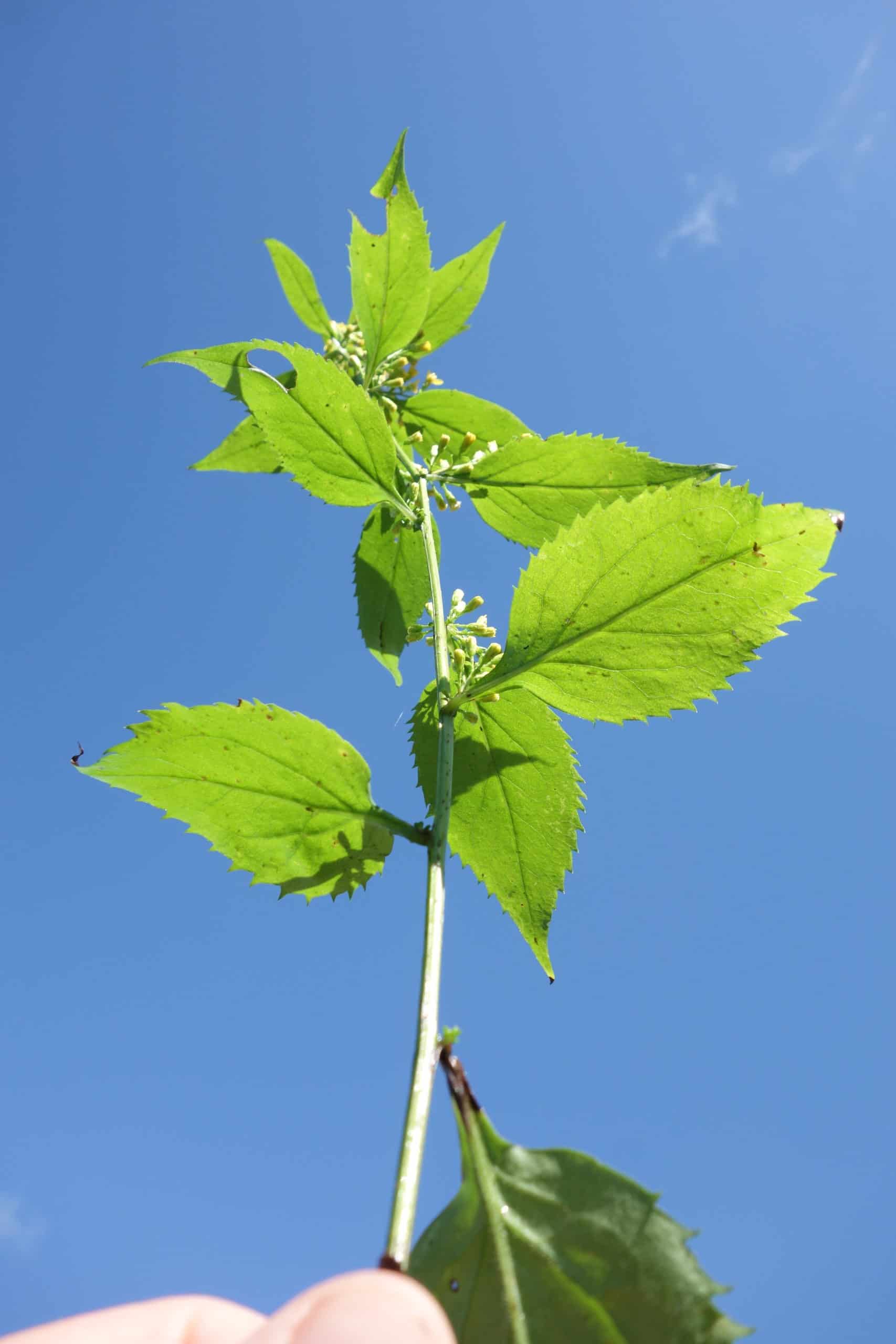
Late August. Waist high. Inflorescence presented in elegant marble-sized globs emerging from the upper-stem leaf axils, giving the stem and blooms a subtle zigzag appearance, which I find difficult to perceive. Lower leaves oval, toothed, with petioles tapering or ‘winged’ to the stalk. Mesic to dry, shady places, oak savanna.


(Photo: Zigzag goldenrod (Solidago flexicaulis))

Blue Sky Botany – Blazing Stars

Blue Sky Botany – Blazing Stars

Botanist and early The Prairie Enthusiasts member Rob Baller created this series for our friends at Blue Mounds Area Project. The “blue sky” technique is Rob’s favorite for taking stunning plant photographs. Let him know what you think at robertballer@outlook.com.

ALWAYS get permission from the property owner if you want to try this technique.

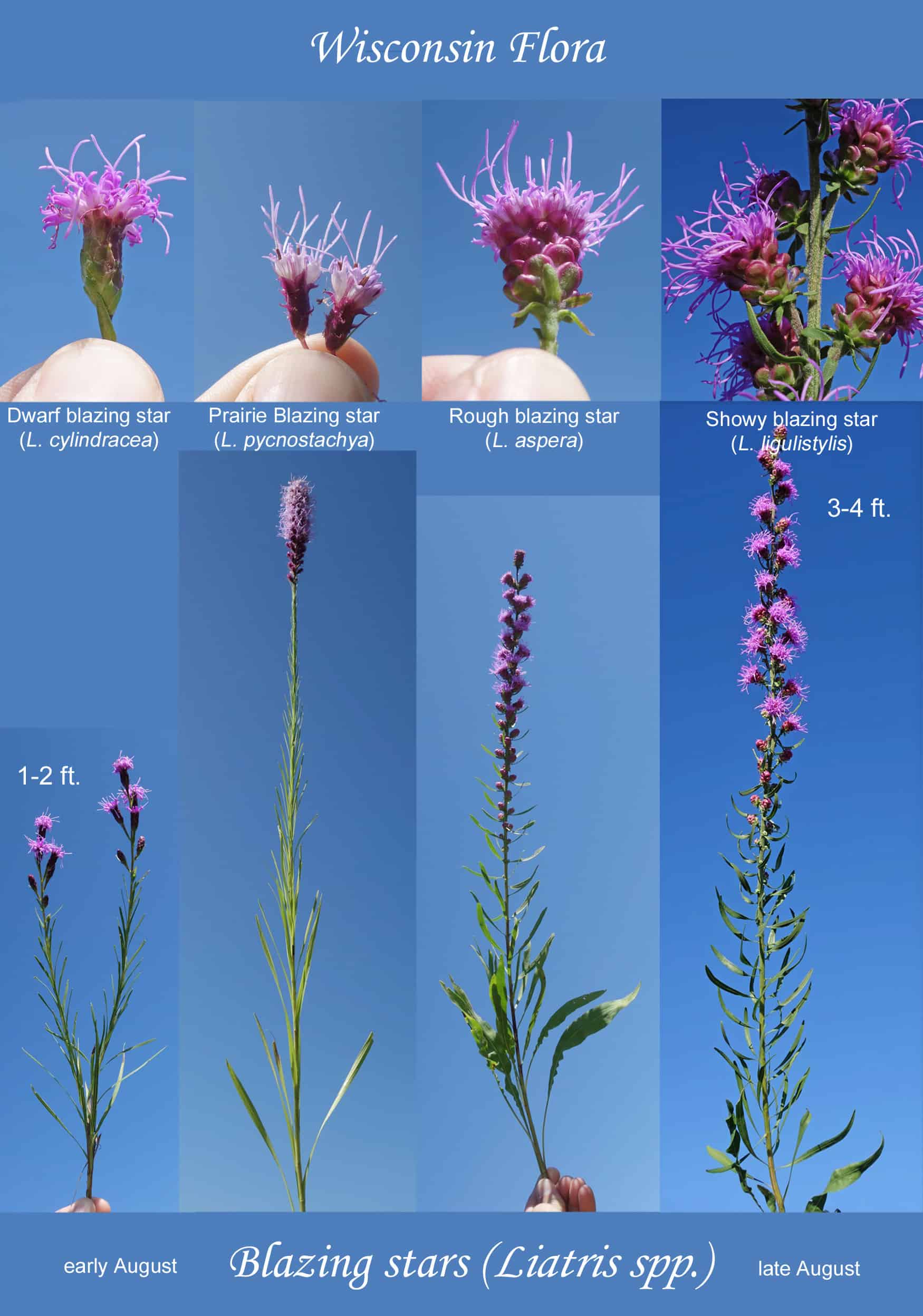
Here are the four Liatris species most likely to be seen on our beloved Wisconsin prairie remnants. All are members of the sunflower family (Asteraceae). All have tiny pink to magenta flowers bundled into ‘floral cups’, with outer bracts on those cups that form layers like shingles, and positively identify the species. Good eyesight is helpful. All species bloom from the bottom upwards. They are discussed here in their order of seasonal blooming.

Dwarf blazing star (Liatris cylindracea)

Late July or early August. Shorter than knee high. Flower bundles loosely alternating up the stems, each bundle waving on a brief stalk more or less as long as the flower cup itself. Floral bracts are rounded like fingernails, with sharp points on each, adhering to the cup and never lifting away. Dry limey prairie.

Prairie blazing star (Liatris pycnostachya) aka ‘gayfeather’

Late July or early August. Knee to waist high. Flowers bundles spaced tightly on the stalk, the whole appearing like a rosy, feathery cattail. Floral bracts triangular, pointed, peeling away. Wet prairie, sometimes mixed into wetlands denoting where the ground is solid enough to stand on.

Rough blazing star (Liatris aspera)

Mid to late August, early September. Knee to waist high. No stalks connecting flower bundles to the main stem (sessile). Floral bracts distinctly rounded and cupping, creating a 3-D texture. Dry mesic to dry prairie, often in sand.

Showy blazing star (Liatris ligulistylis)

In my experience the least common of these. Mid to late August. Waist high. Very similar to L. aspera, except lower flower bundles are born on stalks about as long as the flowers. Mesic to dry prairie. Champion butterfly attractor.