by The Prairie Enthusiasts | Oct 2, 2019 | News

We watched the world strike for action on climate change last month. As we work for conserving prairie and savanna ecosystems in the region, support is growing for taking better care of our global ecosystem.
At an Earth Day celebration in Madison earlier this year, TPE member Ron Endres met Eman Ghanem, a director at Sigma Xi, The Scientific Research Honor Society. A 133-year-old organization that recognizes excellence in science and engineering, Sigma Xi also promotes research ethics, a strong research enterprise, and the public understanding of science.
 Eman invited Ron and other TPE members to Sigma Xi’s Annual Meeting and Student Research Conference at the Monona Terrace Community and Convention Center on November 14–17, 2019, in Madison, Wisconsin. With the theme of Our Changing Global Environment: Scientists and Engineers Designing Solutions for the Future, the meeting is an opportunity for scientists and science supporters to learn about emerging research related to environmental changes.
Sessions are organized by tracks about sustaining water resources, human health, and energy. Other tracks focus on how to best communicate science to the public and other stakeholders, research ethics, and professional development for scientists and engineers. Here is the full schedule.
A group registration discount of up to 25 percent is available to TPE chapters and members. For more information on the group discount, please contact meetings@sigmaxi.org. A one-day pass for non-Sigma Xi members on November 15 or November 16 costs $175 and the full conference is $400.
Sessions include:
The challenges of presenting global environmental problems such as climate change to specific audiences who do not perceive these impacts or are facing more “immediate” concerns, such as economic hardship
A free and public STEM Art and Film Festival from 9 a.m. to 4 p.m. on November 17 at Monona Terrace will be the final event of the conference. The festival features more than 10 documentaries, short films, and animations as well as 30 pieces of art relating to science, technology, engineering, and math (STEM). 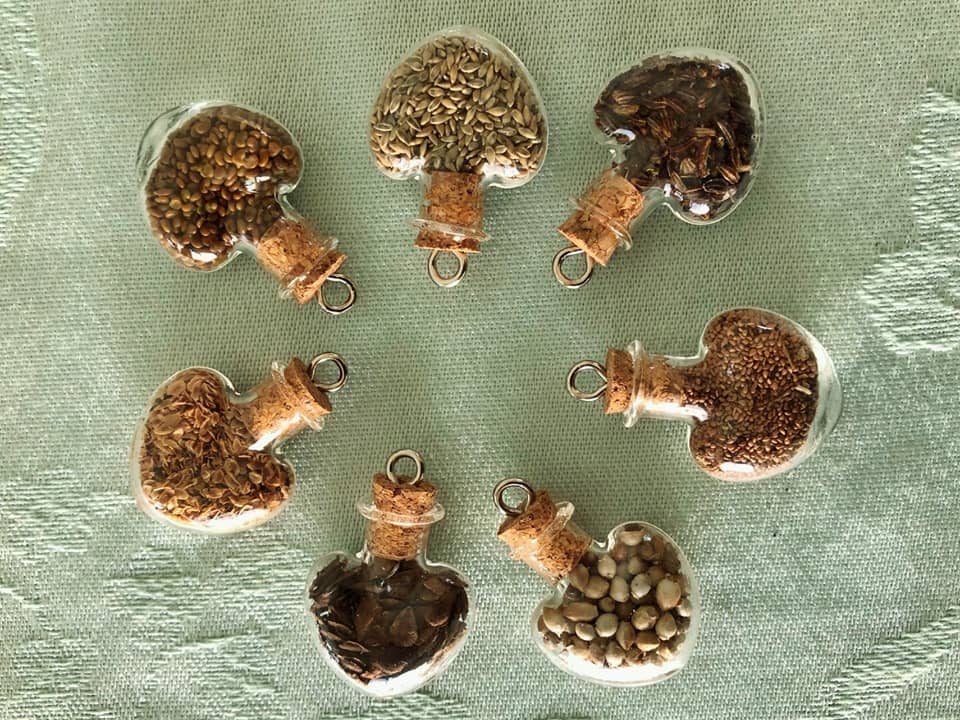
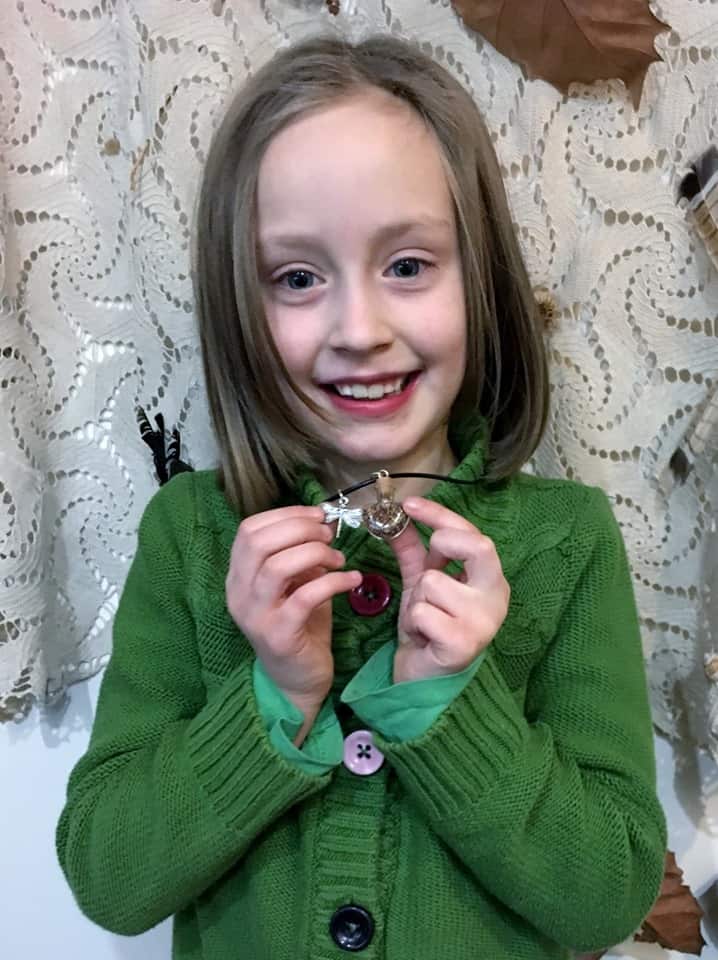
Ron will represent TPE with an exhibit table throughout the conference and sell native seed necklaces, which he makes for people to wear as a symbol for their support of prairies and savannas.
“The carbon sequestration ability of prairies can play a role in curbing climate change,” states Ron’s card that each customer receives with a necklace.
Ron donates his time, materials, and 100 percent of the sales from the necklaces to TPE to help protect prairies.
“The necklaces have become a good vehicle for outreach and education,” he said.
For more information about the Sigma Xi Annual Meeting and Student Research Conference, contact event organizers at meetings@sigmaxi.org.
by The Prairie Enthusiasts | Sep 4, 2019 | Inspiration
This past winter the monarch butterfly populations overwintering in northern Mexico increased significantly for the first time in recent years. The butterflies used over 6 hectares of land at their winter roosting sites. This is significant, as the goal of the Mid-American Monarch Conservation Strategy is to increase the average to around 6 hectares of use each year. A one year increase does not significantly increase the overall average. Implementing the conservation strategy to increase milkweed populations by billions of stems over the next decades is the single biggest driver to help sustain the monarch populations. Hopefully this strategy will keep the monarch butterfly from becoming listed under the Endangered Species Act.
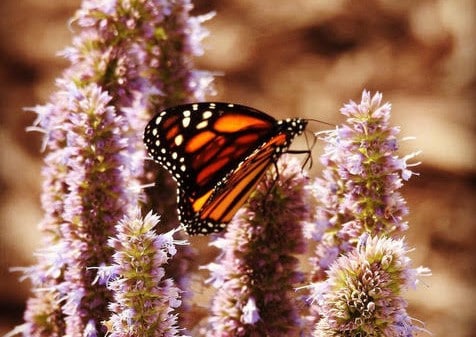 In 2014 the US Fish & Wildlife Service (US FWS) was petitioned to consider listing the monarch as an endangered species. The US FWS was supposed to make their listing decision by this past June 2019. The listing decision has now been delayed until December 2020. You can read more about this decision here: The decision primarily seeks to obtain another over-winter measurement of how many hectares the butterflies use to include in its listing decision.
Since 2017, The Prairie Enthusiasts members, chapters, and conservation partners have collected over 120 pounds of milkweed seed. The seed is being used in restoration efforts to enhance prairie plantings throughout the Upper Midwest, and directly implementing the conservation strategy to increase monarch populations in the years ahead.
Now that we have another season of milkweed seed to collect, it is crucial to keep this program going. Implementing the monarch conservation strategy by planting milkweed seed is the single most important activity that we can do while waiting on an endangered species listing decision by the end of 2020.
The Prairie Enthusiast’s Milkweed to Monarchs ‘19 gives members and volunteers a Grassroots Conservation in Action approach to monarch recovery efforts. This is something practical that every one of us can do this is year, and every year, to contribute towards monarch butterfly sustainability.
All you need to do is collect your milkweed seeds this fall and share it with The Prairie Enthusiasts to helping plant more habitat for monarchs through its chapters, landowners and local conservation partners.
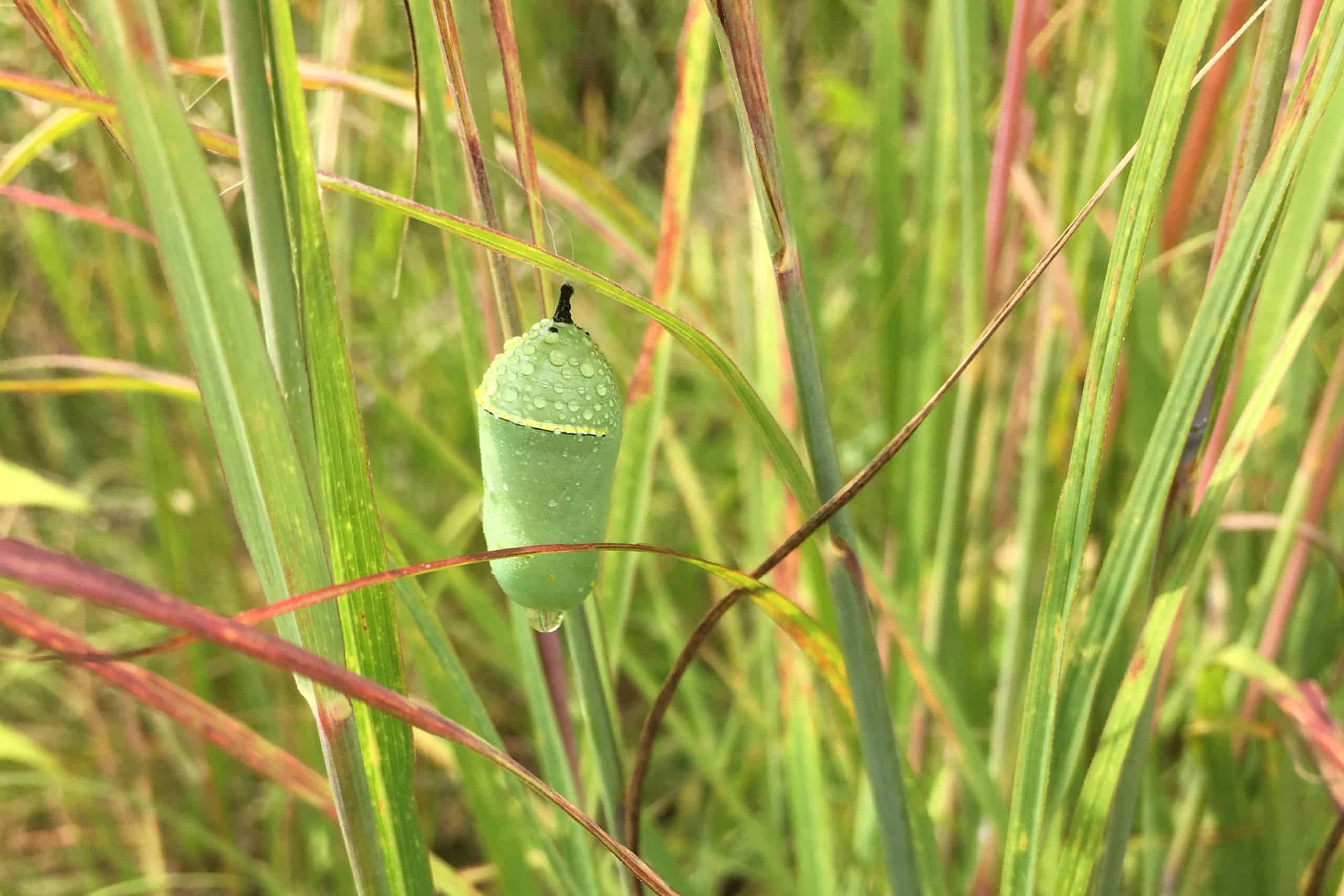 Here is what we need you to do:
- Collect milkweed seed pods by species & note where you collected the seed from. This is best done in September when the pods are green but have started to split open, making the seed easier to clean.
- Process the seed to remove the pod & husk and collect the cleaned milkweed seed. This is also easiest done this month as the seed can easily be removed from the rest of the plant by hand. Watch Bill Cater of Prairie Moon Nursery to see how this is done. There are also some mechanical means of cleaning the seed, See the seed processor.
- Mail (or drop off) your seed to The Prairie Enthusiasts’ office. If you decide to collect significant amounts of milkweed pods weighting dozens of pounds, please contact us to discuss coordinating cleaning of seed in bulk together.
Any interested members, volunteers, or groups interested in picking and cleaning milkweed seed can contact Chris Kirkpatrick, Executive Director at 608-638-1873 or executivedirector@theprairieenthusiasts.org. Seed can be delivered in person or by mail to The Prairie Enthusiasts’ office at: 110 S. Main St., PO Box 824, Viroqua, WI 54665.
Pictures by: Becky Wolter, Brad Keith, and Lydia Martin
by The Prairie Enthusiasts | Sep 4, 2019 | News
By Jim Vonderharr
Many Rivers Chapter has recently started partnerships with several educational entities. We were contacted in the spring of 2017 by Amber Gremmels, a middle school science teacher in New Ulm, Minn. The New Ulm School District has two vacant residential lots next to it that were just being mowed. She envisioned converting one of them to a prairie, and making it a learning experience for students.
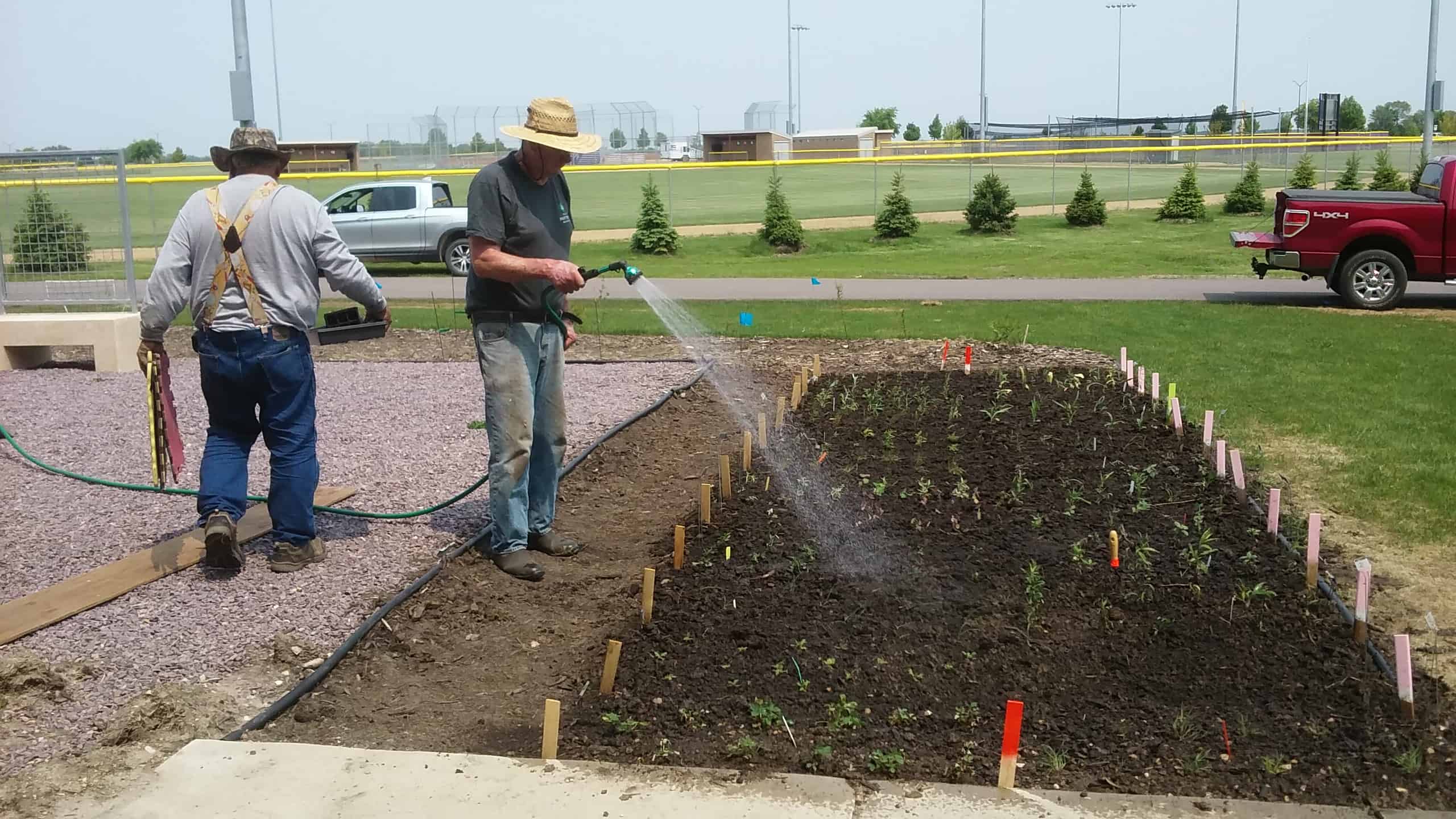 Gremmels was looking for help. Our chapter worked with her, and over that summer we coordinated the clearing (Roundup) of about ¾ of one of the lots. That fall, fellow chapter member Henry Panowitsch and I broadcast seeded the plot with a mix of grasses and forbs. As expected, 2018 produced a typical first-year prairie project – a not-so-beautiful prairie. There were signs of desired plants, however, and this spring (2019) we mowed it. We are anxious to see what comes up and mow again throughout the growing season. We may add some seedlings or transplants.
To allay concerns that the lot was just a neglected “weed patch,” a sign was posted announcing our intended results.
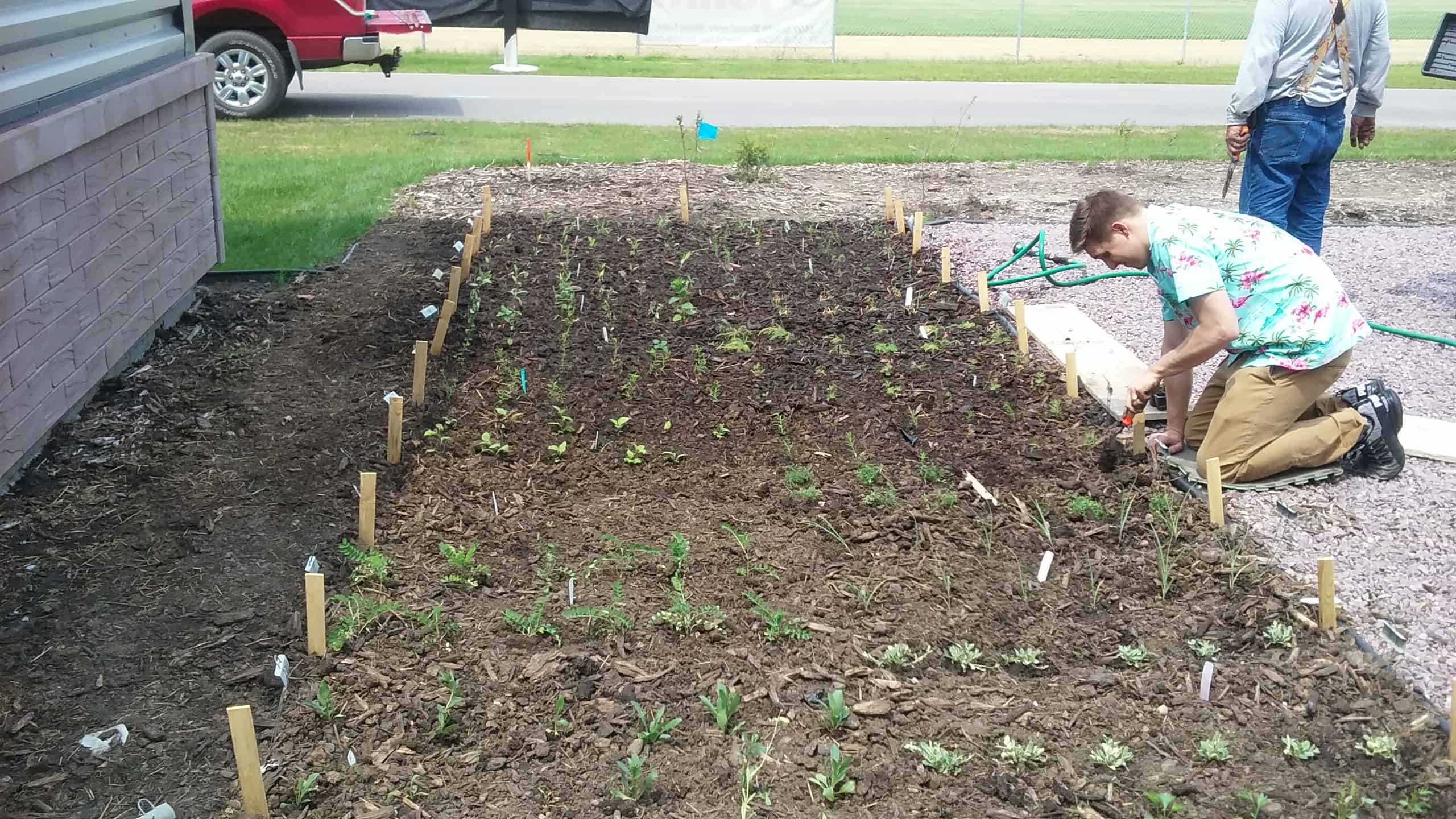
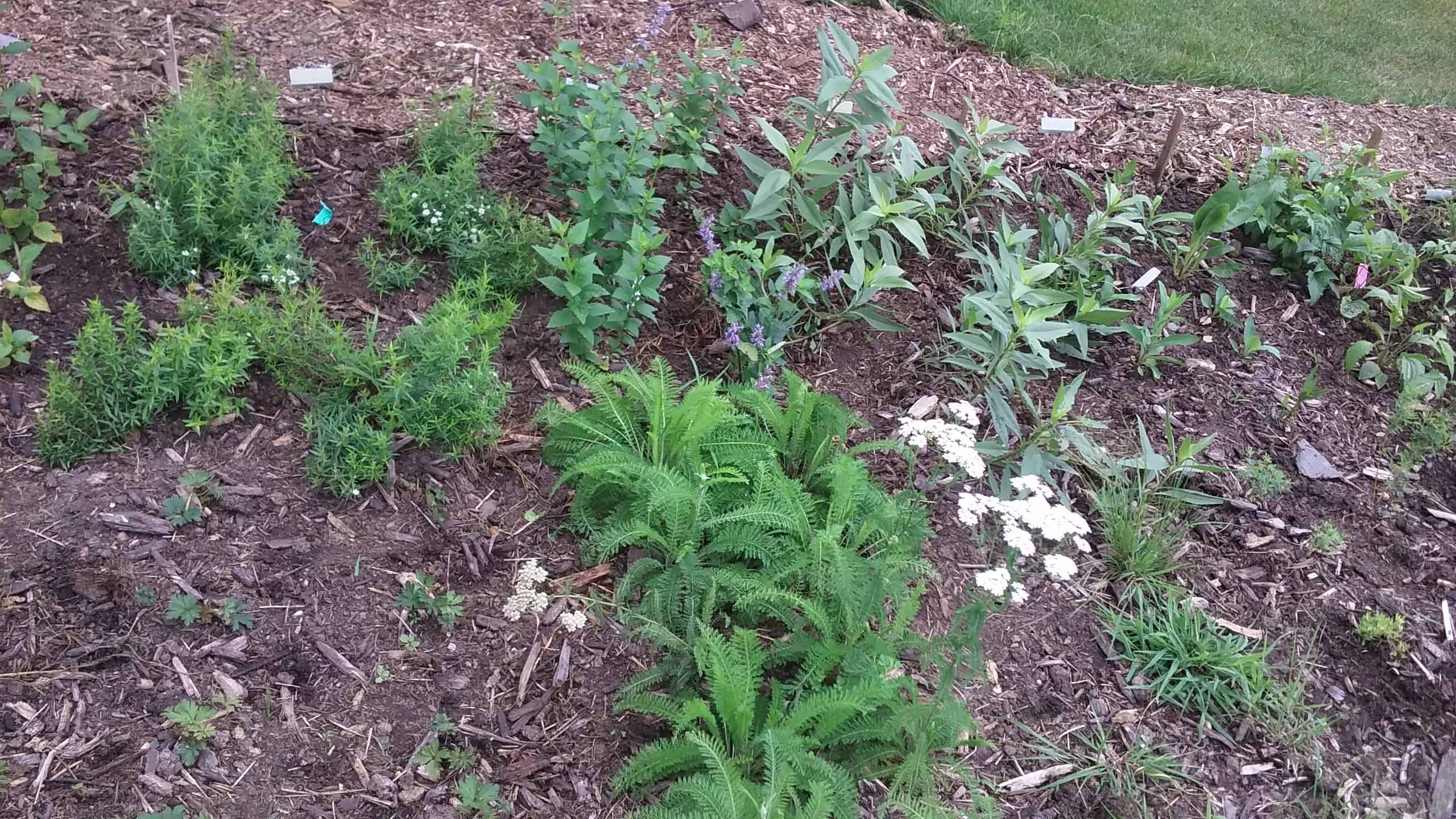
In the fall of 2018, we were contacted by Matt Nelson, a high school science teacher in New Ulm. The school is relatively new (maybe 3 years old) and outside of his classroom is a space designed to be an “outdoor classroom.” Matt wants to make it a prairie education tool. It consists of sections, a couple covered with rock and benches, and several with wood chips.
Once again, Panowitsch and I, accompanied by Jim Lynch, ventured to New Ulm and visited with Nelson. The three of us made an impromptu presentation to his students, and we then discussed options for the project. This time we decided to use a majority of the area for plant identification, which meant buying established seedlings. Because of the cost associated with this plan, we contacted the New Ulm Chapter of the Izaac Walton League for assistance. They have funds from charitable gambling available for investment in their community. They enthusiastically volunteered to support the project and have contributed $1,000.
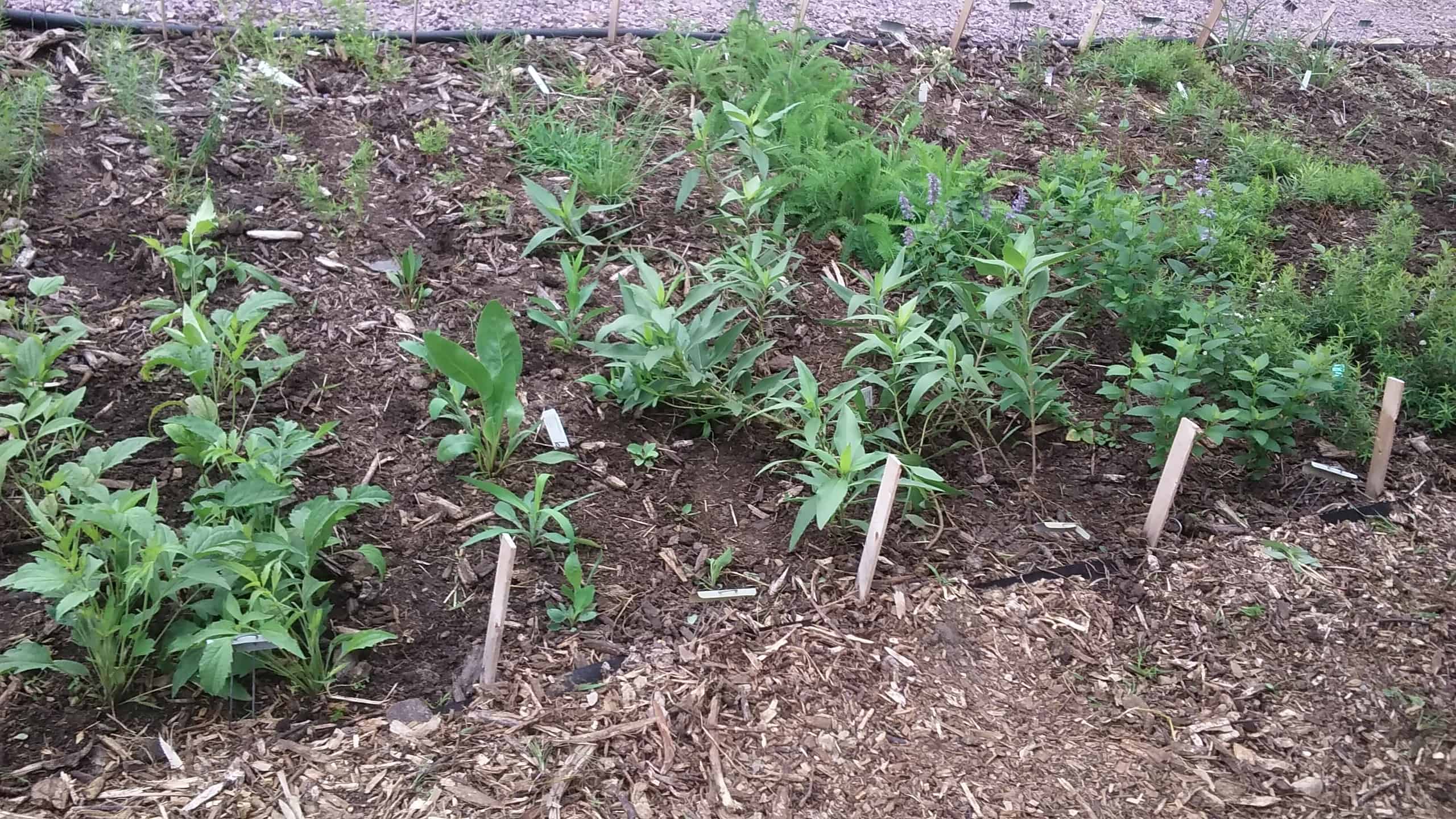
We also hope to help Nelson develop and stock a library with prairie resource materials. Buoyed by enthusiasm for these two projects, we have recently joined a group at Minnesota (Mankato) State University (MSU) that is working on a teaching curriculum that will include prairie education. Julia Batten, a Mankato East High School teacher is a member of the MSU curriculum team. We are hoping for the prairie “bug” to infect Mankato schools soon.
Photos by Jim Lynch
by The Prairie Enthusiasts | Jul 31, 2019 | Inspiration
This introduction to the concept of resilience and how it applies to our prairie restoration work was an article published in the August 2019 Prairie Promoter.
Those of us who were at this year’s TPE conference in Menomonie were introduced to resilience during the keynote address. As a review, resilience is simply the ease at which a disturbance can move a system from one state to another. For us prairie enthusiasts looking to apply these concepts to prairie management, disturbances might be such things as fires or intense woody species removal through herbicide use or grazing by goats. General states might include functioning prairies/savannas, degraded prairies/savannas, and reconstructed prairies, fallow fields or cropland.
As most of us know all too well, shifting from some of these states to another can be difficult, and thus, those states are considered resilient. Note that resilience is not a judgment on quality, but rather just the ability to be changed from one state to another. Also, the shift from one state to another can be rapid (such as plowing a prairie to convert to cropland) or slow (such as absence of disturbance leads to a degraded prairie.) Furthermore, a state can change somewhat without moving to a new state.
Let’s apply the principles of resilience to restoring degraded prairies/savannas. Unfortunately, degraded systems are often resilient! The degraded state of a prairie/savanna could be a result of changes in fire frequency, grazing (too much or too little), climate or other drivers, or combinations of these. Reversing one or more of these drivers does NOT rapidly convert a degraded remnant back to a fully functioning remnant.
Degraded systems usually become degraded through a slow process, and one might expect a shift back to a functioning prairie/savanna state might also be a slow process. A degraded prairie is often degraded because of invading woody species. Using the example of prescribed burning as the disturbance, a fire will not rapidly kill all the woody growth and cause a shift from a degraded state back to a functioning prairie/savanna. In fact, short-term effects of reintroduction of fire might have some undesirable effects such as increased number of stems of clonal species and re-sprouts from most species.
We find similar slow results when applying a quick removal of woody species using herbicides or grazing on a degraded site. The rapid removal of the canopy results in invasions by some opportunistic species. We know these species all too well – sunflowers, brambles and short-lived species. It may take decades for these species to come back into some kind of balance with less aggressive species. Even removed shrubs and trees can return either through resprouting or from a well-established seed bank.
The stability of a state can be influenced by non-native species. These species don’t play by the rules that were established as our prairie/savanna ecosystems were evolving, as insect and disease controls for these species are absent in their new environment. Non-natives therefore have an advantage when invading areas with disturbance. The fact that the invasive non-natives have become so ubiquitous across the landscape further makes a degraded system more resilient and our quality remnants less resilient.
Another consideration at the landscape scale is fragmentation. Fragmentation, the isolation of similar natural communities, can’t be ignored when considering the state of individual remnants. In terms of resilience, the isolation may have altered the state through the loss of healthy genetics or complete loss of some species. This idea leads to our cautious use of disturbance during management that may result in species loss that can’t be undone easily given the lack of proximity of sources for the species potentially lost. Our remnants are less resilient due to this fragmentation.
So where does all of this leave us when considering the effects of management on degraded prairies? Prairie restorationists are probably more patient than the average person, but our expectations are probably still too high. Some might consider the solution to be a heavy dose of frequent fire, herbicides or grazing. However, quick results are unlikely given the resilience of degraded systems, and things may get worse before we finally shift a degraded system back to the state of a functioning prairie/savanna.
Hopefully the rudimentary discussion on resilience provided here serves to keep our minds open to this topic when considering our management practices. Be patient and expect frustrations as we undertake the challenge of altering an undesirable resilient state to a healthy prairie or savanna.
by The Prairie Enthusiasts | Jul 31, 2019 | News
This summer marks my seventh year with TPE and completes our 50th land protection project. One of the special responsibilities that comes along with completing all these projects is the care we give these sites by burning, brushing and planting more prairies and savannas. Now that TPE is accredited, one additional activity we must do is complete an annual visit to all our conservation easements and fee-owned properties to complete a monitoring report. We now need volunteers to help with the monitoring.
 Besides documenting the results of our management, and protecting the land use on the conservation easements, doing these visits gives us a chance to see firsthand the amazing places TPE’s chapters have protected throughout the years. Most of these visits are done in the late fall, and consist of walking the property boundaries and taking landscape photos at certain points and corners. Once done with the visit, a written report with photos and a corresponding map are kept on file.
Last year, TPE invested in a software platform called Landscape (www.landconservationsoftware.com), owned by Caleb Pourchot of Madison, Wis., who created the software program while working for Groundswell Conservancy. This new cloud-based software enables monitors to use a smartphone to take pictures, use the GPS to mark its location, and load everything into the software program on line. Things have come a long way since I was taking 35mm film photos for the first conservation easement baseline back in 2003. Now I can walk the property with my cell phone, take the pictures and fill the report out with my computer back at my desk, and save it all electronically.
 In 2018, TPE added seven new sites that will need to be monitored this fall. We have had a dedicated but small group of conservation easement monitors for the past several years, and most of our site stewards also have completed an annual monitoring report. With our growing land protection program, we need to find additional volunteers to help.
I’ll be hosting an on-line Property Monitoring Training Program at 7 p.m. Sept. 18, with the goal of training new volunteers to help TPE and its chapters continue to monitor our protected lands. If you enjoy taking hikes on TPE’s sites, can navigate a property using a map, and are interested in using the technology of your smartphone to help TPE in carry out its mission, please consider an RSVP to TPE’s Property Monitoring Training. You can reach me at 608-638-1873 or executivedirector@theprairieenthusiasts.org, and I can help get you out on the prairie!