
Monitoring Bat Activity Following Prairie Savanna Restoration
Article and Photos by Robert J. Marquis, St. Croix Valley Chapter
March 3, 2025
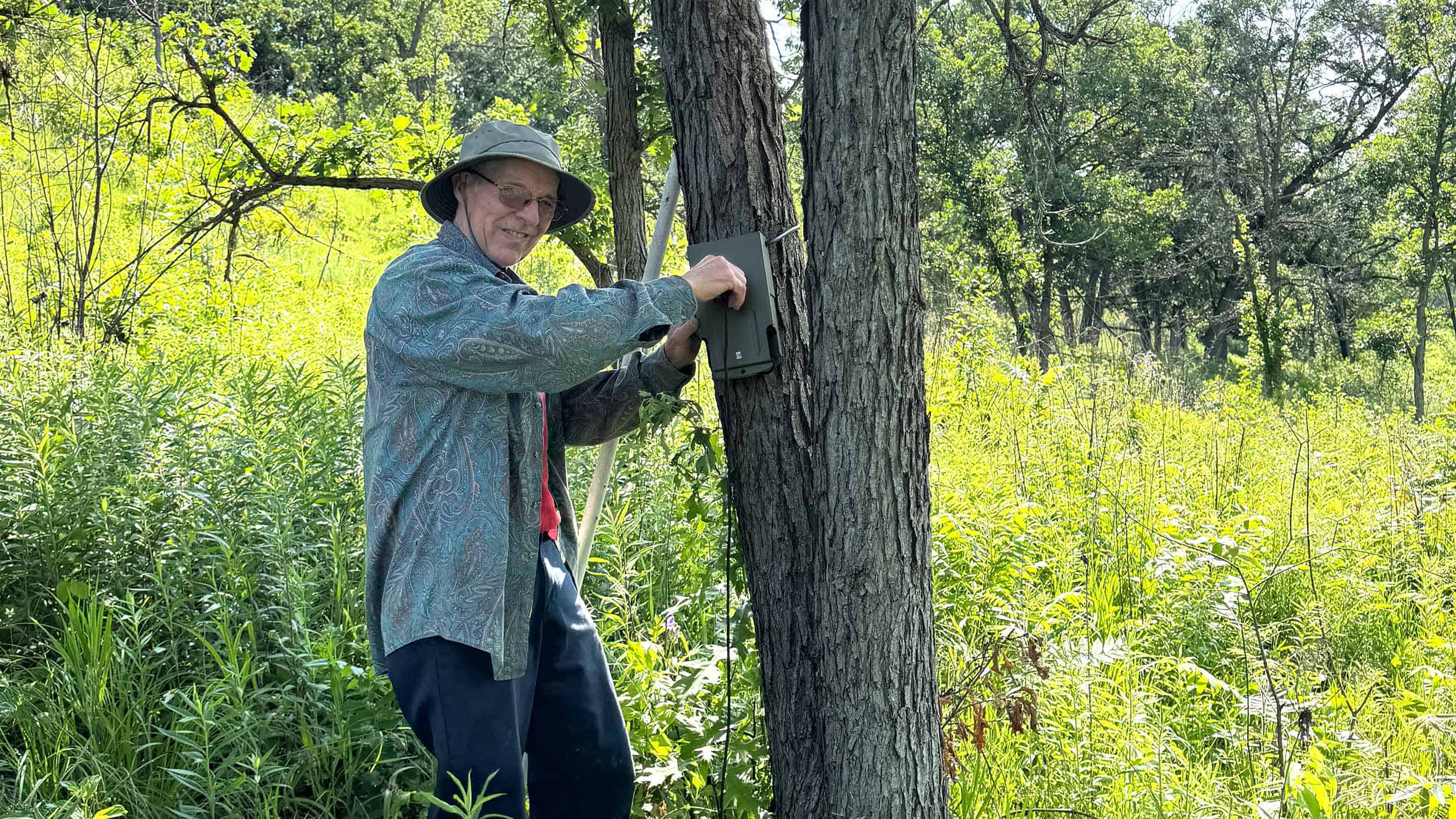
Volunteer Joe Fusilier placing a bat acoustic recorder on a tree to monitor bat activity at Alexander Oak Savanna, June 2025.
Bats Are In Trouble
Bats provide many important ecosystem services, including the control of crop insect pests.1 They may consume insects equal to 9-12% of their body mass in a single evening of foraging.2 Bat populations, however, have been declining due to habitat destruction, pesticides, collisions with windmills and, most recently and most precipitously, due to the white-nose syndrome. In response to increasing number of crop pest insects following predator release, farmers in the eastern U.S. have increased their use of pesticides. This has resulted in an average 7.9% increase in human infant mortality in counties that have experienced bat die-offs.3
We Collected Baseline Data in 2025
Bats use echolocation to find food, especially flying insects, and to avoid collisions with foliage and woody vegetation. There is mounting evidence that invasion of natural habitat by woody plant species can decrease activity of bats. If the invasive plants are tall and dense enough, the habitat can become too “cluttered” for bats to navigate, forcing them forage elsewhere. In June and August, 2025, with the help of fellow Prairie Enthusiasts Denise Thiede, Joe Fusilier, Jay Arneson and Peter Leete, I used bat acoustic recording equipment to monitor activity of bats in Alexander Oak Savanna and in restoration plots along the Kinnickinnic River in River Hills Park in River Falls, WI. The goal was to collect baseline data on bat activity and species composition to understand how habitat restoration influences these important components of terrestrial ecosystems.
Results at Alexander Oak Savanna
We placed four acoustic recorders in June at the Alexander Oak Savanna, a 42-acre parcel that has been the object of restoration efforts since 1999 by the St. Croix Valley Chapter. During the week of June 16, 2025, we recorded activity by four species of bats: big brown bats (threatened in Wisconsin), eastern red bats (species of special concern in Wisconsin), hoary bats (species of special concern in Wisconsin) and little brown bats (threatened in Wisconsin).
Results at River Hills Park
In August of 2025, we placed acoustic recorders in four plots along the Kinnickinnic River in River Hills Park that had been cleared of “old growth” buckthorn (Rhamnus carthartica) and four neighboring control plots highly congested with buckthorn. Buckthorn had invaded the riverside approximately 50 years ago. Many of the buckthorn plants removed were 25-30 feet tall. We tested the hypothesis that buckthorn plants were tall enough and dense enough to reduce the ability of bats to navigate and to find food. This research appears to be the first experimental study to test the impact of invasive plant species removal on bat activity. In addition, there appear to be no previous surveys of bat activity along the entire Kinnickinnic River (C. Trosen, pers. comm.).
Our initial data from the Kinnickinnic River plots show that all four species of bats found at Alexander Oak Savanna also occur along the river, but in addition, silver-haired bats were recorded in riverside plots. More importantly, our initial results show that bat activity was 2-5 times higher in plots from which buckthorn was removed compared to neighboring plots with intact buckthorn canopies. We will repeat surveys during the summer of 2026, with the goal of sampling throughout the summer and in an increased number of paired plots.
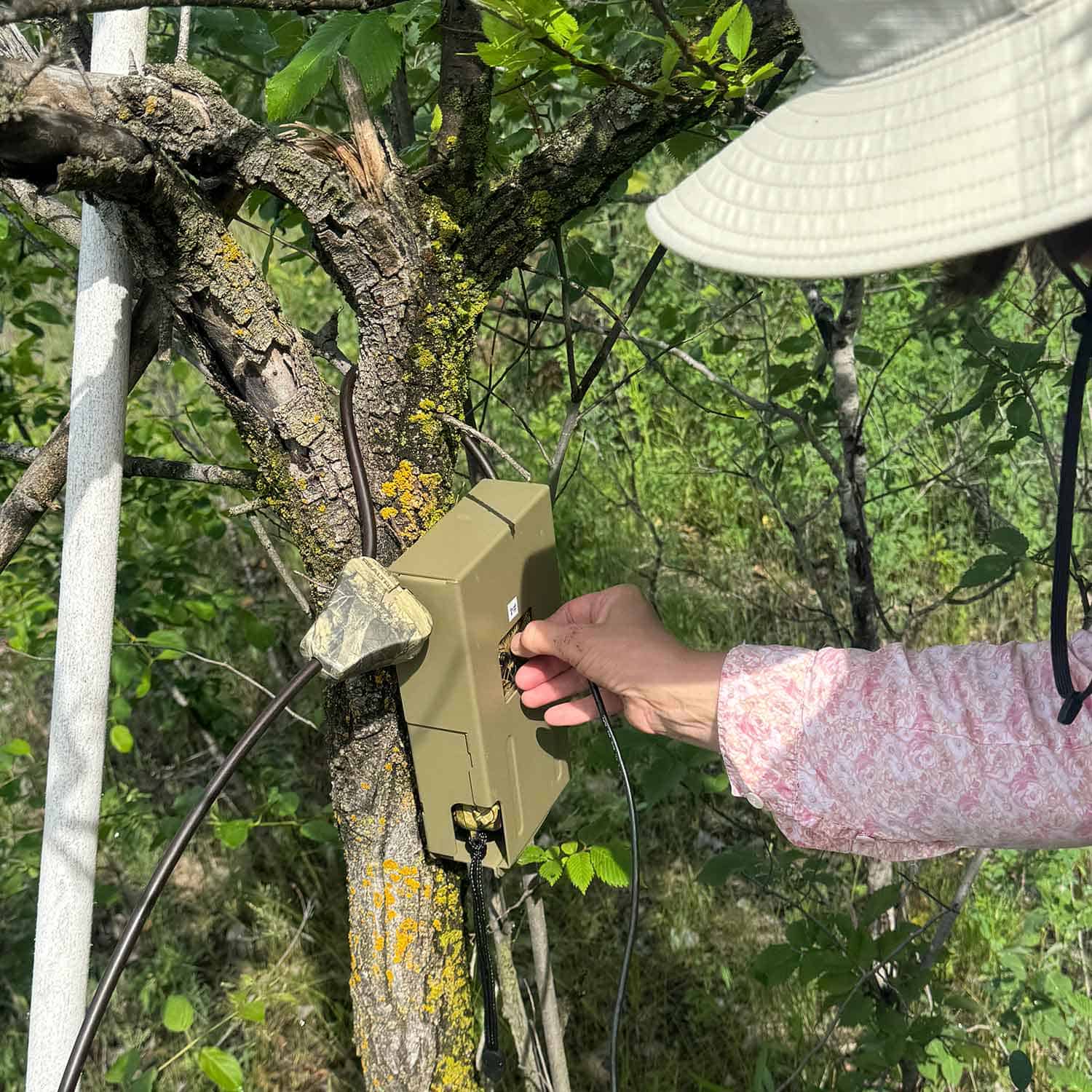
Denise Thiede, St. Croix Valley Chapter volunteer, attaching a microphone cable to an acoustic bat recorder in River Hills Park, River Falls, WI. The recording equipment consists of a microphone on a five foot pole, attached by a microphone cable to the recorder, which is encased in a water proof box and cabled to a tree.
Bats Respond Positively to Restoration
This research is sponsored by the St. Croix Valley Chapter, the City of River Falls, the U.S. Fish and Wildlife Service, and tens of volunteers who helped remove buckthorn. Our approach is akin to that taking place across the planet in which bird response to habitat restoration is being monitored using song-recording equipment.
Bats are a less obvious component of the natural landscape compared to birds, because bats are active when most humans are sleeping and make sounds mostly inaudible to us. However, bats are certainly no less important in their contribution to ecosystem services compared to birds; some studies show bats actually consume significantly more insects from leaf surfaces than do insectivorous birds at the same location.4,5 Our preliminary results suggest that efforts to restore prairies and savanna habitat in the Wisconsin-Minnesota region may increase bat activity and the ecosystem services that they provide.
Thanks to Many Who Helped
We thank the U.S. Fish and Wildlife Service, St. Croix Wetland Management District, for the loan of their equipment; Veronica Bauer, Jill Utrup, Chris Trosen, and Alex Bouthilet for training, logistics, equipment loan, and recording analyses; Evanne Hunt for support and leadership; the City of River Falls, WI, for logistical and financial support; John Lampe for pointing out the New York Times article; and the many volunteers who helped clear buckthorn from experimental plots.
References
1. Frank, E.G., 2024. The economic impacts of ecosystem disruptions: Costs from substituting biological pest control. Science, 385: 6713.
2. Kalka, M.B., Smith, A.R. & Kalko, E.K.V. 2008. Bats limit arthropods and herbivory in a tropical forest. Science 320: 71.
3. Kunz, T. H., E. Braun de Torrez, D. Bauer, T. Lobova, T. H. Fleming. 2011. Ecosystem services provided by bats. Ann. N. Y. Acad. Sci. 1223, 1–38.
4. Moiseienko, M. and Vlaschenko, A., 2021. Quantitative evaluation of individual food intake by insectivorous vespertilionid bats (Chiroptera, Vespertilionidae). Biology open, 10, p.bio058511.
5. Williams-Guillén, K., Perfecto, I. & Vandermeer, J. 2008. Bats limit insects in a Neotropical agroforestry system. Science320: 70.
This article appeared in the Spring 2026 edition of The Prairie Promoter, a publication of news, art and writing from The Prairie Enthusiasts community. Explore the full collection and learn how to submit your work here.
About The Prairie Enthusiasts
The Prairie Enthusiasts is an accredited land trust that seeks to ensure the perpetuation and recovery of prairie, oak savanna, and other fire-dependent ecosystems of the Upper Midwest through protection, management, restoration, and education. In doing so, they strive to work openly and cooperatively with private landowners and other private and public conservation groups. Their management and stewardship centers on high-quality remnants, which contain nearly all the components of endangered prairie communities.