
Reason for Optimism: Long-Term Results from Planting Prairie into Live Exotic Cool–Season Grass Sod
Article and Photos by Dan Carter, The Prairie Enthusiasts Ecologist
March 2, 2025
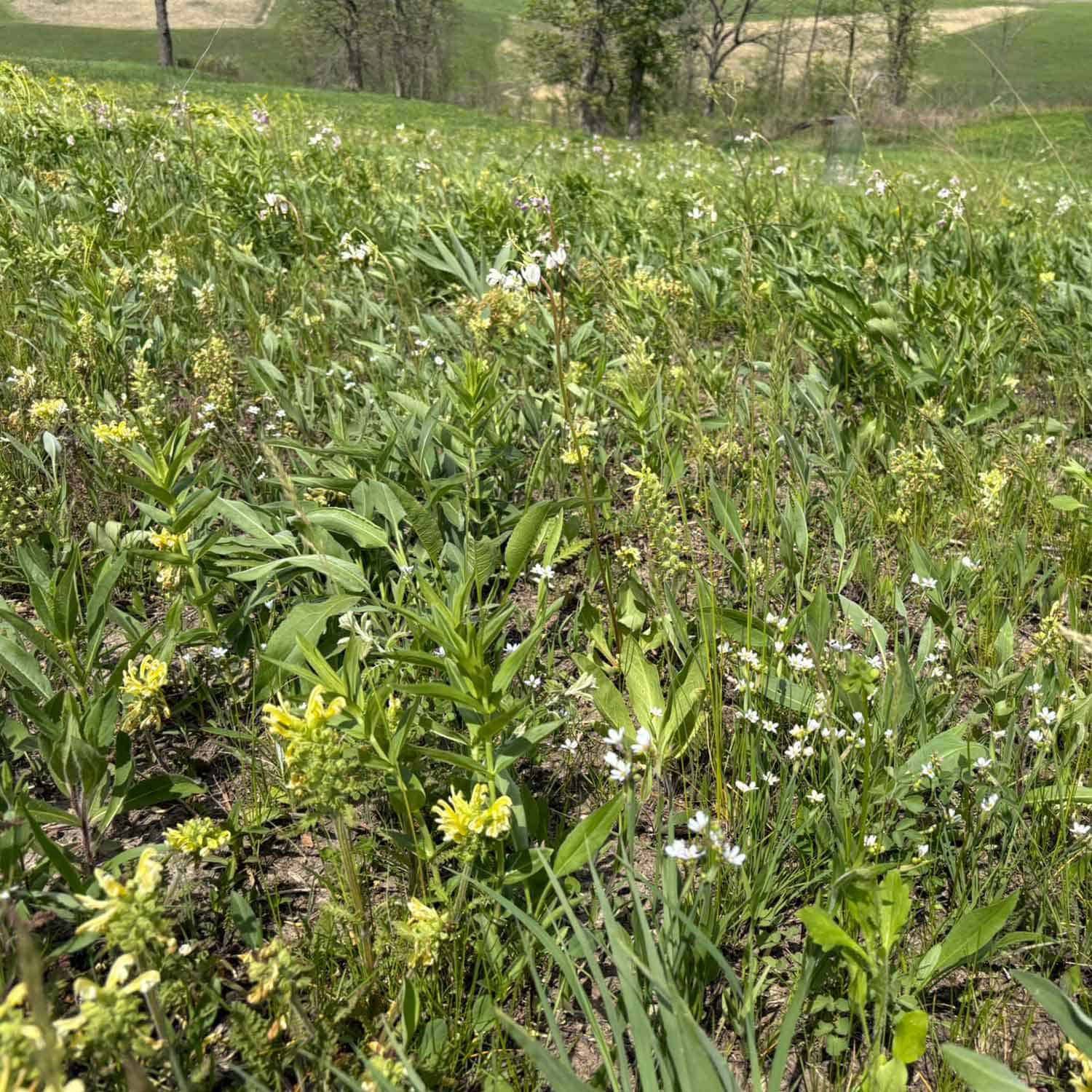
Poke milkweed (Asclepias exaltata) in September after being planted as a plug in May in a shady area of savanna. Plugs were propagated in this case, because only a very limited amount seed with local genetics was available.
A few years back I wrote about the potential of old pastures and mature old fields dominated by cool season grass, many of which still support important populations of native prairie and savanna species. This is often very good reason on its own to forego broadcast spray of broad-spectrum herbicide, cultivation or other start-from-scratch techniques to re-establish prairie or savanna in those contexts. Another reason is that the alternative—treating a nonnative, cool-season-dominated sod as though it were prairie or savanna by restoring fire and facilitating dispersal of appropriate plant species back—can be wildly successful. The best examples of this that I know are the restoration of savanna pasture Sugar River Savanna and prairie plantings into mature smooth brome (Bromus inermis) Conservation Reserve Program (CRP) plantings at the Mounds View Grassland. While these successes are visually obvious to visitors of those sites, data is needed to help us communicate success and advocate for the associated methods.
In the summer 2025 issue of The Prairie Promoter I wrote about assessing ecological integrity using mean C, which is the mean of coefficients of conservatism assigned to the flora based on how faithful or “conservative” they are to old-growth natural communities (remnants). Coefficients range from zero (no fidelity to old-growth) to ten (very high fidelity to old-growth). According to Swink and Wilhelm (1994)1, areas with mean C values of 3.5 or greater are generally of at least marginal natural area quality, areas with mean C values of 4.5 or greater are almost certainly remnants with natural area potential, and only rarely do reconstruction projects achieve a mean C higher than 3.5. That still may be true, though I think more efforts are doing better. Please refer to the previous article for more discussion of ecological integrity and the ecological meaning of coefficients.
Last year I resolved to study the plainly successful prairie plantings into live brome and other exotic cool-season sods at Mounds View Grassland and characterize them in terms of mean C, which is meaningful in and of itself. An additional advantage to studying prairie plantings at Mounds View is the presence of remnant prairies on the same immediate landscape, so remnant prairies’ mean C values were also assessed for reference and compared to those of the prairie plantings. The data I collected will be used to develop a presentation and a manuscript for submission to a regional or restoration-focused journal. Here I share some of the preliminary findings.
Methods
I sampled eight relatively mature upland prairie plantings at Mounds View Grassland, a preserve in eastern Iowa County, Wisconsin owned by The Prairie Enthusiasts. Plantings were generally dry-mesic to borderline mesic. The youngest planting was in its 11th growing season. The oldest was in its 26th growing season. To prepare for each planting, existing sods of cool-season grass were burned for one to three consecutive years in advance of initial seeding to remove thatch and lessen cool-season grass vigor. Most of these cool-season sods had been present for decades and were originally established as smooth brome CRP plantings on land that was previously cultivated. Most prairie plantings received initial broadcast seeding for one or two years with follow-up seeding in lesser amounts subsequently. Seed was broadcast in fall, except for some early-ripening species which were broadcast in summer. Plantings received annual or near-annual early spring burning after seeding (including the spring immediately following fall seeding) for a decade or more. These burns were early enough to avoid killing germinating prairie plants and negative impacts to important prairie cool-season species (March or the first half of April, depending on the conditions).
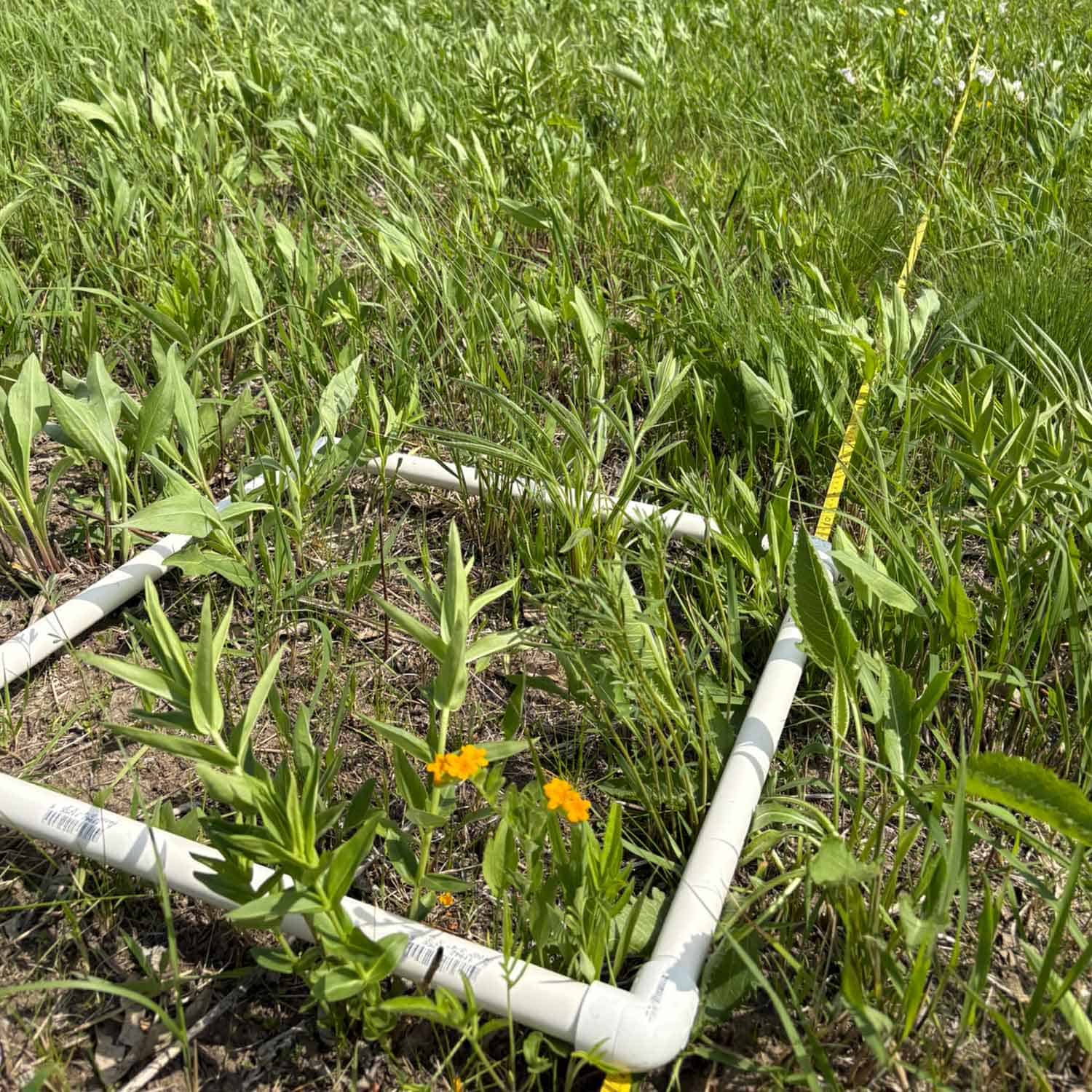
Location where a stiff aster (Ionactis linariifolia) plug was planted and the top was eaten off. I was still watering it, because the crown and roots of the plant were still in the ground.
I identified two ten-meter sampling transect locations in each planting prior to field work using aerial photography. Transect locations were selected such that they were dispersed within the planting area, and all portions of transects were at least three meters from edges. Transects were also positioned parallel to slopes to maximize gradients associated with slope positions and underlying soils, bedrock, and moisture. I wanted to capture as much of the variation within planted prairie units as possible. Along each transect I sampled 10 one-quarter meter square sampling areas (quadrats), which were placed randomly on the left or right side of the transect and randomly along the first or second half meter within each of the ten one-meter intervals of the transect. Thus, within each remnant I assessed mean C from a total of twenty subsamples (ten each along two transects). In addition, eight prairie remnants on the same landscape were sampled in the same way, with the exception that a few transects were repositioned to be in burned portions of otherwise unburned remnants. These remnants do generally tend drier than the plantings, because they are located on parts of the landscape that weren’t arable, ranging from dry to borderline mesic at toe-of-slope positions. All field work was conducted between May 15 and May 27, 2025. With two exceptions (one remnant and one planting), all sampling areas had burned since the 2024 growing season.
Each prairie planting and remnant mean C value was calculated by taking the average of all twenty individual subsample quadrat mean C values. This procedure produces mean C weighted by the frequency of species in the quadrat subsamples; species that occurred in many subsample quadrats had more influence, and those that occurred in only one or a few subsamples had proportionately less. This is of greater interest than mean C calculated from the total list of species in a given planting or remnant, because it distinguishes and assigns higher mean C to areas that have conservative species represented frequently at small scales throughout compared to areas where conservative species are detected at the scale of all sampling within a prairie planting (here the five square meters of total area among quadrats in a unit) or remnant but are sparse such that they are only infrequently detected in subsamples.
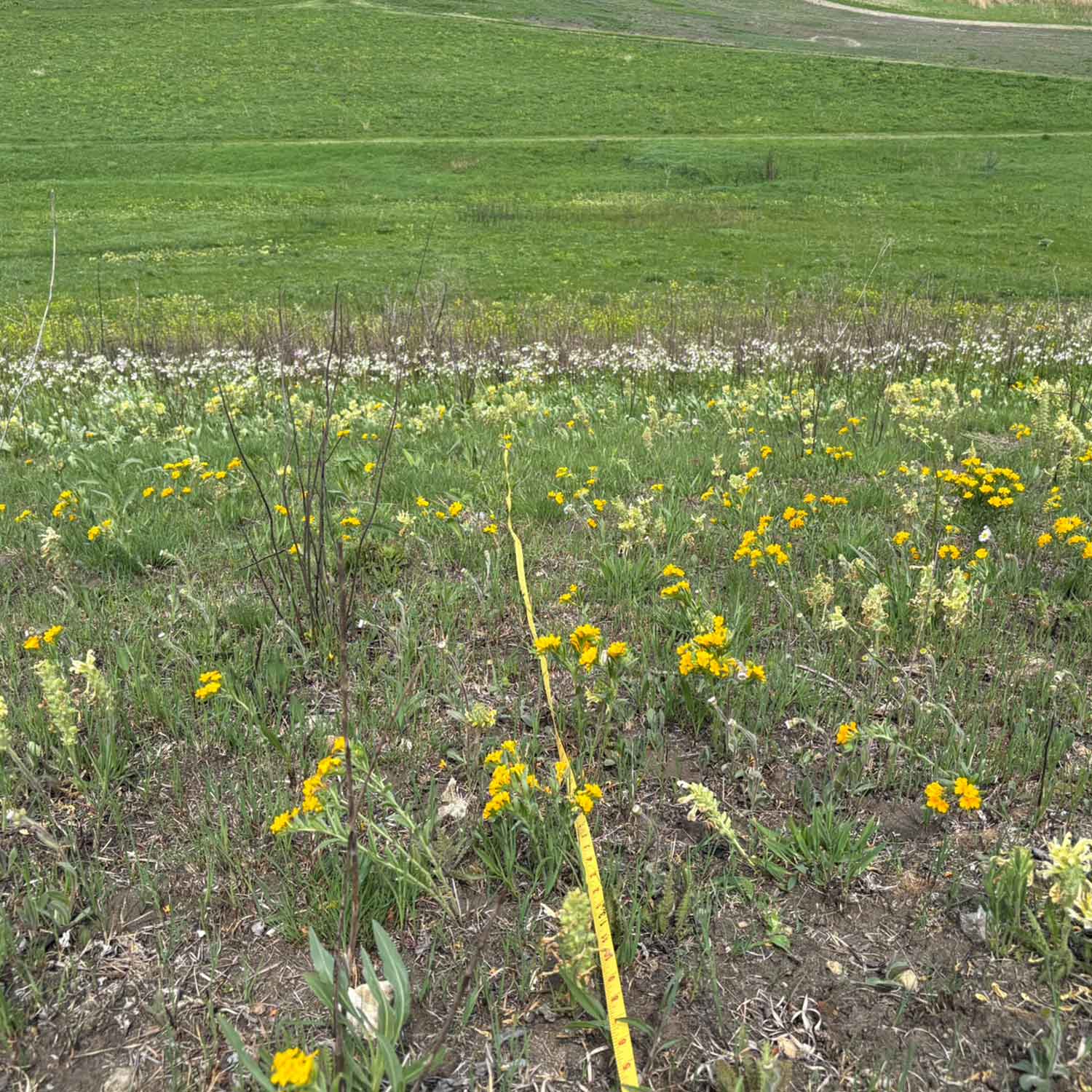
Sweetgrass (Hierochloe odorata) in September after being planted as a plug in moist, sandy savanna in May. It has already spread out by rhizomes several inches in all directions.
Findings
Figures 1-4 are photographs from the plantings and remnants that I sampled. The results were not surprising given how visually impressive the plantings are. Prairie planting mean C values were similar to and fell within the range of mean C values observed on nearby remnants. Many species normally only encountered in remnant, old-growth prairies like hoary puccoon (Lithospermum canescens), wood lily (Lilium philadelphicum), porcupine grass (Hesperostipa spartea), Leiberg’s panic grass (Dichanthelium leibergii), false toadflax (Comandra umbellata) and prairie violet (Viola pedatifida) were encountered in at least one planted prairie. The blog post associated with this article provides a list of all 136 plant species encountered in plantings and remnants during sampling and the number of remnants and plantings they were detected in. Keep in mind that this list does not capture all species present a planted or remnant prairie unit; it captures species abundant and distributed enough to be detected within the five square meters of total sampling in each unit, or sparse species that I was just lucky to detect. Most species that were detected even once would have been apparent to a knowledgeable observer strolling through a unit.
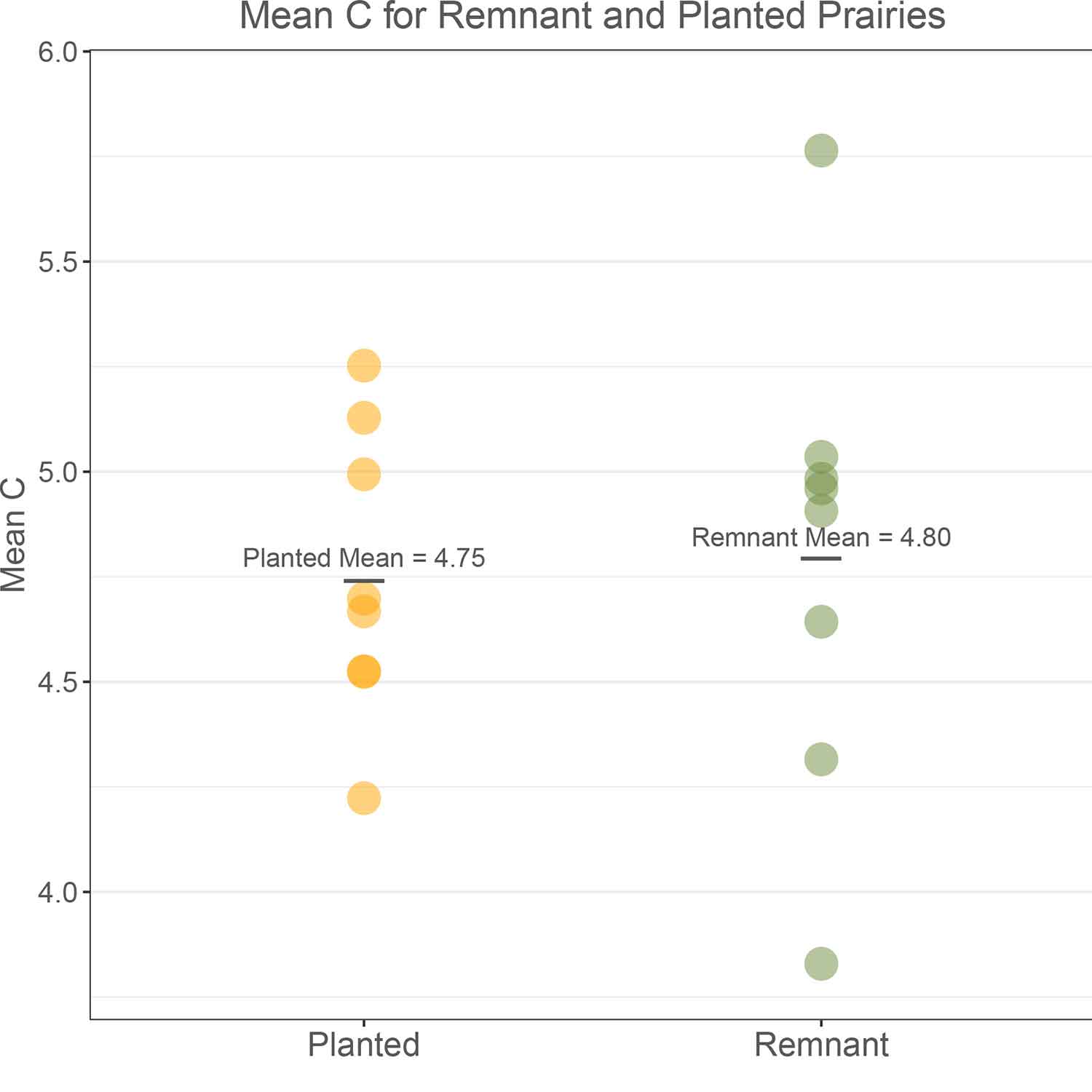
Frequency-weighted mean C among the eight prairie plantings sampled averaged 4.75, which indicates recovery of ecological integrity on par with many remnant natural areas. Values for individual plantings ranged from 4.22 to 5.25. Mean C among the remnants averaged 4.80 and ranged from 3.83 to 5.76. There was not evidence for a statistical difference in mean C between the plantings and the remnants (Wilcoxon test of median difference due to small sample and non-normal data, W = 33, p = 0.96; inference from T-test of mean difference is the same). The data is plotted in figure 5. It should be noted that there are nonetheless differences between the planted and remnant prairies. For example, Richardson’s sedge (Carex richardsonii), Mead’s sedge (Carex meadii), yellow stargrass (Hypoxis hirsuta), violet wood sorrel, (Oxalis violacea) and Great Plains lady’s tresses orchid (Spiranthes magnicamporum) were only observed in remnants. Some of this may be attributed to these species not being included in planting seed mixes or included in only very small amounts. The absence of some of the more xeric species may be attributed to differences in conditions between remnant and planted prairies. In particular, the driest parts of the remnant prairies are drier than most or any parts of the planted prairies.
The success of these plantings can be attributed to several factors, including the following:
- Seeding was diverse, including many conservative species associated with old-growth and species that flower early in the season and are often omitted from plantings (e.g., wood betony, Pedicularis canadensis; prairie blue-eyed grass, Sisyrinchium campestre; false toadflax, Comandra umbellata; etc.).
- A vigorous growth of annual and biennial weeds was not released from the seed bank, because broadcast non-selective herbicide spray and cultivation for site preparation were avoided and nonnative, cool-season grasses provided a sort of cover crop as well as immediate fuel for burning.
- It’s possible that soils and associated microbial communities in established nonnative, cool-season grass sods had recovered to a degree prior to planting. This needs research.
- The existence of remnant prairies nearby on the landscape allowed for recolonization of the plantings by specialist insects and also potentially some plants and microbes (bacteria and fungi).
- Wood betony (Pedicularis canadensis) has been used to prevent over-dominance by tall, warm-season grasses and is abundant in the planted prairies.
- Very importantly, annual or near annual early spring (mostly dormant) fire created and maintained a thatch-free environment for prairie seeds to germinate and establish and in turn disperse more seeds. Frequent fire can also reduce nitrogen availability by volatilizing nitrogen out of the system and producing charcoal that binds some of what is not volatilized; most conservative species have an advantage under conditions of low nutrient availability due to greater efficiency and/or retention of nutrients, and a greater propensity for mutualisms like mycorrhizal associations that can alleviate nutrient limitations. Thus, fire has favored elements of the developing prairie community over time and disfavored relatively opportunistic, weedy species. This is an important factor regardless of method of site preparation. Very frequent dormant season burning is the common denominator of the most successful reconstruction and restoration projects I have encountered.
I did calculate overall mean C for each unit using the mean of coefficients of all species detected among all twenty subsamples. Values calculated at this somewhat larger scale were modestly greater for all plantings and six out of eight remnants (Mean C = 5.15 for plantings and 4.91 for remnants). There are two possible explanations, which are not mutually exclusive. One is that conservative species are still under-represented at small scales due to sparseness or patchiness, implying that plantings may continue to coalesce and stitch back together as plants spread vegetatively or by seed. Likewise, remnants may continue to recover from past land use and fire exclusion with stewardship. The other is that individual conservative species may be more localized within units due to relative specialization along environmental gradients compared to less conservative species, which would result in more conservative species being detected at larger scales. Non-native species like smooth brome (Bromus inermis) and less conservative native species were often sparsely present across many or all subsamples in a unit, and at least some conservative species within units were only detected in positions at either end of or in the middle along transects which were laid out across physical gradients from relative upslope to downslope positions.
While the planted prairies are still subtly different from remnant prairies, insofar as “native systems are defined substantially by their conservative biota,” (Swink and Wilhelm, 1994), these plantings appear well on their way to recovery. With time, restoration of stabilizing dormant season fire, and efforts to compensate for limiting natural dispersal into sites (and more than a little weed pulling, cutting brush, etc.), it seems almost as though these ecosystems want to reconstitute themselves. This gives me great optimism for these sites and others like them where constant and thoughtful stewards are at work giving them a chance.
References
1. Swink, Floyd, and Gerould Wilhelm. “Plants of the Chicago region.” Indiana Academy of Science, 1994.
This article appeared in the Spring 2026 edition of The Prairie Promoter, a publication of news, art and writing from The Prairie Enthusiasts community. Explore the full collection and learn how to submit your work here.
About The Prairie Enthusiasts
The Prairie Enthusiasts is an accredited land trust that seeks to ensure the perpetuation and recovery of prairie, oak savanna, and other fire-dependent ecosystems of the Upper Midwest through protection, management, restoration, and education. In doing so, they strive to work openly and cooperatively with private landowners and other private and public conservation groups. Their management and stewardship centers on high-quality remnants, which contain nearly all the components of endangered prairie communities.
All the species you only observed in remnants, except possibly Spiranthes magnicamporum, have established in prairie reconstructions. In prairie reconstructions, I have seen Spiranthes incurva establish rather than S. magnicamporum. The problem is not that the species you listed will not establish in prairie reconstructions. The problem is collecting a significant amount of seed.
For example, years ago I grew plugs of Carex richardsonii. The plugs were planted on a stoney north facing slope in previous agricultural field. Despite the terrible soil, the C. richardsonii established and spread from seed. At this time, the slope is a nice mat of C. richardsonii with other quality prairie species that had been seeded previously. Stewards at the site collected seed annually and spread it to new areas.
Hey Dan, great article as always.
I’m trying similar management work on my property to what’s being described in this article but am not seeing similar results. So, I have something between a question and a request for advice. If this is too big of a request, I won’t be offended if you decline. 🙂
I have a patch (~5,000 sq ft) of formerly turf grass lawn that I’ve let grow out with intent to recreate prairie. Full sun, flat, mesic, adjacent to a crop field, near Madison WI. I’ve burned it annually in late March/early April since 2022 and have hand broadcast seed each fall before frost. However, Quackgrass has begun to form a monoculture across the plot (only a handful of common natives have taken hold). Burning seems to encourage spread via rhizomes and it re-emerges and shades out native seedlings by May. I’m thinking about changing my approach but there don’t seem to be many resources for this particular non-native cool season grass.
I’d prefer to not use herbicide if possible. So, I’m considering doing a burn in late April after the Quackgrass has emerged instead. I plan on spreading seed soon after the burn and before a rain instead of waiting until fall. I also plan to follow up with periodic mowing during the growing season before the Quackgrass sets seed.
Do you feel a plan like this would be sufficient? Or should I consider other management (planting plugs, herbicide treatment, etc.)? Do I just need more patience? Any help is appreciated.
From Dan Carter: There could be several reasons for a difference. First, the plantings I wrote about are over a decade old. It takes time for them to develop. Second, the cool season grass in the article had had been there a long time and been unfertilized. Many times lawns have been fertilized in the not-so-distant past, either deliberately or from pet waste. Third, The sites I studied were somewhat dry, which reduces the productivity of the grasses somewhat. When they plant into cool-season grass on richer or wetter sites, they sometimes weaken it with a sub-lethal dose of herbicide (I didn’t look at those plantings). Fourth, residential areas are often more sheltered from wind and receive nutrient leaf-litter inputs from non-oak hardwoods, and or some partial shading. All of those factors reduce stress on weedy plants. These areas were wide open, exposed to full sun and wind. Timing of seeding depends on what you spread. If the species need cold-moist stratification, they are better to add in fall–not everything needs that. Except for native warm-season grasses, burning later will harm most things, and quack grass is probably more able to recover from late fire than native cool-season species, because it has many, many dormant buds below ground along its rhizomes where they are protected. Generally my advise for small-scale residential plantings less than a half acre would be to start completely from scratch, be sure weeds are dead, and work establishing one small area at a time using plugs of things like prairie dropseed and little bluestem interspersed with forbs. That’s how I converted our 0.7 acre lot a few hundred square feet at a time.
I would not worry about quack grass. As Dr. Carter mentioned, it tends to be in fertile lawn. I have never seen quack grass in a prairie. It invades one of my plantings weakly. Quack grass tends to either not be competitive with native graminoides or is shaded out by native forbs. I think with continuing burning/mowing and removing clippings and sowing seeds/planting plugs quack grass will fade. I would focus on planting native cool season graminoides that compete directly with quack grass.