
Student Researchers and Local Stewards Team Up to Study How Management Shapes Restored Prairies Under Changing Winters
Article by Katherine Charton, Empire-Sauk Chapter Member
November 17, 2025

Former undergraduate researchers Sam August and Benji Jackson survey plant community composition in summer within the long-term experimental plots at Mounds View Grassland. Photo by Michelle Homann.
On a winter morning at The Prairie Enthusiasts’ Mounds View Grassland, the prairie is quiet but alive. Beneath the snow, small mammals race through hidden tunnels, their paths winding between dormant stems. Just below the soil surface, the buds of prairie perennials wait patiently for the thaw, storing energy for the first warm day of spring. Overhead, a hawk scans the whitened landscape while the wind combs through last season’s seedheads. And in the distance, the scrape of shovels cuts through the stillness as bundled-up students push snow into neat piles or clear it away entirely from flag-marked plots. Few humans venture into the prairie at this time of year, but these students are maintaining an experiment unlike any other in the region—an effort to understand how a changing winter is reshaping prairies across the Midwest.
The project began in 2016 as a collaboration between university research ecologists and local land stewards to test how winter snow cover interacts with the type and timing of managed disturbance. It’s a question that weighs on the minds of practitioners across the region who are working to restore the prairies that once stretched unbroken across the landscape. “Disturbance through fire, mowing and other means defines prairie management,” explains Ellen Damschen, Professor of Integrative Biology at the UW-Madison and principal investigator of the project. “Those actions are essential to restoring and maintaining prairie ecosystems. But a key question for stewards is whether they might amplify—or help offset—the stresses of a changing winter.”
In the Midwest, climate change is advancing fastest in the cold months, and once-reliable snow cover is becoming less certain. Snow acts as an insulating blanket, buffering roots and buds from the full force of winter cold. Without that protection, soils can freeze more deeply and cycle between freezing and thawing more often, increasing plant exposure to potentially damaging conditions. Restoration must be planned with this future in mind. “The prairies being planted today will grow under a different climate than the one that shaped them over their evolutionary history, especially in winter,” says Damschen. “Given the likelihood that we’ll continue to lose insulation in the form of snow, we wanted to know whether burning or mowing before winter would alter the insulation provided by plant litter.”
The idea to test this interaction at Mounds View Grassland took root through conversations between Damschen, then-postdoctoral research associate Laura Ladwig, then-doctoral student Jon Henn and Rich Henderson, longtime Empire-Sauk Chapter Board Representative and Mounds View Grassland site steward for The Prairie Enthusiasts. Together they envisioned a living experiment that could serve both science and restoration. Henn and Henderson worked closely to map out 32 200-m2 plots across two prairie restorations at the site. Henderson coordinated management schedules so that experimental spring burns, fall burns and fall mowing could proceed without disrupting ongoing stewardship, while fire crews from The Prairie Enthusiasts and the local land management company Adaptive Restoration provided the expertise and labor to carry out the treatments.
The research team, initially led by Henn, also manipulated snow in 192 4m2 subplots nested within the larger disturbance plots. Using cross-country skis, snowshoes and shovels, student crews trekked to Mounds View Grassland after each snowfall of four inches or more, removing snow from some plots, adding it to others or leaving it untouched. Maintained now for nearly a decade, this experimental design has allowed researchers to explore how management and insulation interact—to see whether, for instance, removing litter before winter exposes plants to deeper frost in low-snow conditions, or whether keeping litter through the winter offers protection and benefits the plant community.
As the project matured, a new generation of researchers stepped in to continue the work. I joined the Damschen Lab as a graduate student in 2019 and inherited the project from Henn, expanding its scope to explore how plant functional traits—characteristics of plants such as stress tolerance and resource acquisition abilities—might predict which species persist or colonize under different combinations of managed disturbance and snow cover. In 2022, Michelle Homann, a current PhD candidate, joined to lead new rounds of data collection and focus on how the treatments influence early spring thaw and seedling emergence. Christopher Warneke, a postdoctoral research associate, took on the role of data manager, ensuring the consistency and quality of thousands of data points gathered each year. Early funding from the Joint Fire Science Program and the National Science Foundation helped launch the work, while continued support from the U.S. Geological Survey Midwest Climate Adaptation Science Center has sustained the experiment over time, allowing for a rare, long-term assessment of ecological change. At every stage, the project’s continuity has depended on collaboration between graduate students, faculty mentors, practitioners, stewards, funders and the dozens of undergraduate assistants who have kept the experiment alive.
I recently led the publication of a peer-reviewed manuscript summarizing results from seven years of data and exploring how plant traits influence community outcomes. We found that fall burns and reduced snow both led to colder minimum winter soil temperatures, with the coldest conditions occurring when the two treatments were combined. That’s likely because prescribed fire removes insulation in the form of litter before plants have a chance to regrow and replenish it, while the snow removal prevents accumulation of snow that would otherwise buffer the soil from the coldest temperatures.
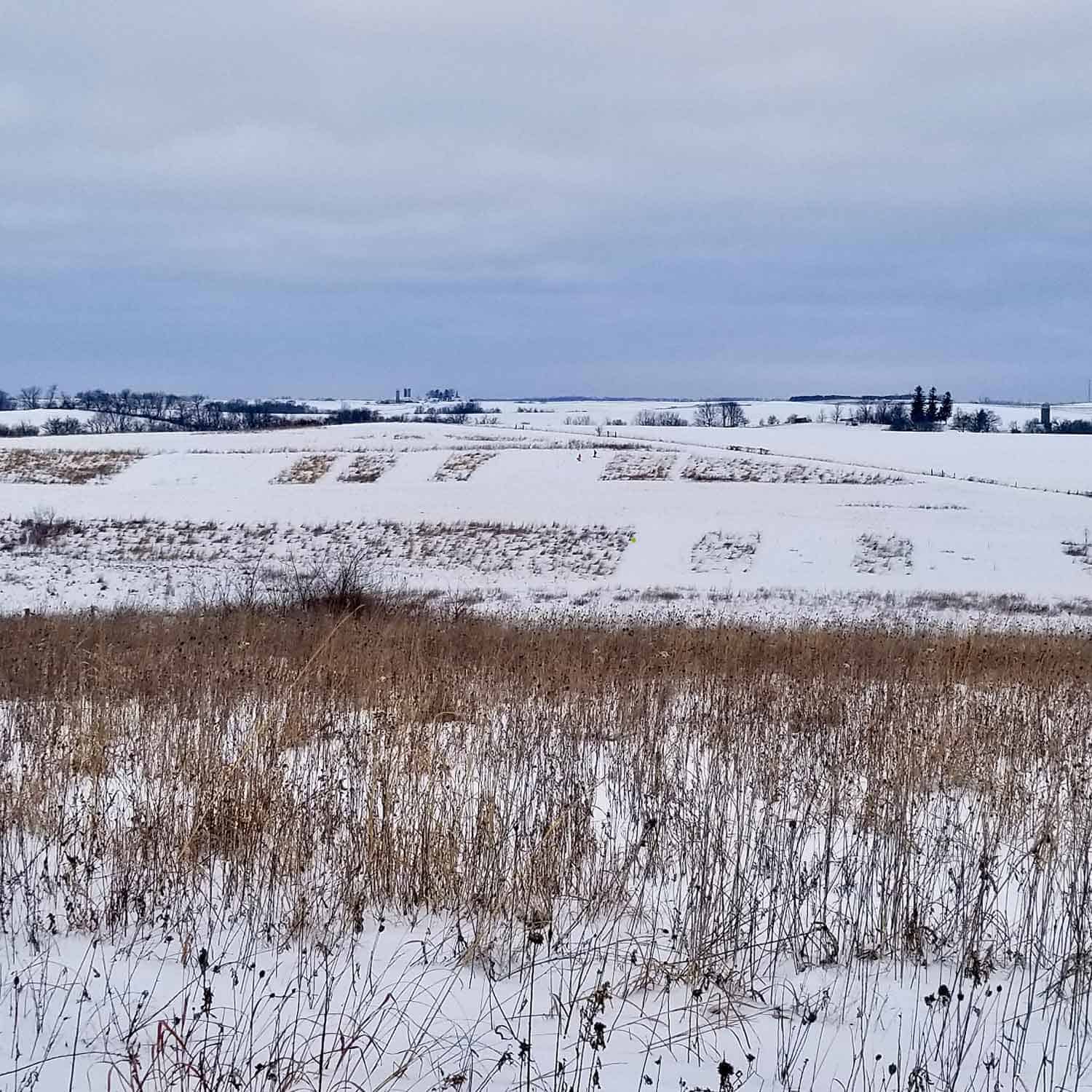
Winter view of the experimental plots at Mounds View Grassland from a nearby hilltop. Photo by Ellen Damschen.
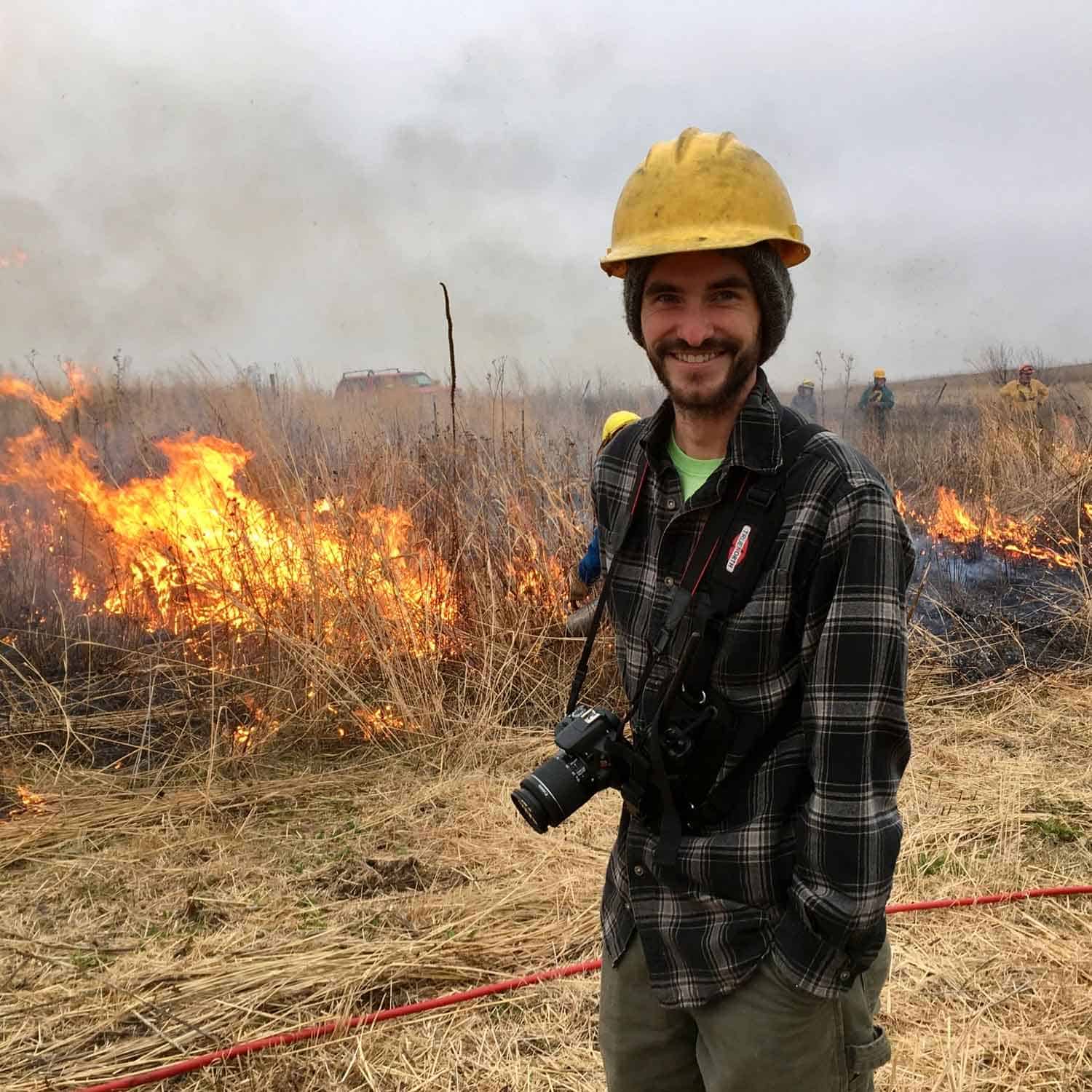
Former graduate student Jon Henn, who helped originate the experiment, joins The Prairie Enthusiasts’ prescribed fire crew to apply a burn treatment at Mounds View Grassland. Photo by Laura Ladwig.
Surprisingly, however, only the management treatments—not the snow manipulations—have produced measurable effects on the composition of species that make-up the plant community so far. We found that both spring and fall burns have resulted in greater increases in species richness than in unmanaged plots, with fall mowing falling somewhere in between, a pattern that aligns with what many practitioners already observe. Despite clear shifts in winter soil conditions and measurable effects on individual species performance, including early life stages, we’ve seen no evidence that altered snow depth is changing the overall composition of these prairie communities. This resilience may stem from the evolutionary history of the species themselves. Most prairie plants are long-lived perennials adapted to disturbance. The same deep roots and underground buds that allow them to survive fire may also protect them from freeze stress.
Digging deeper into the data, subtler patterns have emerged in support of this idea. In young restorations like those at Mounds View Grassland, we typically expect colonization by fast-growing, resource-acquisitive plants. But in the coldest plots—those that were burned in the fall and had snow removed—we found more recruitment of stress-tolerant, slower-growing plants. Among those are wholeleaf rosinweed (Silphium integrifolium), wild quinine (Parthenium integrifolium), big bluestem (Andropogon gerardii), white heath aster (Symphyotrichum ericoides) and prairie dropseed (Sporobolus heterolepis)—plants with tough, nutrient-poor leaves and high tolerance to cold, the botanical hallmarks of endurance.
For now, these restored prairie plant communities appear to be holding steady through the loss of winter snow, but subtle or delayed effects may yet emerge as small shifts—like those seen in colonization trends—accumulate over time. And because the experiment has unfolded during an era of warming winters, it has, in a sense, been running within its own real-world test of change, complicating what the data can reveal. Moreover, the prairies at Mounds View Grassland are still relatively young restorations and don’t yet have the species richness and ecological complexity of remnant prairies, so results may differ in those long-established systems.
In my view, a conservative approach would be to continue keeping litter down through burns to make space for new seedlings, but where possible, those burns should occur in the spring to help soften the potential impacts of warming winters. At the same time, we can’t take disturbance for granted. Fire is essential for maintaining the diversity and function of prairie plant communities, but climate change is shifting weather windows, and practitioners have to stay flexible to burn safely and effectively. In some years, that may mean more fall burning simply to ensure fire remains on the landscape at all.
The lessons from this research extend beyond its scientific findings. The experiment demonstrates how restored prairies can double as living laboratories—places where research questions meet the realities of management. Such work depends on trust and shared learning, where researchers rely on practitioners for on-the-ground expertise and historical context, and practitioners rely on researchers to interpret patterns that can inform future stewardship. At Mounds View Grassland, that collaboration has been ongoing for nearly a decade, spanning three generations of graduate students. Season after season, it reminds us that resilience grows from persistence—from tending the land through uncertainty and trusting that, like the prairie itself, our efforts will endure.
For more information about this research, please see the associated academic papers published in Ecosphere (2022) and American Journal of Botany (2025). The research team thanks the continued support of their collaborators and funders, including The Prairie Enthusiasts, Adaptive Restoration, The Nature Conservancy, the Wisconsin Department of Natural Resources, the National Science Foundation, the Joint Fire Science Program and the U.S. Geological Survey Midwest Climate Adaptation Science Center.
About The Prairie Enthusiasts
The Prairie Enthusiasts is an accredited land trust that seeks to ensure the perpetuation and recovery of prairie, oak savanna, and other fire-dependent ecosystems of the Upper Midwest through protection, management, restoration, and education. In doing so, they strive to work openly and cooperatively with private landowners and other private and public conservation groups. Their management and stewardship centers on high-quality remnants, which contain nearly all the components of endangered prairie communities.