
Mukwonago River Oak Barrens Update
Article and photos by Dan Carter.
September 2026
Mukwonago River Oak Barrens Update
Article and photos by Dan Carter.
September 2026
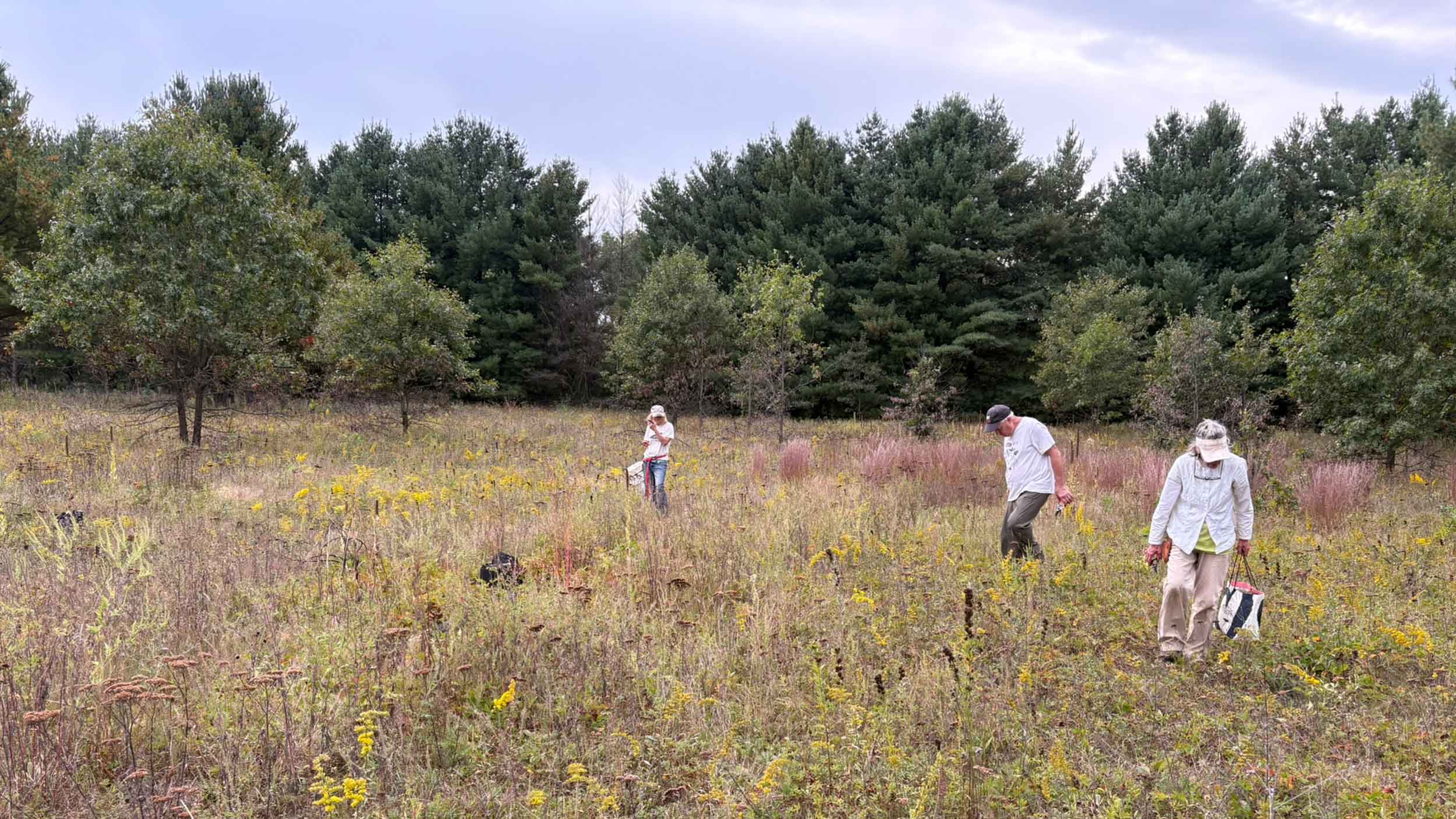
Volunteers collect seed from Great Plains frostweed (Crocanthemum bicknellii), Canada frostweed (Crocanthemum canadense) and prairie pinweed (Lechea stricta) in late summer.
The Prairie Enthusiasts acquired the Mukwonago River Oak Barrens (MROB) a little over one year ago. The site features recovering oak barrens (sandy savanna), moist savanna; and small areas of wet to wet-mesic prairie, sedge meadow, and calcareous fen. It has become a big part of my life and place of community for dozens of people.
In the first year following acquisition, volunteers spent 1500 hours conducting burns, removing brush, collecting and spreading seeds, and staging and burning piles. We’ve also taken time to enjoy the flowers and the birds. We continue to be encouraged by good surprises. Since the spring of 2025 the list of known native vascular plants indigenous to the site has grown from a little over 200 to 320. The new finds include species like yellow stargrass (Hypoxis hirsuta), prairie smoke (Geum triflorum), velvet-leaf blueberry (Vaccinium myrtilloides), Swan’s sedge (Carex swanii), and a Wisconsin threatened plant, which jumped out at me while leading a tour along a route I had passed by dozens of times before. In March, we potlucked around a dusk campfire and then sat in silence as an abundant American woodcock display occurred overhead and in all directions. I have been struck by how long it takes to learn even a fraction of what there is to know about a place through luck and deliberate inspection.
I was nervous about the project in the beginning. I wondered how many people would get involved. I wondered if the property had enough nucleus of persisting native flora, fauna and microbes to continue to heal. Brush was and still is extensive. There were and are thousands of trees to remove. There was and is so much spotted knapweed (Centaurea maculosa). The property had been a Christmas tree farm. Before that it had been a cut flower farm. Before that, much of it was cultivated. And before that, an old herbarium specimen from the vicinity of the property described the land as sheep pasture. Still, small areas avoided the plow. Other areas that were cultivated but had subsequently remained at least partially open into the present seemed well on their way towards recovery. Species like false toadflax (Comandra umbellata), hairy puccoon (Lithospermum caroliniense), clasping leaf milkweed (Asclepias amplexicaulis), short green milkweed (Asclepias viridiflora), rough blazingstar (Liatris aspera), and hairy hawkweed (Hieracium longipilum) had presumably recolonized the sand from uncultivated areas near the wetland edge, fencerows and adjacent road rights of way. Seeing this spontaneous recovery and hoping to amplify it, we made the commitment to join its process.
We have steadily added to the area we are actively managing. Our goal is to bring three to five acres under integrated management each year, first connecting relatively open areas in the central and western part of the property, the open wetlands riparian to the Mukwonago River, and pockets of remnant vegetation in the uncultivated area that runs along the wetland edge in the southern part of the property. By ‘integrated’ I mean that we are removing unwanted vegetation, burning, seeding and continuing to follow up and look for problems in a coordinated way within the areas we have opened up.
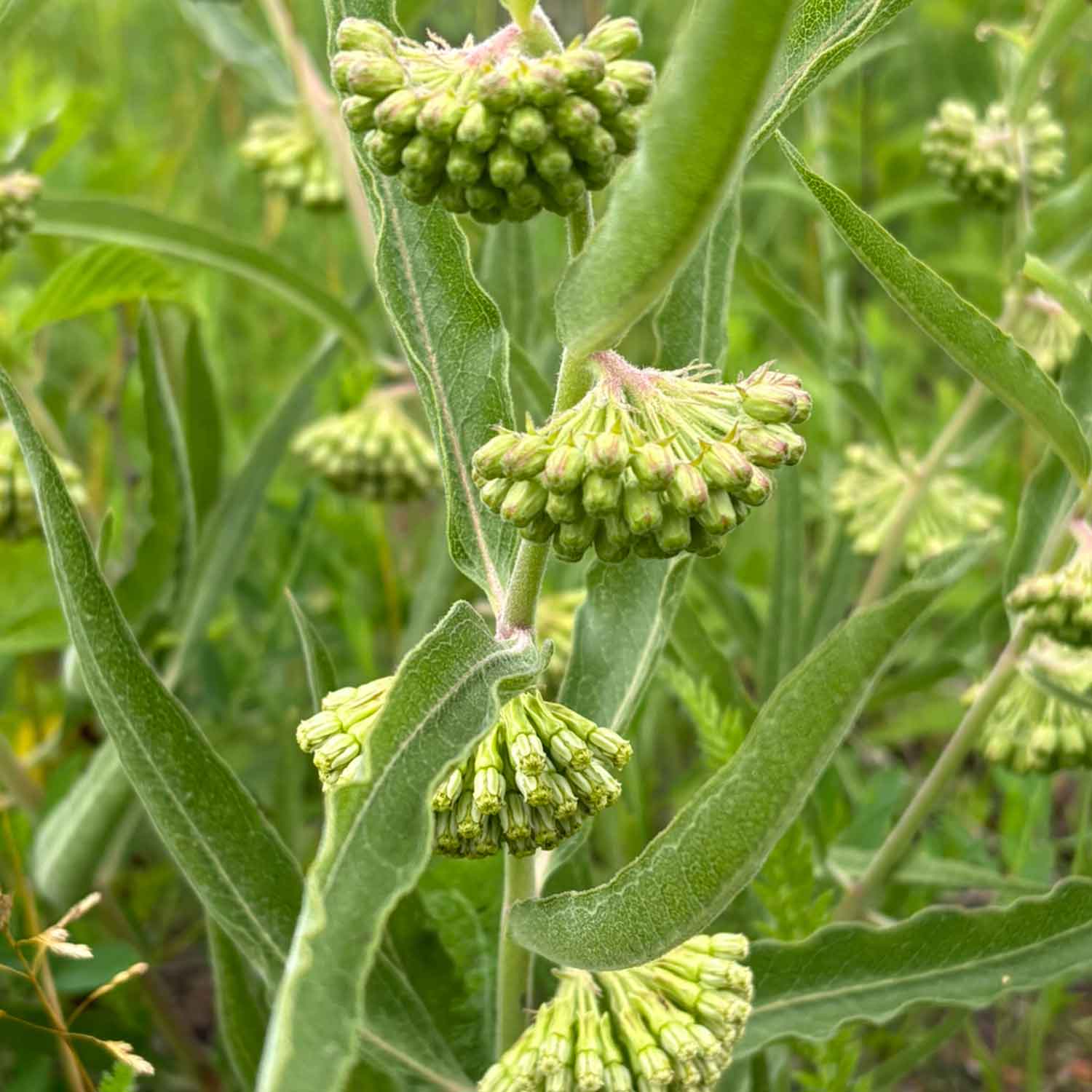
Short green milkweed (Asclepias viridiflora) occurs in a few scattered areas in the western part of the property.
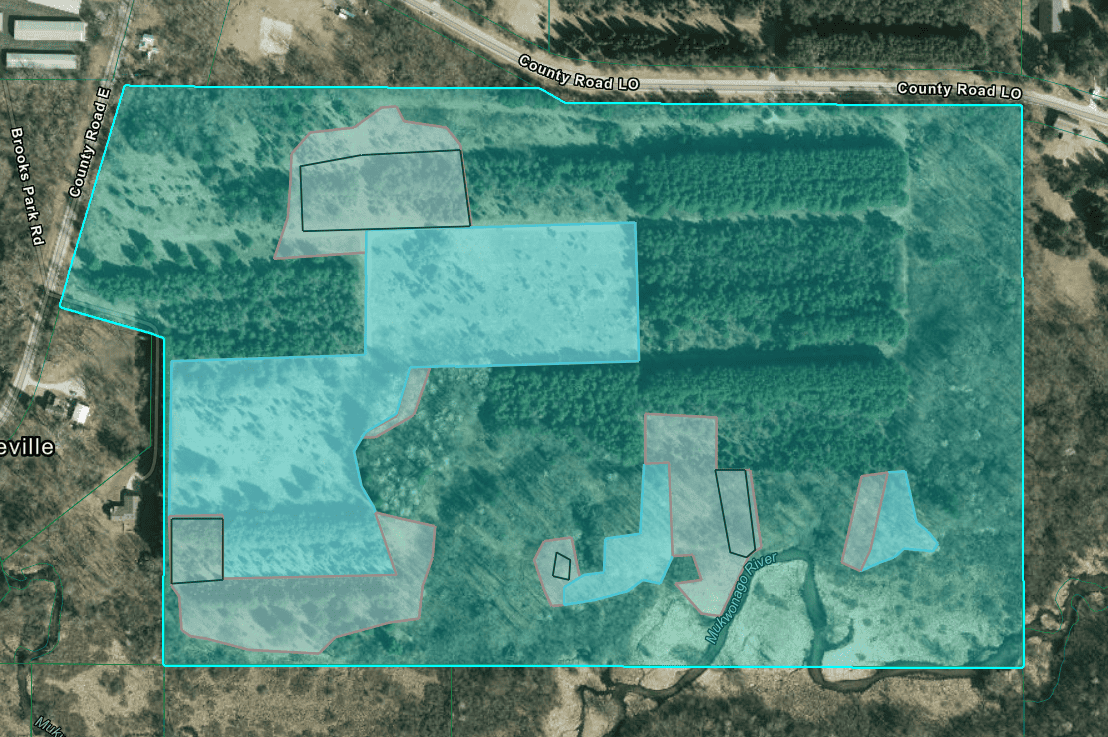
MROB Map: The property boundary is highlighted. Areas within the property boundary outlined and shaded in blue were under our active management at the time of closing in June 2025. Areas outlined and shaded in red have been opened up and added to the management footprint between June 2025 and June 2026. Contract work funded by grantors and donors had completed significant amounts of the clearing within the areas outlined in black as of June 2026.
We started in the partially open center of the property, removing patches of buckthorn and honeysuckle, cutting smooth sumac (Rhus glabra) and quaking aspen (Populus tremuloides) suckers twice during the growing season, girdling aspen trees, removing remaining conifers, and burning about four acres in the fall of 2023. In the fall of 2024, we burned that area again, another similar area immediately to the southwest, and a small area around a concentration of remnant savanna vegetation in a distant corner of the property for a total of just over seven acres. Between October of 2025 and March of 2026, we burned all of those areas again and newly opened areas adjacent to them for a total of just over twelve acres. Having capacity among regular volunteers to burn small areas on short notice has been very helpful. During the 2025-2026 dormant burn season we were able to burn eight small areas after we conducted the main burns of the larger open units. That means we were ready and able to put down seed and give recovery a head start. Productivity over much of the site is quite low, which means that if we apply annual ignitions, there is only enough fuel to carry fire over 70 to 80 percent of the area within burn units.
As of this fall, we’ve connected open areas in the central and western part of the property with a strip of remnant prairie and the adjacent sedge meadow in the southwest corner of the property. We have also expanded our management footprint to incorporate much of the other uncultivated parts of the property, some of the sedge meadow in the south-central and southeastern part of the property, as well as a savanna vernal pond, which was discovered by following the calls of chorus frogs into the brush in 2024. This upcoming dormant burn season, we should increase our burn footprint from 12 to between 17 and 19 acres.
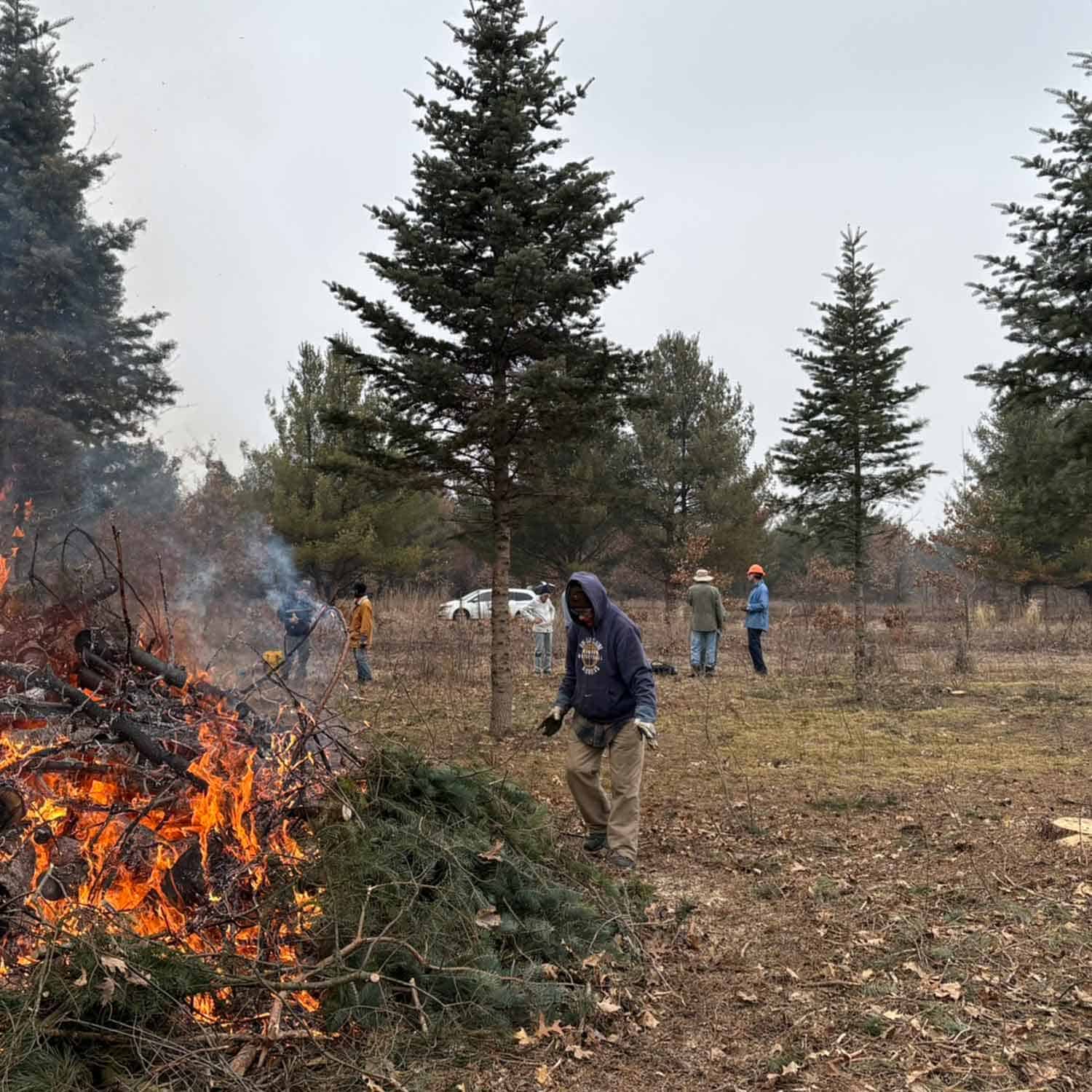
Volunteers burn conifer material on a wet late winter day. White firs (Abies concolor) remaining in the background were left temporarily so volunteers can take the tops for holiday trees later this fall.
Conifer plantations are a challenge. Most of the material isn’t marketable in southeastern Wisconsin, and there are parts of the property where we would rather avoid the use of heavy machinery. We have found that we can cut, pile, and burn about an acre of conifers each year.
One of the biggest challenges so far has been untimely flash droughts in the sandy soils. After April deluges this spring, the site went six weeks from late April into early June with only a quarter inch of rain spread across several inconsequential sprinkles. A similar dry period occurred last June. Seeds broadcast in fall and germinated in April and early May withered and died in the open areas. We have also spent a lot of time watering transplants (plugs, roots, and divisions). Still, local wood betony (Pedicularis canadensis) sown in the summer of 2024 flowered for the first time this year in several areas. Prairie blazingstar (Liatris pycnostachya) sown in moist areas in late fall of 2024 also flowered for the first time. It joins a solitary plant that established after cultivation was abandoned from a population nearby that presumably was lost to brush or land use. More things are coming, even in the drier areas, but especially in lower areas closer to the water table or under the shade of oaks. We’ll get better returns on our seed collecting and sowing efforts if and when we get a wet period during May and early June. We plan to collect and sow what we can every year within our management footprint. We will probably shift as much plug/root/transplant planting as possible in drier areas to autumn to maximize the period of adequate moisture for establishment.
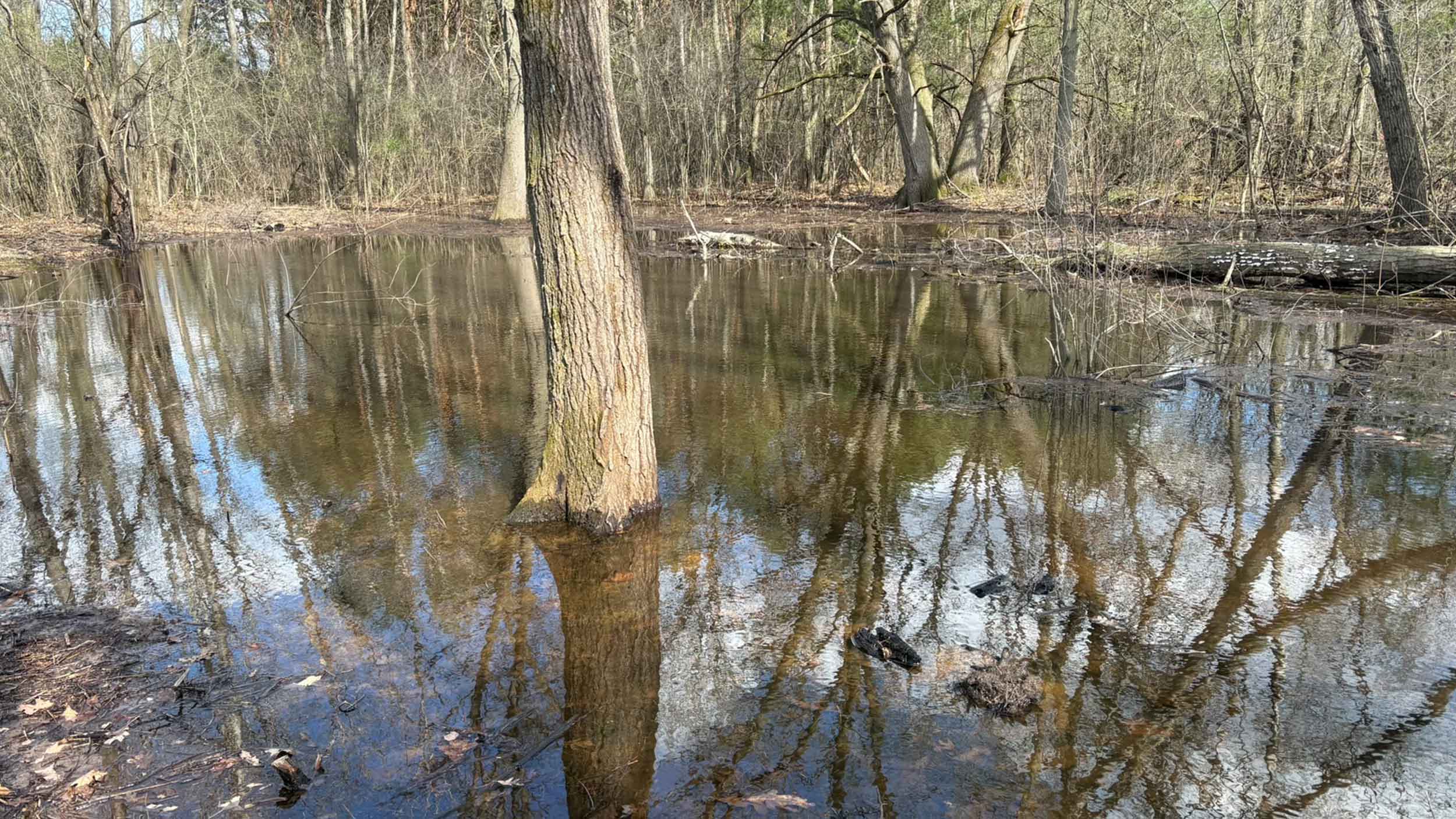
Vernal pool that has been cleared of buckthorn and is now contiguous with open savanna habitat after filling with water in April. Marsh fern (Thelypteris palustris) and blue flag iris (Iris virginica) persisted and are recovering. Many other species known from vernal pools in the area have been introduced where the ground was bare.
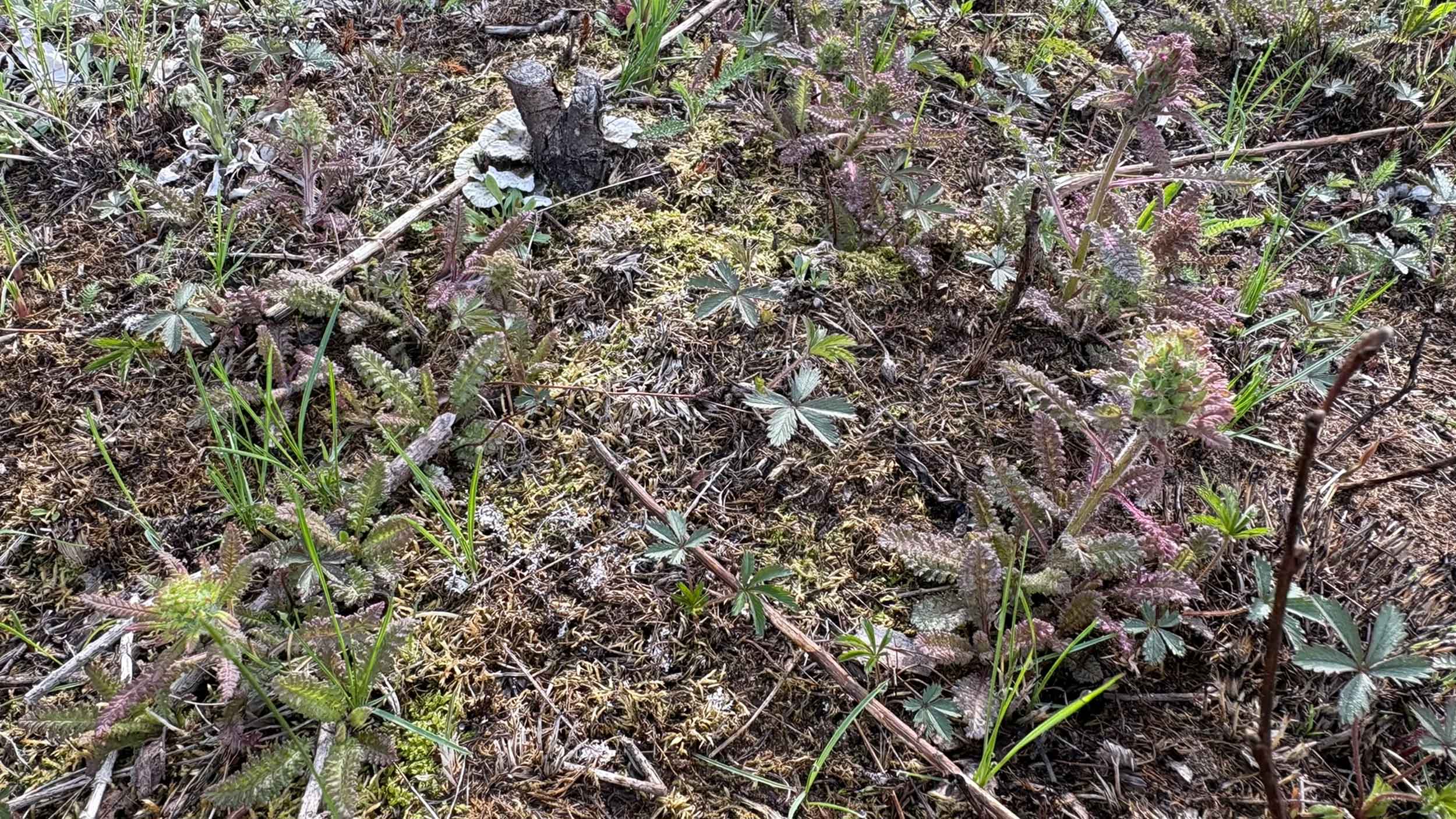
Wood betony (Pedicularis canadensis) emerging in bud in early April, 2026 in an area where it was seeded in the summer of 2024 after brush removal (prior to acquisition of the property).
Support from the Kettle Moraine Chapter of Wild Ones, the Natural Resources Foundation (NRF) C.D. Besadny Conservation and Rare Plant Preservation Funds, Southeastern Wisconsin Invasive Species Consortium Assistance Program, and individual donors has supported our work by helping purchase supplies, seeds, and plugs; and by funding contract work to clear brush and trees on about two acres (so far) to augment our volunteer work. The NRF Rare Plant Preservation Fund is supporting clearing brush to create more suitable habitat for Swan’s sedge (WI Special Concern) and fescue sedge (Carex festucacea, WI Special Concern) and the contract growing plugs from Swan’s sedge seed collected at MROB, a nearby Waukesha County Land Conservancy preserve, and another neighboring property. Plants will be shared between Waukesha County Land Conservancy and The Prairie Enthusiasts.
There is still much to do, and that will always be the case. Our role is to expand and maintain the openness needed for recovery. The land responds with flowers, birds and ornate insects. It provides an honest, transparent and deep sanctuary. Midwestern savannas and prairies exist only from mutually constructive relationships between people and land. If there are to be savannas and prairies, there can be no end to that relationship, and we celebrate that every week. Join us some time, consider leading an element of stewardship, or simply take a walk and listen to the meadow katydids and field sparrows.
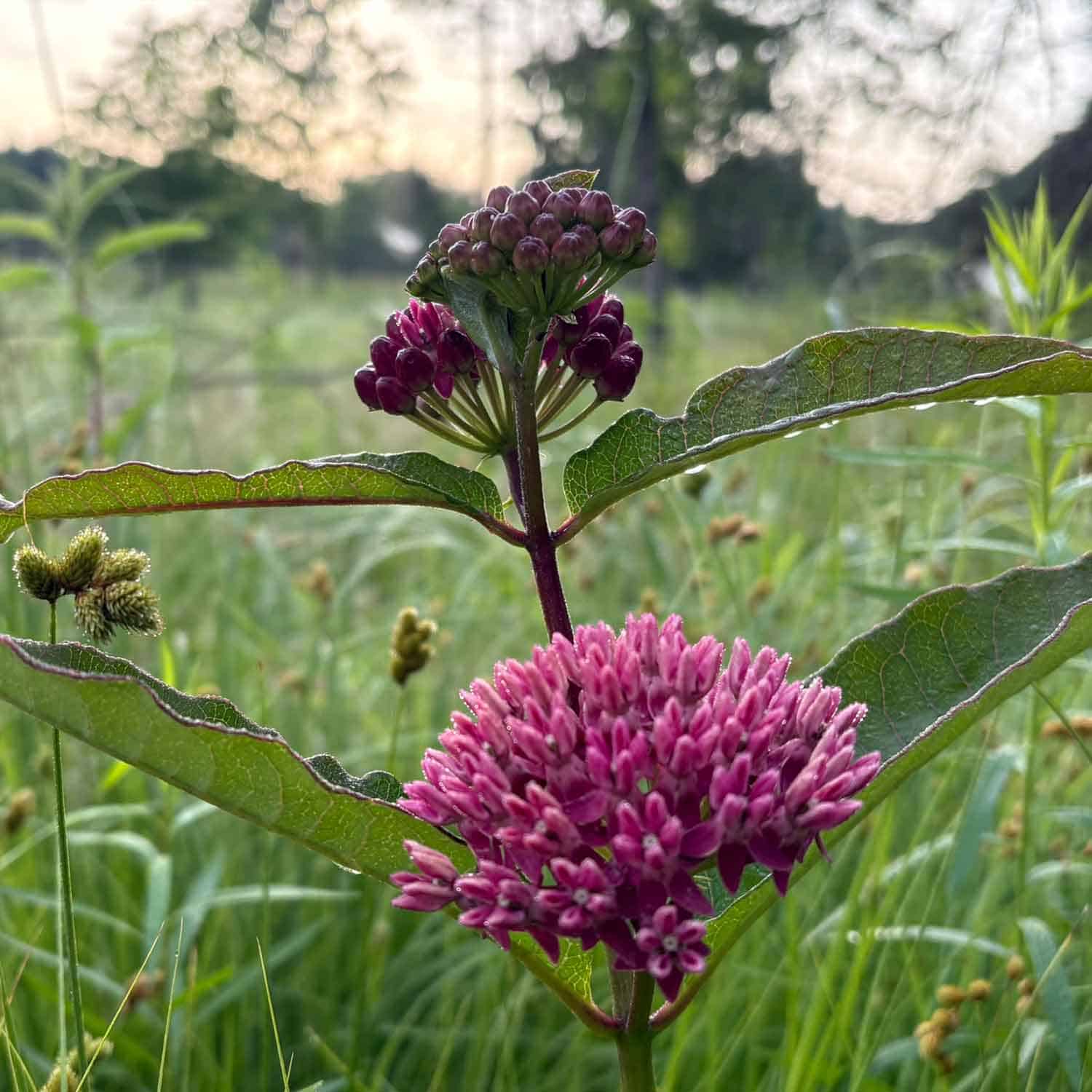
Seven purple milkweed (Asclepias purpurascens)plants flowered in June 2026
in a moist area where it had been planted in 2023 (prior to acquisition of the property).
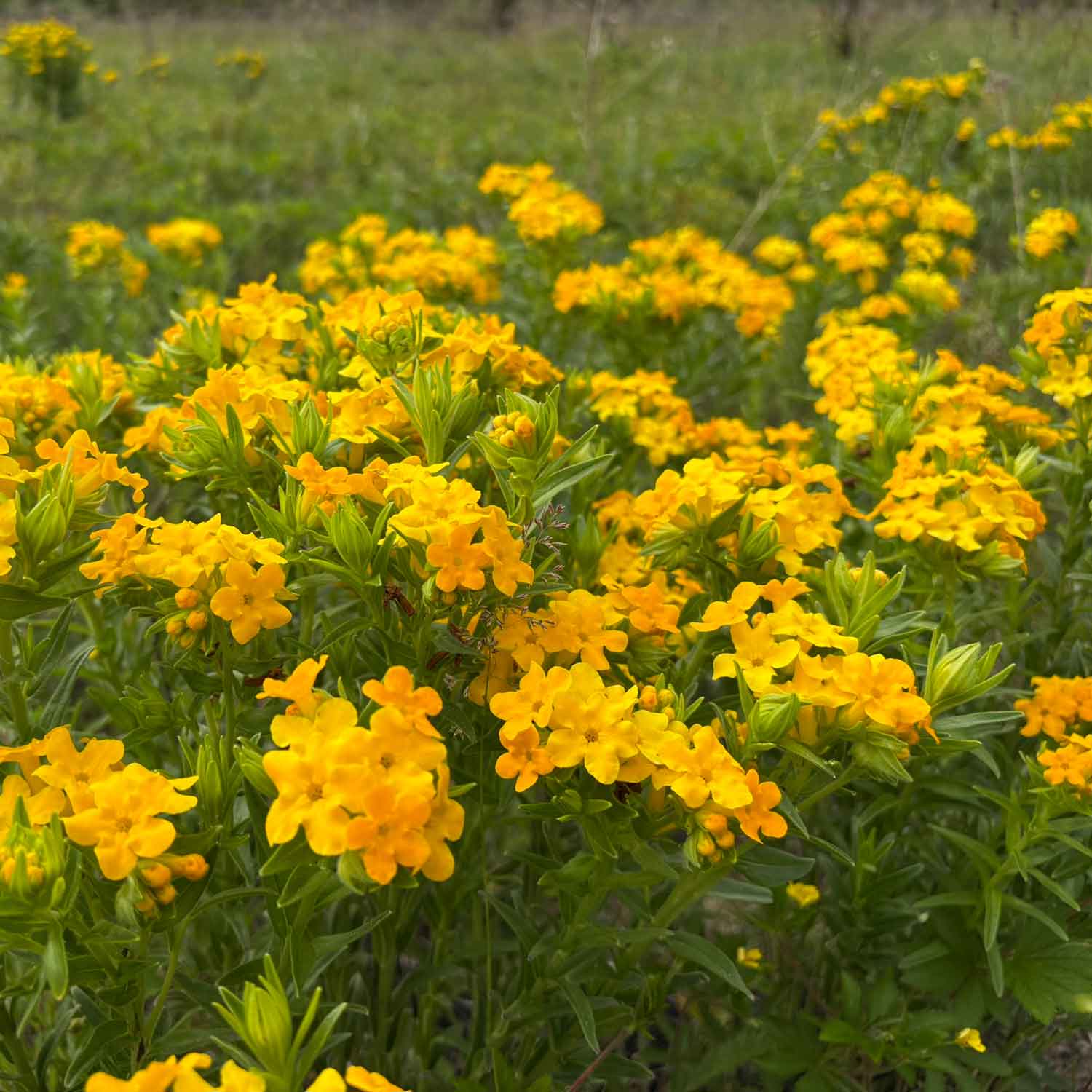
Hairy puccoon (Lithospermum caroliniense) flowering profusely in May.
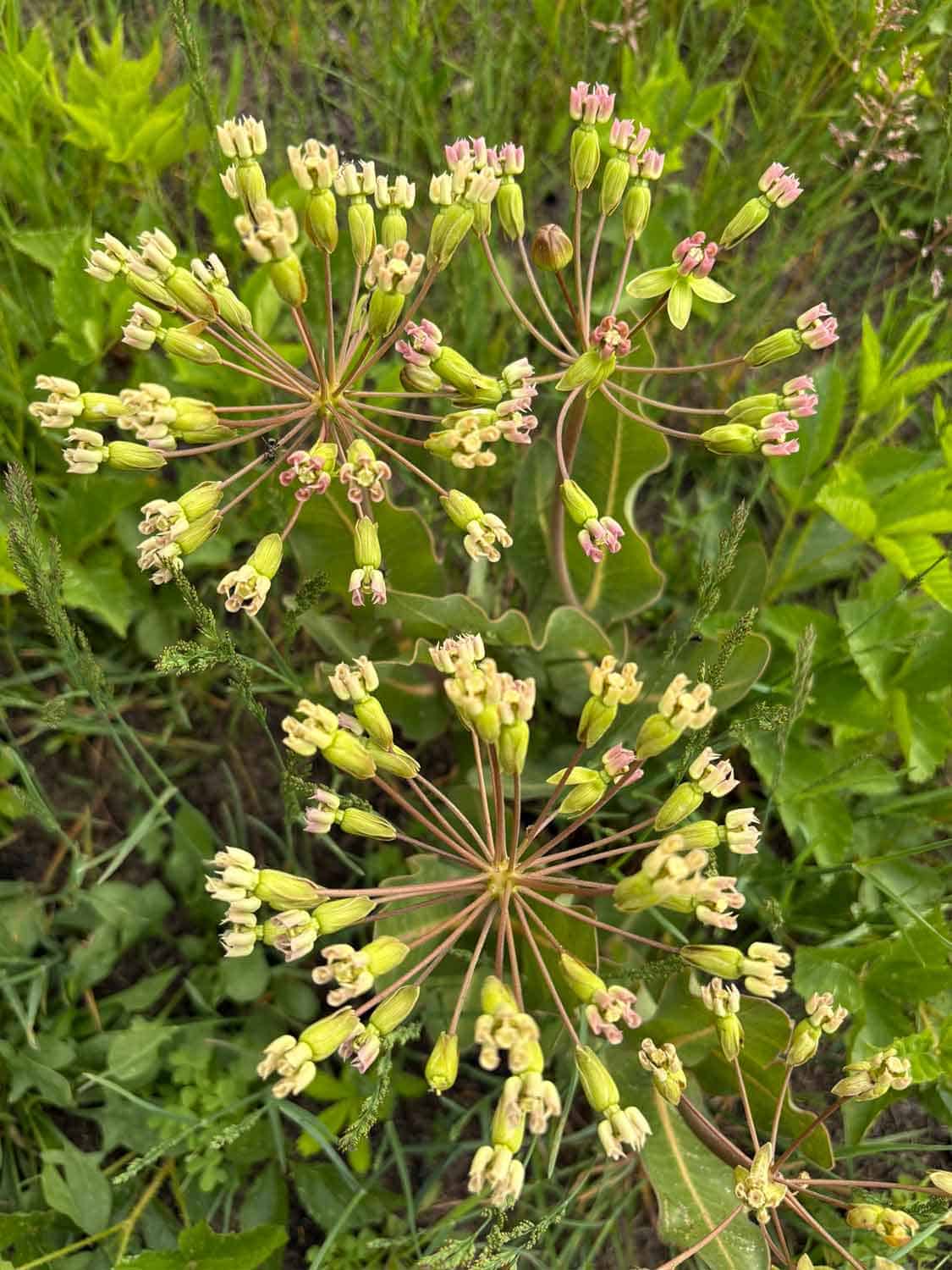
Clasping-leaf milkweed (Asclepias amplexicaulis) is abundant at the site. Hundreds of stems are scattered throughout the open areas.
About The Prairie Enthusiasts
The Prairie Enthusiasts is an accredited land trust that seeks to ensure the perpetuation and recovery of prairie, oak savanna, and other fire-dependent ecosystems of the Upper Midwest through protection, management, restoration, and education. In doing so, they strive to work openly and cooperatively with private landowners and other private and public conservation groups. Their management and stewardship centers on high-quality remnants, which contain nearly all the components of endangered prairie communities.