
Sustained Enthusiasm!
Member Profile: Evanne Hunt, St. Croix Valley Chapter
Article by Melinda Knutson, Coulee Region Chapter Chair
September 18, 2026
Sustained Enthusiasm!
Member Profile: Evanne Hunt, St. Croix Valley Chapter
Article by Melinda Knutson, Coulee Region Chapter Chair
September 18, 2026
Prairie conservation takes many kinds of dedication: the knowledge to guide good management, the hands-on energy to care for the land, and the steady behind-the-scenes service that keeps an organization moving forward. Evanne Hunt has offered that kind of steady service for more than two decades, supporting The Prairie Enthusiasts through leadership, outreach and a genuine commitment to community. She has served as Chair of the St. Croix Valley Chapter since 2001 or 2002, though the exact year is uncertain. This includes Pierce, Polk and St. Croix counties in Wisconsin, along with Washington County in Minnesota. This year, it celebrated its 30-year anniversary. Under Evanne’s leadership, the Chapter has grown to about 140 members and now manages seven properties with remnant prairies and savannas. Over 80 people attended the anniversary celebration in June.
Evanne did not grow up on a farm nor did she have a memorable childhood experience in nature that drew many people into natural resources. Instead, she was a “townie,” raised in the small town of Milaca, Minnesota. Her interest in prairies began in 1991, when she and her husband, Greg Korman, moved onto two acres near Hudson, Wisconsin. Tasked with mowing the lawn, Hunt started looking for ways to reduce the work. She ordered a stack of garden catalogs, and the Prairie Nursery catalog caught her attention.
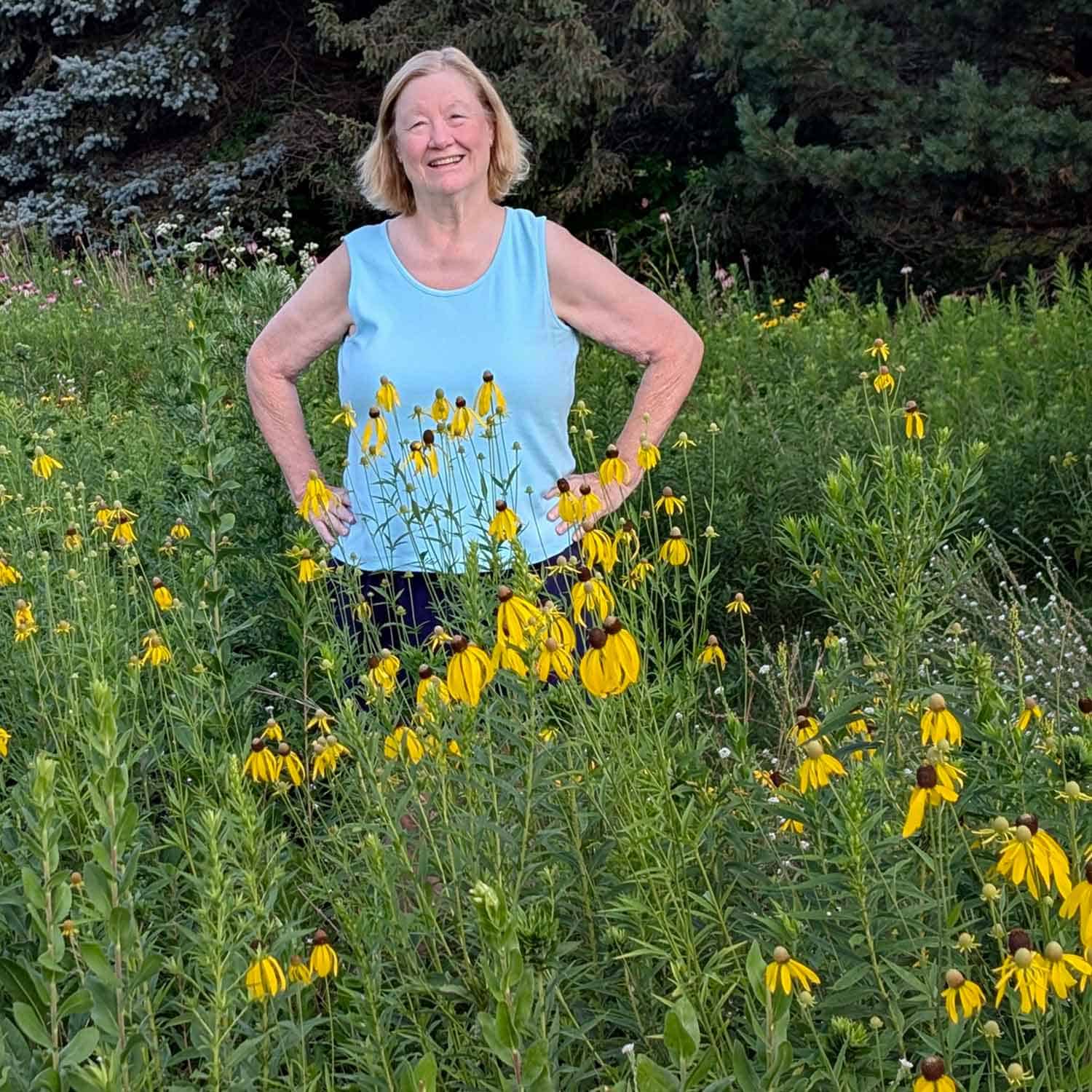
Evanne Hunt among grey-headed coneflower (Ratibida pinnata). Photo by Greg Korman.
“I wanted those beautiful prairie flowers instead of a lawn, but I didn’t know anything about prairies,” she said. “We started with one acre, and we made some mistakes by planting too many tall grasses. Still…that started my passion for prairies. I just love attending work parties, prairie walks and field days. Everyone mentors me; I don’t mentor anyone,” said Hunt when I asked her about her leadership role. “I don’t have the expertise to identify all the prairie plants or know how to manage them. There are many other people with more expertise than I have. But that’s okay! The Prairie Enthusiasts is a big organization now; we need lots of different skills. We need experts in finance, education and many other areas, as well as botany.”
How can we attract more people to engage in prairie restoration? Why do people choose to do work that can be difficult or sometimes unpleasant? Why spend a cold day in the fall cutting buckthorn, treating stumps with herbicide, hauling trees and shrubs into piles and tackling the other routine, sometimes unpleasant tasks of prairie restoration?
“It’s the camaraderie that attracts them,” answered Evanne. “We get a lot of people coming out for work parties that may never join The Prairie Enthusiasts, but they still love learning about the prairie, collecting seeds, and feeling the camaraderie of doing something useful outdoors. Notice that we don’t call them ‘work days,’ we call them ‘work parties’ because we have fun while we work. We always stop for lunch, tell stories, or learn new plants.”
“People love a bonfire!” Evanne stated. “Burning wood piles and fall seed collecting are great times to get new people to join us. We encourage people to bring friends. Most people won’t come if they don’t know at least one other person who is attending. That’s just human nature.”
Why has Evanne been willing to serve in a leadership role for her Chapter for so many years? “It’s difficult to get people to take on leadership roles and attend meetings; most Prairie Enthusiasts would rather work outdoors than go to a meeting,” Evanne remarked. “My work as a technical writer for a computer company was indoors. It was natural for me to go to meetings. Actually, I don’t like meetings that well either; but taking on a leadership role is something I can do to support the organization.”
Evanne’s other major role with The Prairie Enthusiasts is outreach. “I show up at every event in the area with my table and brochures,” Evanne said. “I emphasize the fun involved in helping nature and the satisfaction of making a difference. We also have students from UW-River Falls who help with seed collecting and cleaning and professors who encourage them. We’re lucky to have those connections.”
“I’m very encouraged by the rising public interest in pollinators, butterflies and birds,” expressed Evanne. “I think the schools, government agencies and non-profits have been successful in raising public awareness about what a prairie is and why it is important. Back in the 1990s I had to repeatedly explain to people what a prairie was; most people today have some basic understanding that prairies are important for pollinators and even for birds.”
When I contacted Evanne, she worried her story might be too ordinary to interest readers. I don’t agree! Her story is a reminder that there are many ways to make a difference, and not all of them are flashy. Often, it is the people who stay committed over time—those with sustained enthusiasm—who provide the steady foundation that helps everyone succeed.
About The Prairie Enthusiasts
The Prairie Enthusiasts is an accredited land trust that seeks to ensure the perpetuation and recovery of prairie, oak savanna, and other fire-dependent ecosystems of the Upper Midwest through protection, management, restoration, and education. In doing so, they strive to work openly and cooperatively with private landowners and other private and public conservation groups. Their management and stewardship centers on high-quality remnants, which contain nearly all the components of endangered prairie communities.