Springtime Magic

Springtime Magic

Springtime Magic

Story and Art by Joe Maurer, Multimedia Artist, Chippewa Savannas Chapter Member

Dower Prairie Shooting Stars

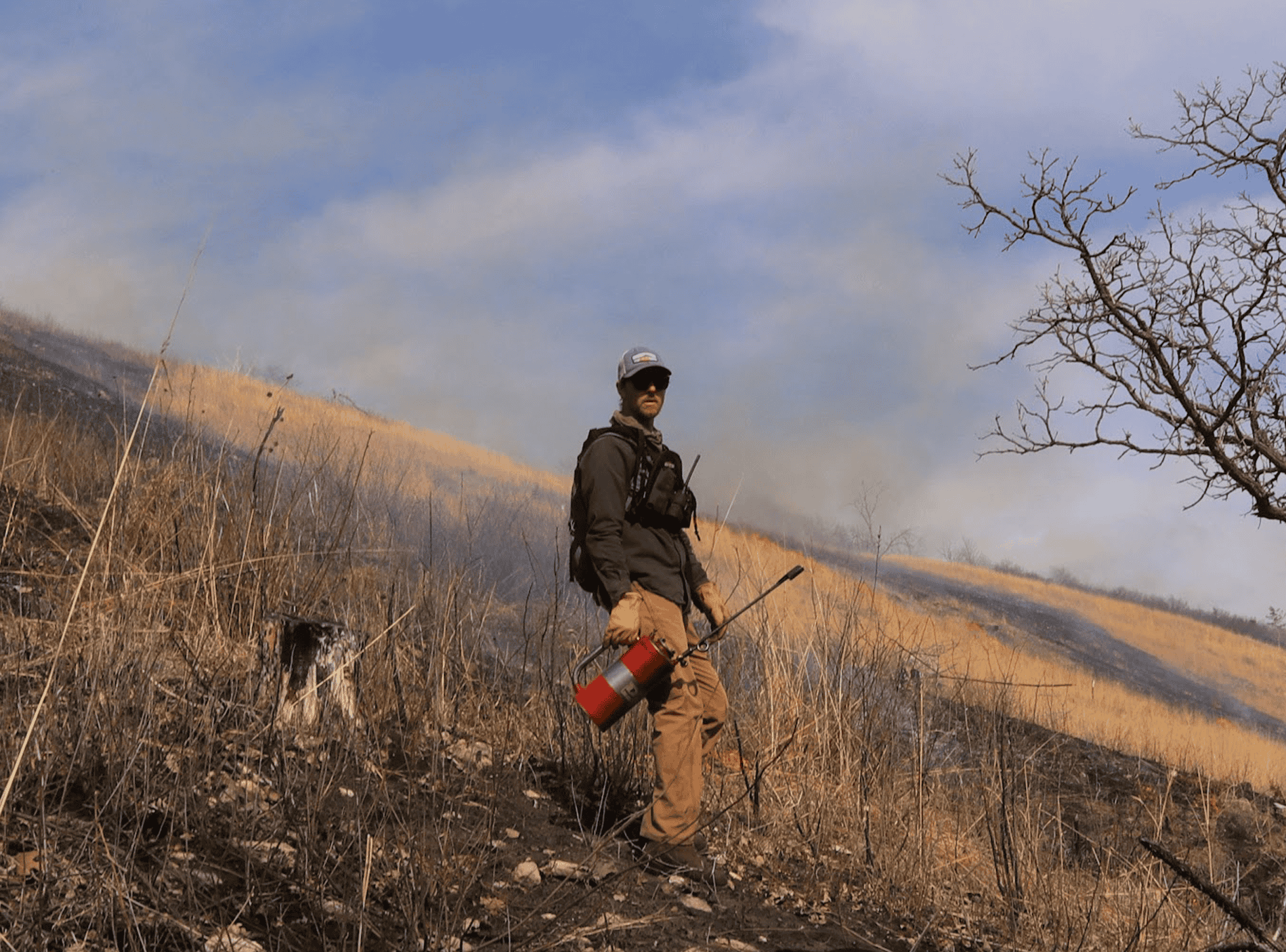
Two springs ago, I got a call from Steve Hubner from the Prairie Bluff chapter. Joe you gotta get down here and see the blooms of these shooting stars.Steve specifically wanted me to create videos that would showcase the extravagant floral displays found in Butenhoff Prairie, Dower’s and Muralt Prairies, all of which had recently been burned earlier in spring of 2022.As is typical for me when I go to these landscapes, I tend to be a tad drifty. I am either hyper-focused on something or I want to see it all.A Prairie Enthusiast knows there really is no way to properly capture the life of the prairie. Its a highly personal experience.You just have to be there and let the landscape direct you.

Shooting with high frame rates to capture slow motion, I spent a lot of my time chasing queen bumblebees.With my camera on a long stick, I looked a bit like somebody with a metal detector obsession searching for treasures.Steve noticed my odd behavior and more than once remarked that I get overview shots to make sure people see and understand the expansiveness of the floral displays.”

When I got back home, I edited together footage that captured some of what I felt.The videos were good, but there was still another feeling I was trying to get to. In my restlessness to find that feeling, I printed out frames from the videos and taped them together on the walls of my art studio. I spent the next year and a half working on a dozen five-to-six-foot paintings derived from the film stills.I wanted that feeling of being at ground level where queen bees collect spring pollen and badgers forage.I am happy to share some of the outcomes of these efforts.   

My gratitude to Steve Hubner and Mary Zimmerman for the support during this project. Prairie Bluff and Southwest Chapters: thank you for keeping the magic alive in these landscape jewels we call prairies!   

Check out the videos mentioned in this article here:

Dower Prairie

Butenhoff Prairie

Muralt Prairie

To experience the magic of prairies firsthand, visit one of our protected sites.

This article appeared in the Summer 2024 edition of The Prairie Promoter, a publication of news, art and writing from The Prairie Enthusiasts community. Explore the full collection and learn how to submit your work here.

Dower’s Prairie

Nederland

Butenhoff Prairie 

Gentians of Eau Claire 

Management Toolbox: How to Prioritize Removing Invasive Species

Management Toolbox: How to Prioritize Removing Invasive Species

Management Toolbox: How to Prioritize Removing Invasive Species  

Story by Jim Rogala, President 

The purpose of this regular section of The Prairie Promoter is to keep proper management methods fresh in your mind. These short articles will sometimes reference past or future articles that contain details on the selected topic. Others will just be some food for thought. I encourage others to provide ideas for articles. You can send those ideas to me at jrogala@theprairieenthusiasts.org.

Prioritizing the sometimes-long list of invasive species to combat  

Oftentimes serving on a committee seems like a burden, albeit necessary. However, those meetings provide an opportunity for committee members to engage in interesting discussions. A recent Land Management Committee meeting found its members talking about strategies for dealing with a long list of invasive species in a management plan. Seldom do we have the resources to control all the invasive species present, so how do we prioritize our management actions?

Let me offer an example of a process that might be used. There are several factors leading to my decision to control a species. The first factor I consider is whether the species has shown up because of a disturbance. Many species take advantage of the lack of competition but can’t compete in the long-term as other more conservative plants establish. Some examples are Queen Anne’s Lace, Mullein, and Canada Thistle. I realize it is difficult to just ignore these and wait them out, but leaving each species can be justified. Both Queen Anne’s Lace and Mullein are biennials and could be controlled by pulling. However, remember why they showed up in the first place, and consider how the additional soil disturbance might perpetuate the problem. Canada Thistle is a deeply rooted perennial that one might suspect could outcompete establishing prairie plants but that is not the case, as it will succumb to solid competition from native plants given enough time. 

In contrast to species that respond to disturbance, there are those that can invade remnant sod. These pesky species require attention because once established they can spread and have an impact on prairie species. Some of these heavy hitters include Crown Vetch, Leafy Spurge, and Spotted Knapweed (I won’t list more because it can be depressing!). These usually require herbicide use, although there are some biocontrol methods that can at least keep populations controlled to some degree. 

I’ve just scratched the surface of this topic here. Look for an upcoming article by Dan Carter in which he will delve into the factors behind why to prioritize control of some invasive species over others.

What timescale do you plan at?

Keeping with the theme of topics discussed at Land Management Committee meetings, one of the committee’s primary responsibilities is to approve land management plans. These are required for all lands owned by The Prairie Enthusiasts, land with easements and areas with management agreements. These are long-term plans, although we are now planning to update them in a 10-year interval. We have also formally added some goals for a 10-year period in our management plans, a period that might require a substantial amount of work for new sites. Although these plans provide valuable context for conducting management, actions are usually planned at much shorter timescales. I like to develop 1-year plans that focus work for the upcoming year. These plans can be much more detailed and therefore provide the basis for scheduling specific work throughout the year. I’d encourage anyone managing lands to consider having plans at several scales, preferably written plans rather than ones just floating around in our heads.

This article appeared in the Fall 2024 edition of The Prairie Promoter, a publication of news, art and writing from The Prairie Enthusiasts community. Explore the full collection and learn how to submit your work here

Invasive Queen Anne’s Lace. Unknown photographer.

Enthusiasm for Restoration Proves Contagious on Rattlesnake Ridge

Enthusiasm for Restoration Proves Contagious on Rattlesnake Ridge

Enthusiasm for Restoration Proves Contagious on Rattlesnake Ridge

Story by Cassidy Coulson and David Myers, Chapter Support Staff

Colorful display of diverse plant life at Rattlesnake Ridge, including purple prairie clover and rattlesnake master. Photo by Sue Steinmann.

Many people in The Prairie Enthusiasts community have interesting tales to tell of chance encounters that result in new land protected, or that inspire someone to become a Prairie Enthusiast. The protection of Rattlesnake Ridge in Southern Wisconsin is just one of those stories

In the fall of 1984, Sue Steinmann and Bill Weege purchased 40 acres in Arena, WI with the intent of building a property on the land and being close to Madison where Bill taught at the University of Wisconsin-Madison in the art department and Sue attended graduate school for horticulture. They didn’t want that much property but needed enough acreage to obtain a building permit. Sue and Bill moved to the property in April. When they looked outside as spring brought blossoms to the sand barrens and the neighboring ridgetop prairie, they thought, “What the heck did we buy?!”

As the seasons progressed, Sue and Bill realized they were sitting on a prairie. “We knew what we had, but we had no experience in trying to preserve it or what we needed to do,” Sue said. “We just started reading and talking to friends.” 

With the unexpected ground cover of bird’s foot violet on Sue and Bill’s newly acquired property, they knew they needed to care for this rare place. Before moving to Arena, Sue and Bill had dabbled in conservation efforts. They met Gary Eldred and other members of The Prairie Enthusiasts, and they volunteered for the toad and frog survey for the state of Wisconsin. But this was a bigger mission they were being called to. They felt the drive to restore this rare habitat and ensure it kept thriving long into the future. 

It was Rich Henderson’s chance meeting with Sue Steinmann at the Madison farmers’ market in 1990 that ignited a decades-long commitment to prairie restoration. Sue was selling flowers at the market when Rich, a leader of The Prairie Enthusiasts and the Empire-Sauk Chapter, happened to notice that among her offerings was rattlesnake master (Eryngium yuccifolium). He asked Sue where she got them from. “They’re not very common,” Rich said. Sue explained that the plant grew on her property. It was this exchange that prompted Rich to ask if he could see her land. “She invited me out to Arena, and sure enough it was a remnant prairie,” Rich said. It was this meeting, and the uniqueness of rattlesnake master in Sue’s bouquets, that would eventually give Rattlesnake Ridge its name.

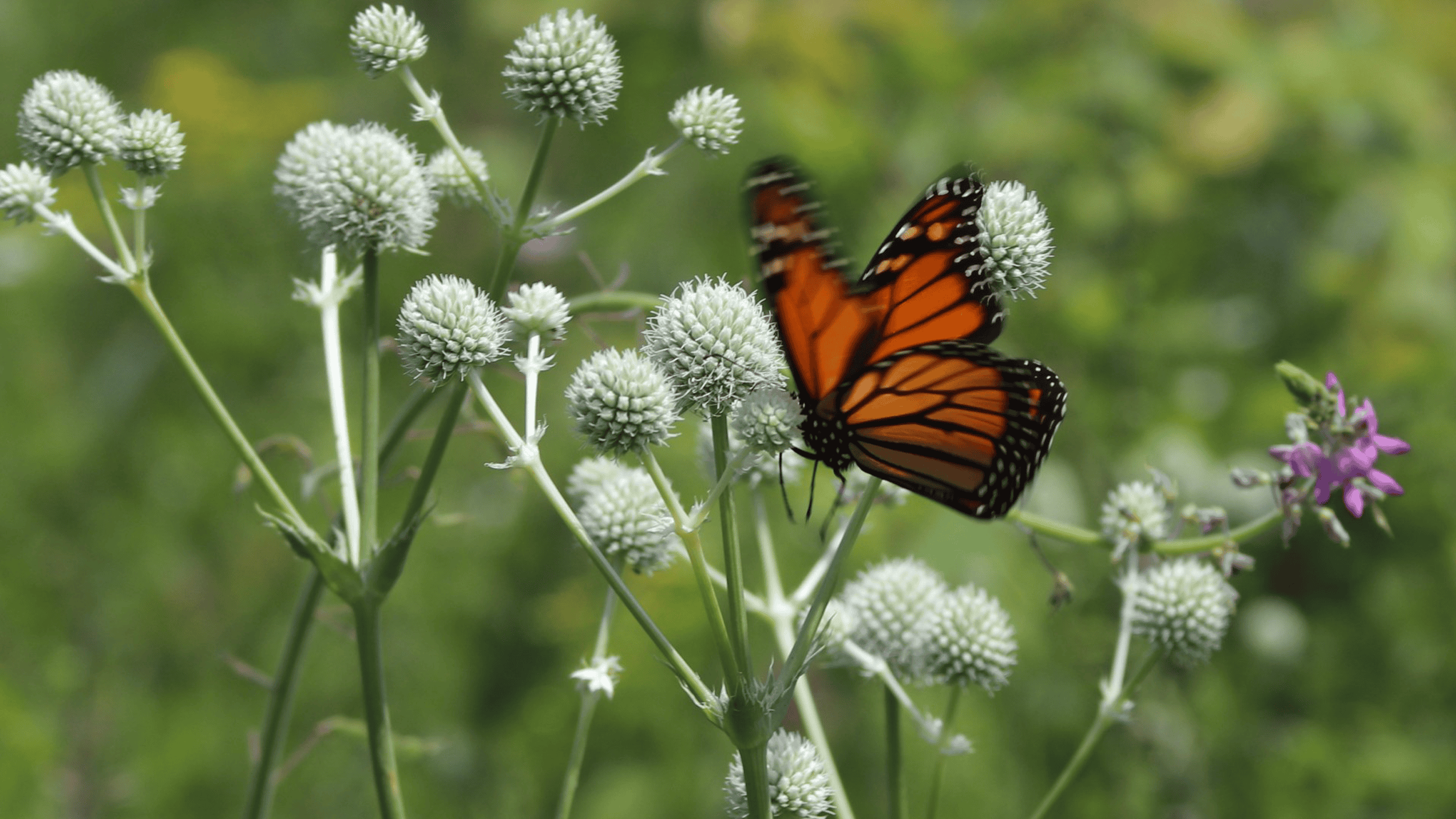
Monarch butterfly lands on rattlesnake master. Photo by Sue Steinmann.

As someone who spent nearly 40 years working as a Research Ecologist for the Wisconsin Department of Natural Resources, it is not surprising that a sighting of rattlesnake master piqued Rich’s interest. The fact that Sue and Bill took such a fervent interest in restoration work is what makes Rattlesnake Ridge such a success story. 

With help from Rich, the couple started making connections with community members who were also passionate about restoration work. They deepened their knowledge and brought others into their work at Rattlesnake Ridge. From Bill clearing cedar with one of his graduate students to Sue looking for grants through the Wisconsin DNR, they threw themselves into land stewardship. Bill put an incredible amount of work into the land and left his mark. Sue remarked, “He would just disappear for hours and say, ‘I’m going up to the prairie!’ He absolutely loved it.”

Sue and Bill eventually purchased the ridge top prairie from a neighbor, preventing the remnant prairie from being plowed and planted. They sold the property to The Prairie Enthusiasts in 2015 and were asked to stay involved as Site Stewards. Sue “of course” said yes;  however, she felt a little in over her head during the first few years of her new role. “So many preserve owners and chapter members are professionals from the DNR with an awful lot of experience,” Sue reflected. “Then come Bill and me, an artist and a horticulturist. I needed more guidance, and it took a long time for me to get confident.”  

A woman poses with several dishes of food.

Sue at home in Arena, hosting one of her famous thank-you dinners for volunteers and supporters. Photo by Beth Shannon.

According to Rich, Sue and Bill’s level of engagement was “unusual,” and was the biggest surprise to Rich as he approached Rattlesnake Ridge as a project. Despite Sue’s trepidation, she had a “knack for” stewardship. Rich said: 

Sue and Bill were very much good stewards. They took to what we were doing immediately. When you find landowners that are that engaged, that are asking questions, that’s great. Sue’s doing what we should be doing on all our sites, but we don’t always have stewards that have the interest or background or time commitment. She has thank-you events for all the volunteers and keeps reaching out through friends and connections and bringing people in who don’t even know The Prairie Enthusiasts. There’s a core group now of volunteers, either directly through The Prairie Enthusiasts or through personal connections of Sue’s, that have been brought together.

After 35 years of land stewardship, Bill Weege passed in 2020. Sue has continued on with restoration work and basks in the beauty that land stewardship brings. In the sand barrens, she experienced an eruption of lupine blooms after clearing a hillside of oak scrub. “It’s like magic,” she remarked. She has a fondness for butterfly milkweed in the sand barrens as well, and “can’t have enough purple prairie clover” on the ridge top prairie. 

The original acreage that The Prairie Enthusiasts purchased from Sue and Bill in 2015 covered 43 acres. In 2017, Sue and Bill helped The Prairie Enthusiasts acquire an additional 37 acres from a neighboring family, and in 2019, they donated another 16 acres that they bought from their neighbors.

The preserve that The Prairie Enthusiasts currently holds title on is 96 acres. Sue has another 100-plus acres that she’s working on. “It’s a pretty significant couple hundred acres there,” Rich said. “It goes down into the river valley system, with sand prairie and sand barrens from the sands along the Wisconsin River, so there’s a lot of intact habitat. There’s a lot of reptiles, like hog-nosed snakes and many more uncommon species; it’s great habitat.”

According to Rich, there’s a lot to be hopeful for in this work. Stewards are burning and clearing brush, allowing rare and endangered plants to thrive in the abundant sunlight. Rich remarked, “They can come back. It’s not all gone yet.”

Recently, Sue hosted a couple dozen supporters and volunteers for food and celebration on the property. As Rich pointed out, these gatherings are not unusual for Sue to host, underlining the joy and heart she brings to her role as a Site Steward.

When Sue and Bill first discovered they had purchased a prairie remnant back in 1985, they knew they were embarking on a special journey. sue said, “Bill and I always wanted to see the land get better and pass it on so people could enjoy it.” Through Sue and Bill’s efforts and community organizing, they have indeed achieved their mission.

Because of Sue and Bill’s decades of dedication, Rattlesnake Ridge can be enjoyed for generations to come. This habitat, like all prairies and oak savannas, will require continual stewardship, but the diversity of life there wouldn’t exist today without the couple’s care throughout the years. Bill and Sue may have started as mentees, but they became mentors. They have ignited relationships with the land and inspired a community of new land stewards, ensuring Rattlesnake Ridge will be cared for long into the future.

Anyone looking to help steward this property can contact Sue at ssteinmann6@gmail.com.

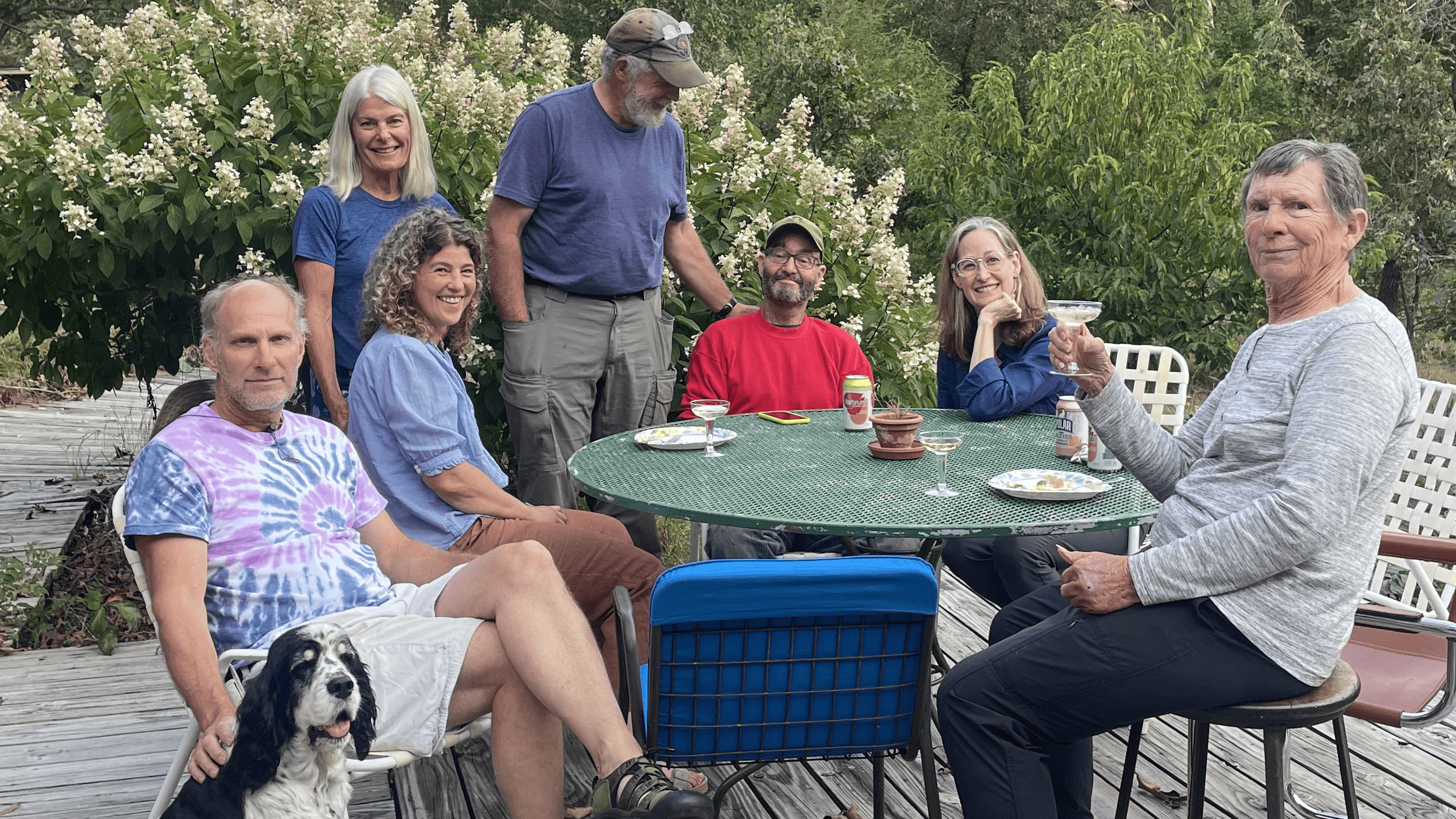
Seven people and a dog gathered around a table and smiling at the camera.

Rattlesnake Ridge supporters and volunteers gather for food and celebration on September 10, 2024. From left to right: Cupcake, Sue’s springer spaniel and Rattlesnake Ridge ambassador; Rob Baller, Prairie Enthusiast and volunteer; Darcy Kind, Wisconsin DNR Landowner Incentive Program (sitting); Sue Steinmann, Landowner and Site Steward; Jeb Barzen, Prescribed Burn Boss; Bill Moore, Land Manager and Burn Boss; Samantha Crownover, neighbor; Diane Iles, friend and supporter of Sue’s.

This article appeared in the Fall 2024 edition of  The Prairie Promoter, a publication of news, art and writing from The Prairie Enthusiasts community. Explore the full collection and learn how to submit your work here

Fifty Years of Fire: Stewarding Muralt Bluff Prairie

Fifty Years of Fire: Stewarding Muralt Bluff Prairie

Fifty Years of Fire: Stewarding Muralt Bluff Prairie

Story by Kysh Lindell, The Prairie Enthusiasts AmeriCorps Member
April 2, 2025

From left to right Fred Ochsner, Reynold Zeller, Jonathon Wilde, Deanne DeLaronde and John Ochsner manage the first burn at Muralt Bluff on April 13, 1975. Photo by Gary Eldred.

This April marks the historic 50th anniversary of the first prescribed burn on Muralt Bluff Prairie by early Prairie Enthusiasts—an event that would serve as a catalyst for grassroots prairie conservation in Wisconsin and beyond. But why revisit Muralt Bluff? What does this story have to teach us today?

In the early 1970s, two Albany, WI locals independently discovered a dry, bluff prairie remnant near their hometown in Green County. The site was part of an old cow pasture owned by the Muralt family and had been lightly grazed, but never plowed. Gary Eldred—a young outdoorsman who had previously hunted on the bluff—was working as a seasonal employee with the Wisconsin DNR at the time. While helping build the Sugar River State Trail, Gary grew intrigued by the rare and beautiful native plants he encountered in prairie remnants along the trail and soon blossomed into an amateur naturalist under the guidance of his Wisconsin DNR supervisor, Reynold Zeller. Gary spent much of his spare time traveling the backroads of Green County searching for prairie plants. It was the glowing blades of Indian grass and the curious purple spikes of blazing stars at Muralt Bluff that first drew him in, but the realization that these plants were a tangible connection to an ancient world kept him coming back.

John Ochsner, the son of a local cheesemaking family, met the Muralt Bluff prairie in a more unexpected way. Living just down the road from the property, John frequented the Muralt family’s farm on his milk route. One spring day in 1973, John spotted a group of college students and their professor—famed UW-Madison botanist Hugh Iltis—gathered for a field trip at nearby Abraham’s Woods State Natural Area. Tagging along out of curiosity, he followed as the group visited two UW Arboretum properties—Abraham’s Woods and Oliver Prairie—identifying native plants as they went. Fascinated, like Gary, by the presence of these unfamiliar plants so close to home, John repeatedly returned to Oliver Prairie to identify prairie plants. When he moved into the farmhouse at the base of Muralt Bluff that fall, he began to recognize some of the same native grasses and forbs he had come to know. To his delight, John had found another prairie remnant.

Professor Hugh Iltis (center) shows UW-Madison botany students a Pasque flower at Muralt Bluff in 1975. Photo by John Ochsner.

Journalist George Bachay and John Ochsner walk Muralt Bluff, 1974. Bachey was the outdoor writer for the Janesville Gazette for more than 20 years, providing early media coverage about Muralt Bluff and the importance of prairies. Photo by Gary Eldred.

Gary and John independently deepened their connection to Muralt Bluff until one serendipitous day in 1974 when the two happened to meet. Discussing their passion for prairie and Muralt Bluff, it became clear that they shared a mission: to protect the Muralt Bluff prairie, to help those fascinating plants thrive and to share this special place with others who could appreciate its value. Shared curiosity bled into a true prairie partnership as the two secured permission to manage the prairie from the landowners and began informal workdays at the site. Allies emerged from the local conservation community, including members of the Green County Conservation League and assorted friends. These newly fledged Prairie Enthusiasts felt called to act and transform Muralt Bluff with fire. And act they did.

On April 13, 1975, a small group gathered at the southeast corner, eager to coax a fire through this ancient prairie remnant for probably first time since early settlement. The crew consisted of Gary and John, Reynold Zeller, and friends Dan Hazlett, Jonathon Wilde, Deanne DeLaronde, Chuck Philipson, Tim and Peggy Hammerly, and John Ringhand. They were hardly the well-equipped, thoroughly trained burn crew you might meet at a burn today. Most had minimal knowledge or experience with burning, and their firefighting tools consisted of a few shovels, brooms, burlap sacks and two questionable water packs. But the rare chance to bring fire back to a prairie compelled swift action.

Intending only to conduct a test burn on a manageable 1/20th of an acre that day, the crew proceeded with little plan or pretense. John raked a thin line in the dry grass across the north end of the unit—a cursory firebreak—and Reynold unceremoniously dropped a match as the group stood leaning on their tools and chatting. Within thirty seconds, the southerly wind had carried the fire north and over the break, roaring uphill and toward the red cedars that dotted the slopes. “There she goes,” remarked Jon Wilde, and the crew scattered to respond.

Activity was panicked as the crew—and a few spectators—scrambled to contain the escaped fire. Snow shovels were pulled from the back of pickup trucks as makeshift flappers, and shirts and jackets shed in an attempt to swat out the flames. The fire raced through the grassy fuels, leaving a striking black scar and dramatically torching many of the cedars in its path. Terrifying on one hand, but practical on another: “I wasn’t really sure whether I should keep it going or put it out,” recalls Dan Hazlett. In seconds, the fire scorched many of the woody invasive plants that the group had been working to remove from the site.

Despite the initial mayhem, Jon Wilde managed the fire’s west flank well, and the fire soon ran out of fuel as the rest of the crew worked to tamp down the last of the flames. All told, the burn lasted just 20 minutes and consumed five or six acres. The only casualties were a few articles of clothing and $50 owed to the Monticello Fire Department, who had responded to a neighbor’s wildfire call after the burn had already been contained.

After an experience like that, would they ever burn again? “That was without question,” smirks Eldred in response, “we would just be more prepared.”

John Ochsner lighting a brush pile on the slopes of Muralt Bluff, February 1975. Photo by Gary Eldred.

From left to right: Dan Hazlett, Cliff Kohl, Fred Ochsner and Chuck Philipson extinguishing the last of the flames with unconventional tools. April 1975. Photo by John Ochsner.

What might have traumatized some exhilarated these self-described “prairie freaks.” A chaotic burn was still a burn—an essential, revitalizing process that the Muralt Bluff prairie had not experienced in a very long time. In that instant, the crew became committed to this place, as friends and as stewards. They were the first people since settlement who were willing to learn what this piece of land needed and able to put in the hard work to deliver it. They recognized the incredible history bound deep in the roots of these plants and their responsibility to care for that legacy. The burn was not a failure, but another chance at renewal.

Both the land and the local community responded to the fire remarkably well. As Gary remembers, the spring after that first burn “we had whole hillsides of shooting stars and blazing stars. The whole thing just responded to that fire like a huge breath.” Photos of the striking displays of native flowers and the enthralling story of the burn found their way into the local press thanks to several writers who were connected with the Muralt Bluff crew, including burn crew member Chuck Philipson who wrote for the newspaper in nearby New Glarus.

More than passing publicity, this effort to share the Muralt Bluff story became a grassroots public education campaign on the history and importance of prairies. Wielding a powerful combination of community connections and undeniable enthusiasm, the crew introduced local residents to native prairie plants and wildlife through stories and interviews, photos and illustrations, volunteer days and field trips. Some residents were encountering these native flora and fauna for the very first time in the local paper or on the slopes of Muralt Bluff. Others were renewing an interest in the flowers and insects they had once glimpsed in childhood, but lost sight of as southern Wisconsin’s prairies gave way to pasture, agriculture and development. Soon enough, one could almost guarantee that everyone in Green County had read or seen something about prairies, and many were on board with seeing them managed as prairies—even when that included the somewhat unfamiliar practice of prescribed burning.

By the summer of 1976, Prairie Enthusiasm proved contagious in Green County. Thanks to collaborative efforts to educate the public about prairies and advocate for the protection of this profoundly important natural area, members of the Green County Parks Committee paid a visit to Muralt Bluff to evaluate it for purchase. Thoroughly impressed by the prolific bloom of rough blazing stars and the Muralt Bluff crew’s dedication to caring for this piece of land, the Green County Board of Supervisors soon agreed to purchase and protect the 62.4-acre property using a combination of state and county funds.

An unusually spectacular bloom of blazing stars and goldenrods at Muralt Prairie, 1989. Photo by Gary Eldred.

Regal fritillary butterfly feeding on wild bergamot, 2017. Photo by Gary Eldred.

As with every site The Prairie Enthusiasts protect, the tale of Muralt Bluff does not end with the inked check. The success at Muralt Bluff spurred these and other early Prairie Enthusiasts to double down on their efforts to find and protect remnant prairies across the Upper Midwest, to form groups of volunteers dedicated to stewarding land and to keep spreading a passion for prairie. All the while, there stood Muralt Bluff—challenging its stewards to experiment, teaching them how to listen to the land and ever urging them to renew their shared commitment to this place.

Though the Green County Board originally assigned official stewardship responsibilities at Muralt Bluff to the Wisconsin DNR, members of the original burn crew and a growing core of Green County prairie-lovers remained the site’s most dedicated volunteers. Ownership of the site was transferred to The Prairie Enthusiasts in 2013, and the Prairie Bluff Chapter continues to steward Muralt Bluff today. Over the last 50 years, Muralt Bluff’s devotees have faced nearly every predicament familiar to prairie practitioners: invasions of sumac, cedar, cherry and plum, burn restrictions, funding challenges, conflicting management styles, disappearing flora and fauna and questions about when, where and how often to mow, cut, treat and burn on the prairie. While some issues could be solved with time, trial and lots of error, others proved mysteries.

While discouraging losses of rare prairie plants, insects and habitats have played out at Muralt Bluff over the years, so too have natural wonders that could renew the curiosity of even the most downtrodden Prairie Enthusiast. Following a drought in 1988, Muralt Bluff exploded in a profusion of rough blazing star (Liatris aspera) and showy goldenrod (Solidago speciosa) beyond belief. “I’ve been going up there for 50 years,” reminisces Gary, “I never knew that those plants were there. There’s hundreds and hundreds of them and they’re blooming, so that indicates they were mature plants. God knows how long those root systems have been lying dormant in that soil before the drought shook them up enough to sprout. I was absolutely flabbergasted. It’ll never look like that again in my lifetime, so what is the secret there? How long have those blazing stars been dormant?”

When you stick around long enough, as Muralt Bluff’s devotees have, prairies have a way of surprising you like this. A rare plant emerges, blooms once and folds itself back into the soil, never to be seen again by the same eyes. New grassland birds find tiny pockets of prairie in a sea of corn and soy, making themselves at home as if they have always lived there. Amidst extreme weather events and a rapidly changing climate, the prairie dips into its well of resilience and acts.

This and Muralt Bluff’s many other mysteries bring into focus our role as Prairie Enthusiasts: to recognize what we are losing, and the immense power of what we still have. “Your whole perspective on who we are and what we’re here for changes when you visit Muralt Bluff,” says Prairie Bluff Chapter volunteer Jerry Newman. To steward this place is to humbly return to it with respect, curiosity and wonder, putting in the difficult work to restore a place, all the while knowing that the prairie holds a wisdom much older than you. Like that first burn, prairie conservation is a chaotic, dynamic and deeply collaborative process. The important thing is to keep trying at it, even when the fire jumps your breaks.

In many ways, the Muralt Bluff story endures as the model for The Prairie Enthusiasts’ land protection efforts today. We understand that if we want to save the prairies around us, we must act, and we must do so holistically. Like those early Prairie Enthusiasts, we build trust with landowners and local communities. We share land management knowledge and take initiative to steward land, embracing uncertainty and failures. We connect people with prairies through field trips, work parties, education and art. We find creative ways to raise funds and collaborate with others to further our impact. We do not let our enthusiasm dwindle, even after 50 years. This is a resilient method of conservation because it depends, at its core, on people loving the land enough to want to protect it and make it better. This enthusiasm is alive and well at Muralt Bluff and everywhere there are prairie people, and that is something to celebrate.

20th anniversary of the first burn, 1995. From left to right: Tim Hammerly, John Ochsner, Peggy Hammerly, Gary Eldred, Dan Hazlett. Photographer unknown.

30th anniversary of the first burn, 2005. From left to right: Jonathon Wilde, Dan Hazlett, John Ochsner, Gary Eldred (front). Photographer unknown.

40th anniversary of the first burn, 2015. From left to right: John Ochsner, Dan Hazlett, Gary Eldred, Jonathon Wilde, Chuck Phillipson. Photographer unknown.

Invasive red cedar on fire during first burn, April 1975. Photo by Gary Eldred.

This article appeared in the Spring 2025 edition of The Prairie Promoter, a publication of news, art and writing from The Prairie Enthusiasts community. Explore the full collection and learn how to submit your work here

About The Prairie Enthusiasts 

The Prairie Enthusiasts is an accredited land trust that seeks to ensure the perpetuation and recovery of prairie, oak savanna, and other fire-dependent ecosystems of the Upper Midwest through protection, management, restoration, and education. In doing so, they strive to work openly and cooperatively with private landowners and other private and public conservation groups. Their management and stewardship centers on high-quality remnants, which contain nearly all the components of endangered prairie communities. 

Stability Part Three: Promoting Old Growth and Controlling Unwanted Vegetation Should Go Hand in Hand

Stability Part Three: Promoting Old Growth and Controlling Unwanted Vegetation Should Go Hand in Hand

Stability Part Three: Promoting Old Growth and Controlling Unwanted Vegetation Should Go Hand in Hand   

Story and Photos by Ecologist Dan Carter
April 2, 2025

Figure 1: Spring view of an area where glossy buckthorn (Frangula alnus) was removed the previous fall and winter. Little herbaceous vegetation remained beneath. What is visible here is a mix of species seeded immediately after brush work and opportunistic natives like burnweed (Erechtites hieraciifolius). Quaking aspen (Populus deltoides) was subsequently girdled. Here seeding, aspen girdling, prescribed fire, and targeted removal of unwanted vegetation (e.g., pulling and flaming of glossy buckthorn seedings, pulling of small Canada thistles, Cirsium arvense) are being combined in close sequence.  

This article is the third in a series on promoting stability—or perhaps doing the least damage to it—as we encourage and sustain old-growth prairie, savanna, and oak woodland sods. Prescribed fire1 and grazing2 were obvious topics that were addressed earlier, but the other management practices we use, particularly those that kill or remove excessive woody vegetation or invasive/aggressive herbaceous species, deserve attention. Removing unwanted species represents much of what we do in defense of fire dependent ecosystems. As with fire and grazing, its effects relate to physical parameters like nutrient availability, light, and microclimate, but those effects also relate to direct impacts to what we’re trying to save. Sometimes it just comes down to not injuring or killing the good stuff by accident.

Woody encroachment and many non-native herbaceous plants can destabilize old growth composition, structure, and ecological process if not addressed. They do this by altering light, water, nutrients, and air movement. Some species produce allelochemicals that cause local changes to vegetation. A good example of a species that alters most or all of those parameters is common buckthorn (Rhamnus cathartica), which casts excessive shade and produces emodin, a likely allelochemical. What I find more sinister is the microbial community associated with buckthorn3, which supports more free-living nitrogen fixing (diazotrophic) bacteria; these ensure that the buckthorn has a continual supply of nitrogen to fertilize the area under its canopy with its fast-decomposing (labile) leaf litter. The increased nutrient cycling and availability from leaf litter inputs of many problem species, woody4 and herbaceous5, are a big part of why intervention is needed. However, practices that remove unwanted vegetation usually create physical disturbance or leave behind excessive available nutrients in their wake. These wounds require mending, and their healing requires sustained care.

A common mistake is instead to assume that the ecosystem will heal on its own, either by natural dispersal or from the seed bank. Three inconvenient realities work against that hope. Opportunistic species (most herbaceous invasive species, sometimes “weedy natives” like tall goldenrod, Solidago altissima), many of which are problems in the communities we manage, are better at dispersing to open spaces where unwanted species have previously been removed. In many instances the landscape is too fragmented for old-growth-associated species to have any chance to get there, However, disturbed areas overrun with opportunistic species surround the places we care for. Second, physical conditions continue to be altered even after areas are daylit (e.g., nitrogen availability is greater), which further favors re-colonization by opportunistic species. Finally, many long-lived, old-growth-associated species do not persist in seed banks6,7, which means recovery in the wake of invasive species removal relies on remaining vegetative plants. Often when plants have persisted, they have not flowered and set seed for a long time, so use of heavy-handed management practices should not assume that the seed bank is an insurance policy, but I hear that exact claim or assumption again, and again! It is true that there are native species in the seed bank, including uncommon native species8 (especially where seed inputs are still ongoing), but flora that may lead to the restoration of ecological integrity9 do not reside where old growth vegetation has been suppressed or absent for any length of time.

Figure 2: Winter application of 20% triclopyr ester in mineral oil with basal dye by drip from a pump sprayer to a fresh glossy buckthorn stump in the areas shown in Figure 1. 

Figure 3: Representative late winter / early spring sap flow in a previously treated glossy buckthorn stump.  

Healing the damage caused by unwanted species requires integrating approaches that both control those species and actively promote the establishment and persistence of species associated with old growth. In cases where desirable species have been lost or gaps in desirable vegetation have been created in the wake of removing unwanted species, we should gather and broadcast seed or propagate and plant plugs. We can also ameliorate the excessive nutrient availability by facilitating the early establishment of species that produce relatively slow-decomposing litter (native grasses and sedges especially10), the decomposition of which requires microbes to draw more nutrients from the surrounding environment. Grassier and sedgier vegetation also allows us to reestablish flammability and volatilize excess nitrogen out of the ecosystem using frequent dormant fire. Finally, establishing grassy vegetation (and probably the vegetation of our restoration target community more generally) may slow re-invasion by providing competition for the seedlings of invasive species (e.g., buckthorn11), though I believe complementing the establishment of desirable vegetation with the use frequent fire is important for suppressing invasive species in the longer term. Removal of unwanted species ought to be combined with restoration of core ecological processes—by facilitating dispersal and using frequent dormant fire to promote and sustain conditions (low litter, low nitrogen availability) that allow species associated with old growth to establish and begin to stitch themselves back into a functioning ecosystem.

We often make faulty assumptions about how safe certain applications of herbicide are for ecosystems, but we can also do damage even when we follow herbicide labels to the letter. In old growth the use of herbicide should be very judicious. Where necessary, it should utilize only the most targeted applications of the chemicals that pose the lowest risk, either because they are the most selective or they can be applied in very targeted ways and do not tend to persist in or migrate through the soil. Do not assume that overspray from herbicide treatments in winter will not affect native vegetation, many old-growth-associated species maintain green tissues above ground that can be impacted. Assessment of that risk is where most mistakes happen. We need to start paying closer attention to and sharing accounts the collateral impacts treatments have.  I’ll describe and share photographs of a couple examples from my experience.

The first involves a degraded area where I oversaw the cutting and stump treatment of glossy buckthorn (Frangula alnus), common buckthorn and several other unwanted woody species in a dense thicket between late autumn and late winter. I applied 20% triclopyr ester, either in mineral oil with basal dye or basal oil with dye, to cut stumps using a hand-held pump sprayer on low pressure. This allowed me to carefully drip herbicide onto the cut stumps. Herbaceous vegetation was very sparse in the wake of clearing, so the area was seeded heavily with wild ryes (Elymus spp.) to quickly establish grassy cover. I also seeded conservative, old-growth-associated species appropriate for the site. In late February and very early March when the ground began to thaw and warm, I noticed that glossy buckthorn stumps, most treated weeks or months before, began oozing sap. None of the other treated species oozed sap in the same way. By midsummer it was obvious that treatment had effectively killed the buckthorn and other unwanted species. Nearly all treated stumps were dead, but around each glossy buckthorn stump was a dead zone where no herbaceous vegetation (including seedlings—even those of wild ryes) grew. While the extent of these dead areas and their impact was minor in this instance, the experience has made me wary of treating cut stumps with triclopyr ester in areas with high quality vegetation, especially where the density of treated stumps would be high. It will be worth investigating whether herbicides that are mixed with water (vs. oil) or applications made in summer that potentially have more time to kill stumps ahead of the following spring could produce fewer negative effects.

Figure 4: Broader cut-stump treatment area where damage to pointed-leaf tick-trefoil occurred. Ten years ago when this area was in the early stages of common buckthorn (Rhamnus cathartica) and gray dogwood (Cornus racemosa) invasion/encroachment, it supported a low woodland sod of false toadflax (Comandra umbellata, still visible), Pennsylvania sedge (Carex pensylvanica), poverty oats (Danthonia spicata), kittentails (Synthyris bullii), Carolina vetch, alumroot (Heuchera richardsonii), etc. In the wake of brush work, opportunistic species like woodland sunflowers (Helianthus spp.) and clonal goldenrods (Solidago spp.) are poised to increase unless other actions are implemented.  

Figure 5: Representative late July view of a treated glossy buckthorn stump with surrounding bare area inferred to be result of spring sap flow. Away from stumps seeded species as well as seed bank species like burnweed and biennial evening primrose (Oenothera biennis) grow. In this setting this collateral effect is probably acceptable, but in cases with remnant old growth-associated vegetation, it would not have been.  

Recently, I visited a site where several months prior 20% triclopyr ester in basal oil had been used to treat mostly common buckthorn cut stumps with a wick-type applicator. That treatment had been performed in the winter when there was a shallow layer of snow. Still, there was obvious damage to the herbaceous woodland and savanna vegetation, presumably from herbicide that had come in contact with the snow or moist soil and spread out, and probably also leached into the sandy soil without being immobilized or broken down by soil organic matter or microbial activity. Triclopyr has a relatively short half-life, but that half-life depends on temperature, moisture, and sun exposure. In summer we worry about volatilization of triclopyr ester and some other herbicides due to heat, but in winter reduced microbial activity and solar irradiance might allow herbicides more time to migrate to where they can cause damage, even if they are being applied in targeted ways.

In both cases I was surprised by the collateral effects. My own calculation of risk versus reward for my actions and the advice I offer changed. I urge readers to take a second look at practices that are often taken for granted. Don’t just track the efficacy of treatments against unwanted species; also monitor surrounding vegetation before and after treatment. Do areas that receive treatment continue to be problem areas? Perhaps there were collateral impacts to native vegetation that further destabilized the community, or perhaps additional types of care (e.g., seeding, monitoring for re-invasion, more fire) are needed to address underlying problems and get things on the right track. Last year on his Strategies for Stewards blog12 Stephen Packard offered the following wisdom:

“Is killing invasives our goal? Or restoring integrity and health to the ecosystem? Herbicides are needed. But herbicide treatments may solve one problem while ultimately not helping, or even making things worse. Restoration requires a wise overall plan with appropriate sequencing. The work then needs close oversight by someone who has a good working knowledge of the site’s ecology and the long-range impact of possible treatments.”

Figure 6: February view of green Carolina vetch, a conservative and old growth-associated species of oak woodlands that would have been vulnerable had late fall foliar spray of buckthorn or winter overspray or drip from basal or cut stump treatment occurred in its vicinity.  

Figure 7: Pointed-leaved tick-trefoil in the same area that was presumably impacted by herbicide dripped on snow during a winter, 2023 cut stump treatment.  

References

1 Carter, D. (2024). Stability part one: Why I recommend frequent dormant season burning. Prairie Promoter, Spring: 14-19. https://theprairieenthusiasts.org/stability-part-one/

2 Carter, D. (2024). Stability part two: Stability Part Two: Why I Seldom Recommend Grazing. Prairie Promoter, Summer: 12-17.  https://theprairieenthusiasts.org/blog_dan-carter/

3 Rodrigues, R. R., Pineda, R. P., Barney, J. N., Nilsen, E. T., Barrett, J. E., & Williams, M. A. (2015). Plant invasions associated with change in root-zone microbial community structure and diversity. PLoS One, 10(10), e0141424. (Shown in Rhamnus davurica, which is nearly identical to R. carthartica, similar ecologically, and also occurs in the Upper Midwest where it may often be mistaken for R. cathartica).

4 Ashton, Isabel W., et al. “Invasive species accelerate decomposition and litter nitrogen loss in a mixed deciduous forest.” Ecological Applications 15.4 (2005): 1263-1272.

5 Edwards, J. D., Cook, A. M., Yannarell, A. C., & Yang, W. H. (2022). Accelerated gross nitrogen cycling following garlic mustard invasion is linked with abiotic and biotic changes to soils. Frontiers in Forests and Global Change, 5, 1050542.

6 Schott, G. W., & Hamburg, S. P. (1997). The seed rain and seed bank of an adjacent native tallgrass prairie and old field. Canadian Journal of Botany, 75(1), 1-7.

7 Lamb, N., Havens, K., Holloway, J., Steffen, J. F., Zeldin, J., & Kramer, A. T. (2022). Low passive restoration potential following invasive woody species removal in oak woodlands. Restoration ecology, 30(4), e13568.

8 Abella, S. R., Hodel, J. L., & Schetter, T. A. (2020). Unusually high‐quality soil seed banks in a Midwestern US oak savanna region: variation with land use history, habitat restoration, and soil properties. Restoration Ecology, 28(5), 1100-1112.

9 Ecological integrity is the condition of an ecosystem where composition, structure, and function operate within the natural range of variation for that region.

10 These are an important element for restoring ecological processes like fire and nutrient dynamics, but so are some forbs and forbs should not be neglected, because they support much of the biodiversity.

11 Schuster, M. J., Wragg, P. D., Roth, A. M., Bockenstedt, P., Frelich, L., & Reich, P. B. (2025). Revegetation of Elymus grasses suppresses invasive Rhamnus cathartica in deciduous forest understories. Ecological Engineering, 210, 107438.

12Packard, Stephen. (2024) Destructive herbicide in the ecosystem. Strategies for Stewards blog. https://woodsandprairie.blogspot.com/2024/01/destructive-herbicide-in-ecosystem.html

This article appeared in the Spring 2025 edition of The Prairie Promoter, a publication of news, art and writing from The Prairie Enthusiasts community. Explore the full collection and learn how to submit your work here

About The Prairie Enthusiasts 

The Prairie Enthusiasts is an accredited land trust that seeks to ensure the perpetuation and recovery of prairie, oak savanna, and other fire-dependent ecosystems of the Upper Midwest through protection, management, restoration, and education. In doing so, they strive to work openly and cooperatively with private landowners and other private and public conservation groups. Their management and stewardship centers on high-quality remnants, which contain nearly all the components of endangered prairie communities.