
Keeping Prairies in the News
We are excited to share this Milwaukee Journal Sentinel article and the mention of The Prairie Enthusiasts below:
Wisconsin’s prairies shine in late summer, from Lapham Peak to the UW Arboretum
by Chelsey Lewis
Milwaukee Journal Sentinel
August 19, 2021
As August winds down, the flowers in my home garden are nearing the end of their seasonal lifespan.
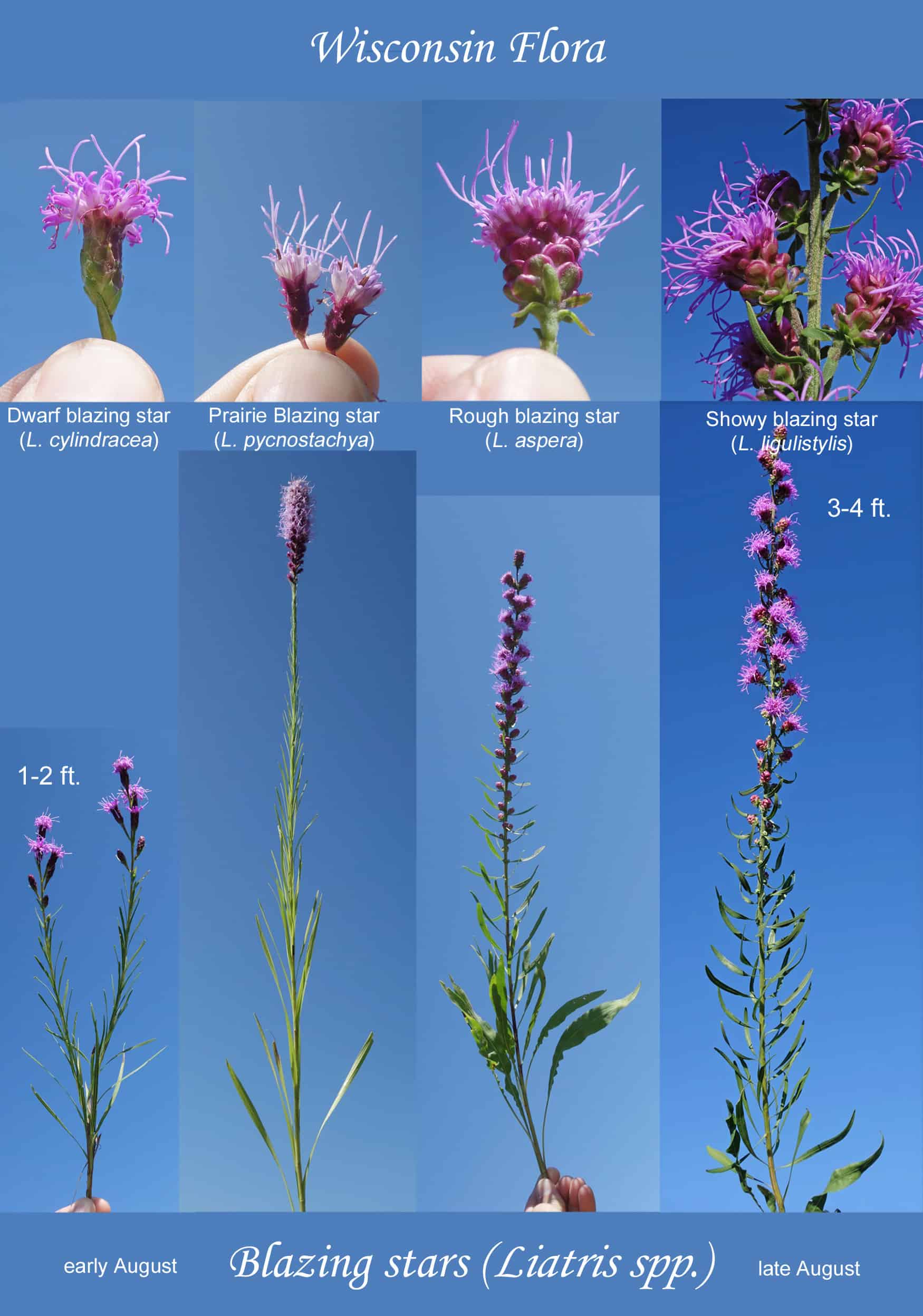
But here at Lapham Peak, yellow prairie dock and compass plant shoot into the sky, leaning toward the bright late-summer sun like miniature sunflowers. The goldenrod has just begun to bloom, its feathery yellow stalks peppering the hillsides. The wispy purple spikes of blazing stars are beginning to open, bees buzzing around them in search of pollen. A patch of black-eyed Susans are in full bloom, while a few yellow coneflowers hold on to their delicate yellow petals. Even the big bluestem grasses are getting in on the action, small buds emerging from the tips of their 6-foot-tall stalks.
I’ve missed the peak of wildflower season here, which usually comes in July, but late summer and fall are almost like a second spring for Wisconsin prairies, with a variety of colorful flowers blooming in August and head-high grasses reaching their apex before turning golden colors to complement the changing leaves.
This savanna might not have the flashy rock formations of Devil’s Lake, or the stunning sand dunes of Kohler-Andrae, but it’s one of my favorite places to hike in southern Wisconsin — not only because it’s not as popular as those places, but also because this landscape is so rare, and carries its own subtle beauty. I love that I can see the contours of the land, the big bluestem
grasses waving from the rolling hillsides in the late summer breeze. I love the little oak tree enclaves, like woodland oases in the middle of that sea of grasses. I love the almost comically tall prairie dock, its skinny stems trying to outreach those grasses in a quest for sunlight. The scattering of oaks here make this part of the park an oak savanna, a subset of prairies, which are landscapes populated by grasses, sedges (grass-like plants) and forbs (flowering plants). Prairies aren’t just pretty to look it and nice to walk through. They’re vital to species like American kestrels, bobolinks, sandhill cranes, eastern meadowlark, federally endangered Karner blue butterflies, bees and other pollinators.
They’re also vital to us. Prairie plants like big bluestem have deep root systems that filter groundwater and store carbon — the root systems are so extensive that they’ve been likened to underground forests. Prairies also create fertile soil for farming and grazing.
Prairies used to cover 2 million acres of Wisconsin, mostly in the southern part of the state. But as more settlers cleared the fertile land for farming, Wisconsin’s grasslands became a much rarer landscape. Today there are only about 12,000 acres left — less than .1% of the original landscape, according to the Wisconsin Department of Natural Resources.
Conservationists are working to reverse that trend and restore prairies, but as with most things when it comes to the environment, it’s not easy. Land where prairies flourished, especially in the southeastern part of the state, is heavily populated, fragmented and farmed today.
Plus, prairies need something dangerous to thrive that other landscapes — including human populated ones — don’t like: fire.
Fire reduces the leaf litter that accumulates in grasslands, allowing sunlight to penetrate and warm the soil, which increases microbial activity that releases nutrients to feed new plants as they grow. Fire also helps eliminate non-native and faster-growing species like maple trees, which overshadow prairie plants and slow-growing oaks.
Before Europeans arrived, American Indian tribes actively burned prairies to improve grazing for game species, for safety (in order to see enemies as they approached), and to make travel easier.
In the Curtis Prairie at the UW Arboretum in Madison, it’s easy to see why they burned prairies to make travel easier.
Eight-foot-tall big bluestem tickled my arms and legs as I walked along a narrow path cut through the prairie. Without the trail, walking and navigating would have been a challenge.
I emerged from the tall grasses and walked into another segment of the prairie that had been burned more recently, as evidenced by the barely knee-high grasses. At least a portion of the prairie has been burned nearly every year since 1950, making it the
oldest ecologically restored prairie in the world. That restoration work began even earlier than 1950. When the Arboretum was dedicated in 1934, work was already going on to establish representations of all of Wisconsin’s plant communities, from the
northern forests to the southern plains. A portion of the land that used to be a farm was set aside to become prairie, and the first plants were planted in 1935.
“That had never been done before. Nobody really knew how to do it,” said Michael Hansen, land care manager for the Arboretum.
Since nobody had attempted that kind of land restoration before, nobody knew how to manage things like invasive grasses, left over from the fallow farm field that was there before. University of Wisconsin-Madison botany professor John Curtis came up with the idea
of intentionally burning the prairie to kill the invasive plants. Other universities out west were doing fire research at the time, but theirs was mainly geared toward increasing forage for livestock grazing, Hansen said. The idea of using fire to restore a landscape to prairie was new. In 1940, the first experimental burn was held at the Arboretum.
“They were assuming those native prairie plants were adaptive to fire and would respond really well, and that was what happened,” Hansen said.
The success of the first fire led to more experiments, and in 1950, the Arboretum began landscape-wide burns — establishing prescribed fire as an effective method to restore and maintain prairies.
Today, prescribed burns are used to manage grasslands throughout the Midwest. Trained professionals intentionally set the fires in defined areas under specific conditions to meet certain land management objectives. They’re typically set in the early spring or late summer or fall. communities. … I think that’s good just from a resilience standpoint and living on. The results are the big bluestem grasses and federally endangered rusty patch bumblebee that are found in the Arboretum and the soaring prairie dock and honking sandhill cranes in Lapham Peak. A snapshot of what Wisconsin was before Europeans moved in. A snapshot worth preserving.
“(Prairies) are part of our natural heritage, especially in this part of the country. They help make all that good soil that was farmed. It’s the foundation of that whole industry,” Hansen said. “It played an important part in the history of our state, and the Great Plains in general. … I think that’s important to try and preserve like you would an old historic building or some other artifacts.
“We often refer to different parts of the Arboretum as a living museum. It’s a collection of what our state used to look like in terms of the plant healthy land. But also for a healthy mind, I think diversity is important, too. Having that accessible to people is important.”
Prairies in southern Wisconsin
Here is a sampling of prairie sites you can visit in southern Wisconsin. Many prairies are protected as part of state natural areas. To find more, visit dnr.wi.gov/topic/Lands/naturalareas.
Havenwoods State Forest, Milwaukee: Don’t let the forest in this site’s name throw you — much of the interior of this urban forest is prairie and wetlands. Six miles of trails wind through those landscapes; the main loop is open to pets.
Lapham Peak, Delafield: More than 5 miles of trails wind through prairie and oak savanna on the west side of Highway C. Access the
trails from the Evergreen Parking lot (carefully cross Highway C) or a small Ice Age Trail parking lot on South Cushing Park Road. Leashed pets are permitted.
Ice Age Trail Stony Ridge Segment, Eagle: This 3-mile segment of the Ice Age Trail passes through a patch of prairie just west of the Kettle Moraine State Forest’s southern unit headquarters on Highway 59. Look for goldenrod and prairie dock in late August. Find parking and access at the Emma Carlin trailhead on County Highway Z or the forest headquarters.
Bald Bluff, Kettle Moraine State Forest-Southern Unit, Palmyra: American Indians
used this open prairie site on a bluff for signal fires and ceremonial dances, according to the DNR. U.S. troops also camped at the site during the Blackhawk War — future presidents Abraham Lincoln and Zachary Taylor among them. Today a half-mile nature trail climbs the bluff then connects with the Ice Age Trail and travels through a prairie that the DNR is working to restore. Find a parking lot on County Highway H south of Palmyra. Because this is a nature trail, pets are not permitted. Pets are permitted on the Ice Age Trail.
Riveredge Nature Center, Saukville: Ten miles of trails wind through a variety of landscapes, including a 28-acre prairie named for Lorrie Otto, who founded the natural landscaping movement and helped lead the push to ban DDT in Wisconsin and the rest of the
country. The nature center also has an all-terrain wheelchair that’s available to borrow for free through Access Ability Wisconsin. Trail fees are $5 for adults and $2 for kids ages 3-12 (free for kids 2 and under).
Pope Farm Conservancy, Verona: This former farm features a handful of restored prairies, including tall grass, short grass and oak savanna. The conservancy has a pamphlet on its website that outlines a one-hour self-guided walking tour of the prairies. The conservancy is open from sunrise to sunset daily and is free to visit. Dogs are not permitted.
UW Arboretum, Madison: More than 300 native grasses, sedges and wildflowers grow in the 73-acre Curtis Prairie, the world’s oldest ecologically restored prairie. The prairie’s 8-foot-tall big bluestem and Indian grasses are especially beautiful in the fall. A handful of trails wind through the prairie, which is accessible via a parking lot on McCaffrey Drive south of the visitor center. The Arboretum is home to a few other grasslands, including the 47-acre restored Greene Prairie, the 14-acre Wingra Oak Savanna, and the 53-acre Southwest Grady Oak Savanna.
Military Ridge Prairie Heritage Area, Dane and Iowa counties: About 30 miles west of the Arboretum are the Thomson Memorial Prairie and the Barneveld Prairie, part of the 95,000-acre Military Ridge Prairie Heritage Area. The area contains 60 prairie remnants in Dane and Iowa counties — one of the highest concentrations of native grasslands in the Midwest. The DNR has recognized the area as being a high priority for protection and management, and together with the Nature Conservancy — which manages the Thomson and Barneveld prairies — and other nonprofits and government agencies, is working to do that. The 706-acre Thomson Memorial Prairie does not have any official trails (and poison ivy is abundant, according to the Nature Conservancy), but the 1,193-acre Barneveld Prairie does have a rough, unmarked trail. The prairie is home to rare grassland bird species including bobolinks, meadowlarks, dickcissels and vesper sparrows — all species of special concern in Wisconsin; and upland sandpipers, a state threatened species. Dogs are permitted but must be on a leash from April 1 through July 31.
Pleasant Valley Conservancy, Black Earth: Nearly every landscape native to southern Wisconsin, including oak savanna and dry and wet prairie, is present at this 143-acre state natural area. Tom and Kathie Brock began restoration work on the property in 1995, and it continues today with the support of The Prairie Enthusiasts, a Viroqua-based nonprofit. More than 300 flowering species have been documented at the site, including rare ones like purple milkweed. Trails that wind through the property are open to hiking; bicycles and dogs are not permitted.
Contact Chelsey Lewis at clewis@journalsentinel.com. Follow her on Twitter
at @chelseylew and @TravelMJS and Facebook at Journal Sentinel Travel.