Monitoring Bat Activity Following  Prairie Savanna Restoration

Monitoring Bat Activity Following Prairie Savanna Restoration

Monitoring Bat Activity Following Prairie Savanna Restoration 

Article and Photos by Robert J. Marquis, St. Croix Valley Chapter

March 3, 2025

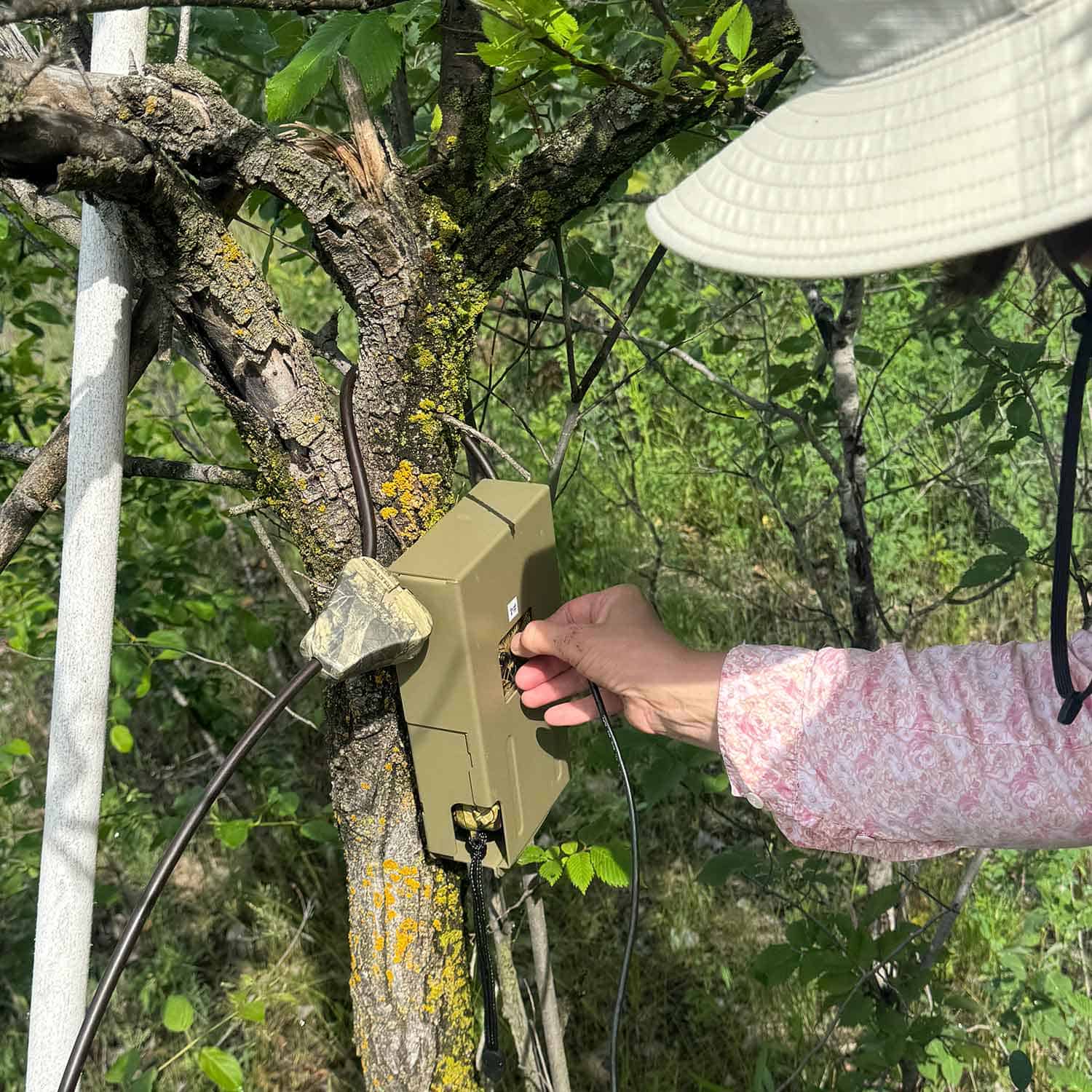
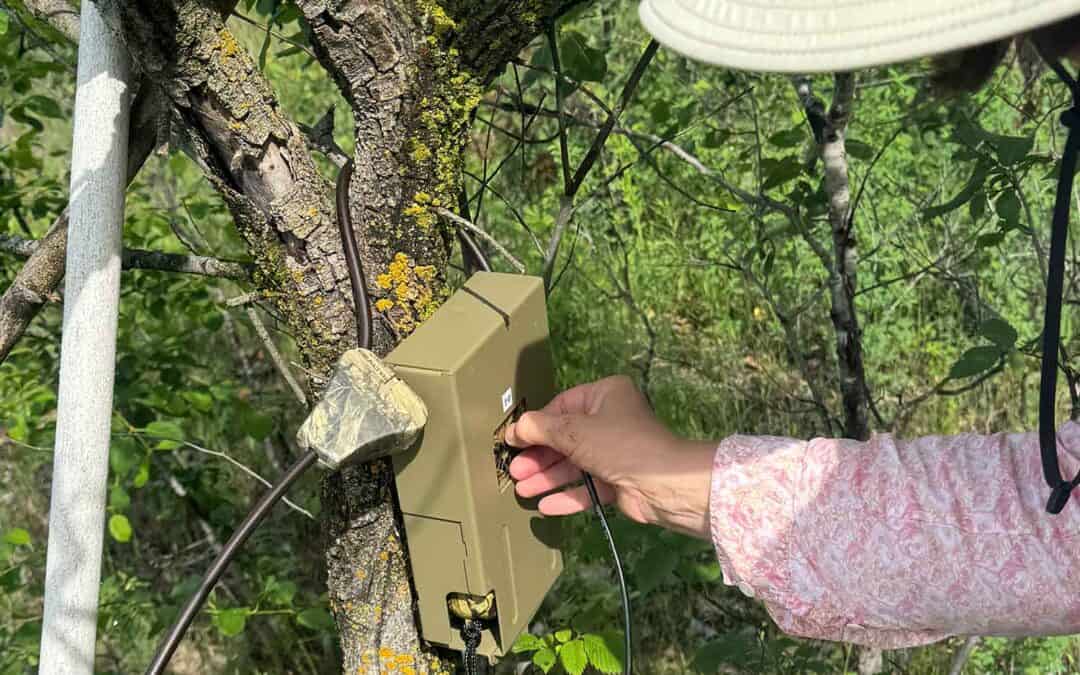
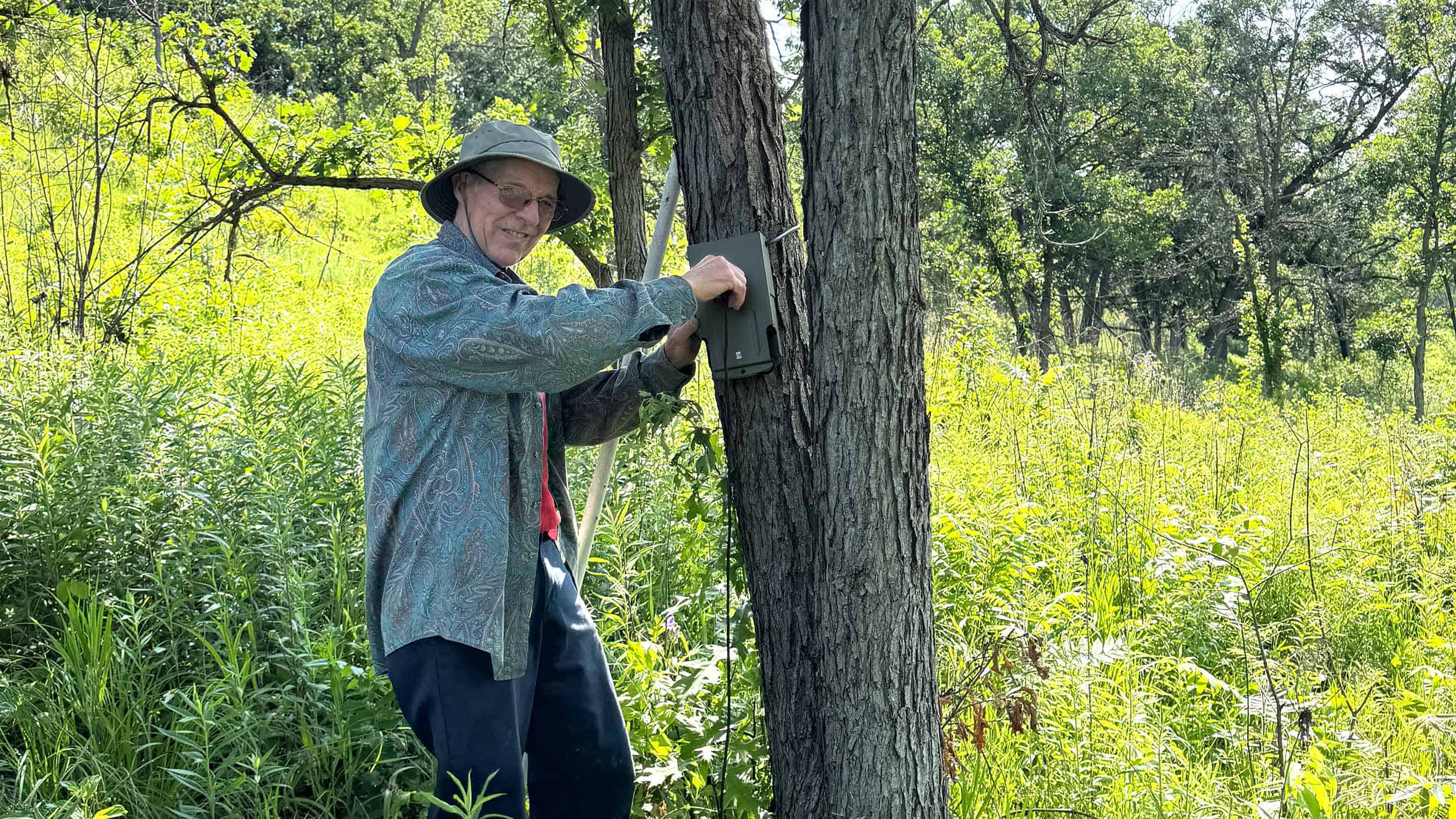
Volunteer Joe Fusilier placing a bat acoustic recorder on a tree to monitor bat activity at Alexander Oak Savanna, June 2025.

Bats Are In Trouble

Bats provide many important ecosystem services, including the control of crop insect pests.1 They may consume insects equal to 9-12% of their body mass in a single evening of foraging.2 Bat populations, however, have been declining due to habitat destruction, pesticides, collisions with windmills and, most recently and most precipitously, due to the white-nose syndrome. In response to increasing number of crop pest insects following predator release, farmers in the eastern U.S. have increased their use of pesticides. This has resulted in an average 7.9% increase in human infant mortality in counties that have experienced bat die-offs.3


We Collected Baseline Data in 2025

Bats use echolocation to find food, especially flying insects, and to avoid collisions with foliage and woody vegetation. There is mounting evidence that invasion of natural habitat by woody plant species can decrease activity of bats. If the invasive plants are tall and dense enough, the habitat can become too “cluttered” for bats to navigate, forcing them forage elsewhere. In June and August, 2025,  with the help of fellow Prairie Enthusiasts Denise Thiede, Joe Fusilier, Jay Arneson and Peter Leete, I used bat acoustic recording equipment to monitor activity of bats in Alexander Oak Savanna and in restoration plots along the Kinnickinnic River in River Hills Park in River Falls, WI. The goal was to collect baseline data on bat activity and species composition to understand how habitat restoration influences these important components of terrestrial ecosystems. 

Results at Alexander Oak Savanna

We placed four acoustic recorders in June at the Alexander Oak Savanna, a 42-acre parcel that has been the object of restoration efforts since 1999 by the St. Croix Valley Chapter. During the week of June 16, 2025, we recorded activity by four species of bats: big brown bats (threatened in Wisconsin), eastern red bats (species of special concern in Wisconsin), hoary bats (species of special concern in Wisconsin) and little brown bats (threatened in Wisconsin). 

Results at River Hills Park

In August of 2025, we placed acoustic recorders in four plots along the Kinnickinnic River in River Hills Park that had been cleared of “old growth” buckthorn (Rhamnus carthartica) and four neighboring control plots highly congested with buckthorn. Buckthorn had invaded the riverside approximately 50 years ago. Many of the buckthorn plants removed were 25-30 feet tall. We tested the hypothesis that buckthorn plants were tall enough and dense enough to reduce the ability of bats to navigate and to find food. This research appears to be the first experimental study to test the impact of invasive plant species removal on bat activity. In addition, there appear to be no previous surveys of bat activity along the entire Kinnickinnic River (C. Trosen, pers. comm.).  

Our initial data from the Kinnickinnic River plots show that all four species of bats found at Alexander Oak Savanna also occur along the river, but in addition, silver-haired bats were recorded in riverside plots. More importantly, our initial results show that bat activity was 2-5 times higher in plots from which buckthorn was removed compared to neighboring plots with intact buckthorn canopies. We will repeat surveys during the summer of 2026, with the goal of sampling throughout the summer and in an increased number of paired plots.  

Denise Thiede, St. Croix Valley Chapter volunteer, attaching a microphone cable to an acoustic bat recorder in River Hills Park, River Falls, WI. The recording equipment consists of a microphone on a five foot pole, attached by a microphone cable to the recorder, which is encased in a water proof box and cabled to a tree.

Bats Respond Positively to Restoration

This research is sponsored by the St. Croix Valley Chapter, the City of River Falls, the U.S. Fish and Wildlife Service, and tens of volunteers who helped remove buckthorn. Our approach is akin to that taking place across the planet in which bird response to habitat restoration is being monitored using song-recording equipment. 

Bats are a less obvious component of the natural landscape compared to birds, because bats are active when most humans are sleeping and make sounds mostly inaudible to us. However, bats are certainly no less important in their contribution to ecosystem services compared to birds; some studies show bats actually consume significantly more insects from leaf surfaces than do insectivorous birds at the same location.4,5 Our preliminary results suggest that efforts to restore prairies and savanna habitat in the Wisconsin-Minnesota region may increase bat activity and the ecosystem services that they provide. 


Thanks to Many Who Helped

We thank the U.S. Fish and Wildlife Service, St. Croix Wetland Management District, for the loan of their equipment; Veronica Bauer, Jill Utrup, Chris Trosen, and Alex Bouthilet for training, logistics, equipment loan, and recording analyses; Evanne Hunt for support and leadership; the City of River Falls, WI, for logistical and financial support; John Lampe for pointing out the New York Times article; and the many volunteers who helped clear buckthorn from experimental plots.

References

1. Frank, E.G., 2024. The economic impacts of ecosystem disruptions: Costs from substituting biological pest control. Science, 385: 6713.

 2. Kalka, M.B., Smith, A.R. & Kalko, E.K.V. 2008. Bats limit arthropods and herbivory in a tropical forest. Science 320: 71.

 3. Kunz, T. H., E. Braun de Torrez, D. Bauer, T. Lobova,
T. H. Fleming. 2011. Ecosystem services provided by bats. Ann. N. Y. Acad. Sci. 1223, 1–38.

4. Moiseienko, M. and Vlaschenko, A., 2021. Quantitative evaluation of individual food intake by insectivorous vespertilionid bats (Chiroptera, Vespertilionidae). Biology open, 10, p.bio058511.

 5. Williams-Guillén, K., Perfecto, I. & Vandermeer, J. 2008. Bats limit insects in a Neotropical agroforestry system. Science320: 70.

This article appeared in the Spring 2026 edition of The Prairie Promoter, a publication of news, art and writing from The Prairie Enthusiasts community. Explore the full collection and learn how to submit your work here

About The Prairie Enthusiasts 

The Prairie Enthusiasts is an accredited land trust that seeks to ensure the perpetuation and recovery of prairie, oak savanna, and other fire-dependent ecosystems of the Upper Midwest through protection, management, restoration, and education. In doing so, they strive to work openly and cooperatively with private landowners and other private and public conservation groups. Their management and stewardship centers on high-quality remnants, which contain nearly all the components of endangered prairie communities. 
Volunteer Spotlight: Gary Eldred

Volunteer Spotlight: Gary Eldred

Volunteer Spotlight: Gary Eldred

Article by Kay Wienke, Southwest Wisconsin Chapter Board Representative

November 17, 2025

Gary Eldred is the volunteer every organization yearns to have in their membership. He has spent 50 years of his life dedicated to prairie restoration and The Prairie Enthusiasts. He was instrumental in the discovery of the organization’s first prairie (Muralt Bluff Prairie), participated in the first burn there in 1975 and several since. He is also credited with helping to find and acquire  several other prairies for the organization. To discover prairie remnants, Gary has conducted surveys in over a dozen Wisconsin counties and three counties in Iowa.

His service on the ground is legendary. He served as site steward for several prairies at one time, conducting weekly work parties with an experienced group of volunteers. He served as President of the early Southwest Prairie Enthusiasts for its first five years. When the group became The Prairie Enthusiasts in 1993, he served as the organization’s President for 10 years. He continues to serve as Emeritus on the The Prairie Enthusiasts Board and regularly attends the Southwest Wisconsin Chapter meetings, presentations and workdays.

His artwork is an accurate, beautiful representation of nature and prairie species. In 1989, his drawing of a meadowlark on a fence became the organizational logo and continues to this day. Historically his art was sold at Chapter banquets to raise funds for the work of the organization.

All this work and dedication to prairies resulted in Gary Eldred being inducted into the Wisconsin Conservation Hall of Fame in 2021. Thomas Hunt, Southwest Wisconsin Chapter Member, describes him as “a renaissance man—artist, writer, scientist, organizer and leader.”

Gary indicates that when he had a job, it was to support his habit of discovering and preserving prairies. He has spent more hours than can be counted dedicated to prairies and The Prairie Enthusiasts. Gary Eldred is the example we can all strive to become! Thank you, Gary, for your lifelong service!

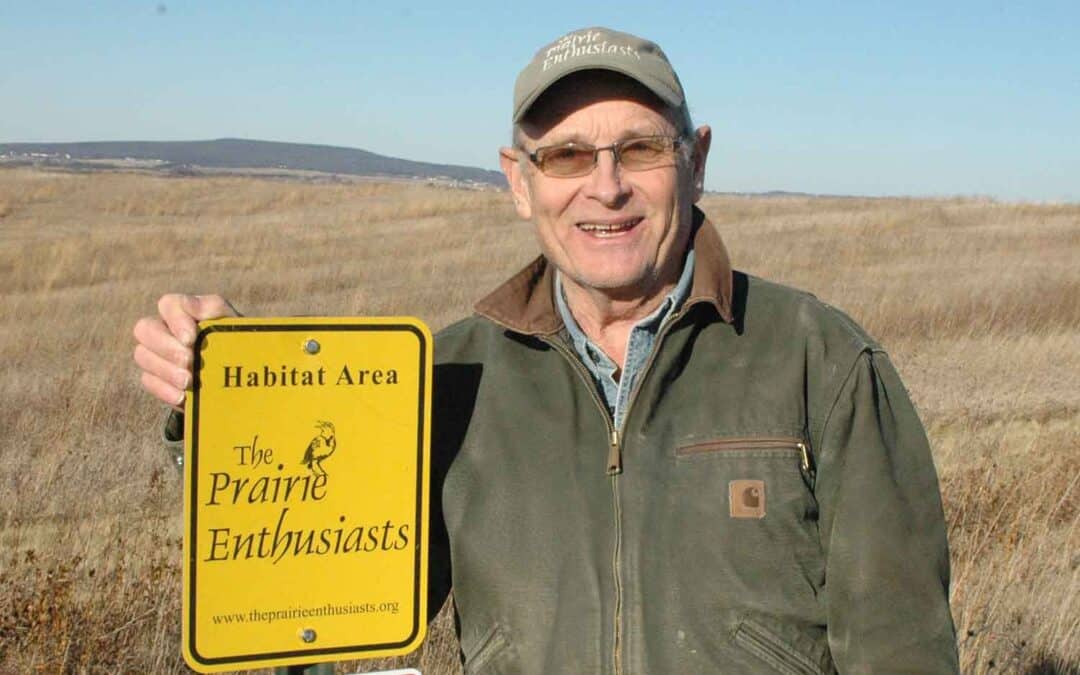
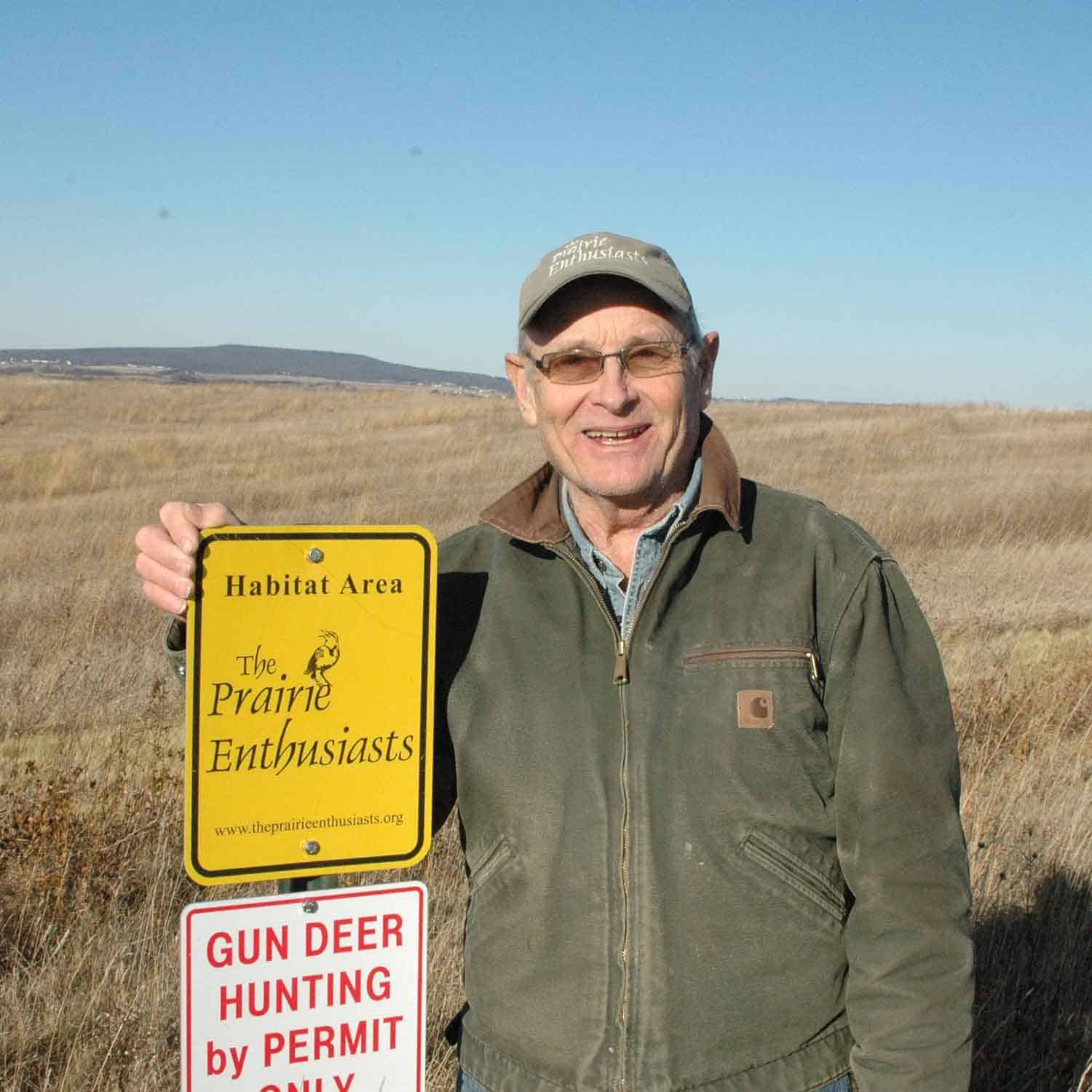
Gary Eldred standing by a boundary sign with the meadowlark illustration he created. Photo by Tim Eisele.

This article appeared in the Fall 2025 edition of The Prairie Promoter, a publication of news, art and writing from The Prairie Enthusiasts community. Explore the full collection and learn how to submit your work here

About The Prairie Enthusiasts 

The Prairie Enthusiasts is an accredited land trust that seeks to ensure the perpetuation and recovery of prairie, oak savanna, and other fire-dependent ecosystems of the Upper Midwest through protection, management, restoration, and education. In doing so, they strive to work openly and cooperatively with private landowners and other private and public conservation groups. Their management and stewardship centers on high-quality remnants, which contain nearly all the components of endangered prairie communities. 
How It’s Made: Parsnip Predators

How It’s Made: Parsnip Predators

How It’s Made: Parsnip Predators

Summer 2024 Chapter Update by Rebecca Gilman and Charles Harmon. Photos by Rebecca Gilman.

Nick Faessler, Jerry Newman, Den Oostdik, Chris Roberts, Fred Faessler and Tom Mitchell with a crate of finished Predators

What’s a Prairie Enthusiast to do when the skies of February turn gloomy? Members of the Prairie Bluff Chapter spent the short days of winter—as they have for years—producing the tool that tames the nightmare that is wild parsnip (Pastinaca sativa). 

If you’re lucky enough not to know it, wild parsnip is an aggressive invasive that spreads like wildfire and burns like it too. Handling the plant without proper protection can be dangerous. If an unsuspecting weed-puller gets sap from wild parsnip on their skin and the sap is then exposed to UV light, it causes phytophotodermatitis, or burn-like blisters. That’s the scenario that faced George and Kay Barry, stewards of a prairie planting at Honey Creek Park in Monroe, WI, in the early 1990’s. Presented with a field full of parsnip, Kay turned to The Prairie Enthusiasts for help. 

As chapter member Rob Baller recalls, “I contacted Mark Martin, (of the Wisconsin DNR), and asked how the State Natural Area crew treated parsnip. He told me that crew members sharpen spades, and on prairie remnants they jab the plant a couple inches from the base, angling the blade so it intercepts and slices the root an inch or two below-ground. Then, with gloves on, they pull out the severed plant. A parsnip with the root crown so severed will not resprout.” 

Rob took Mark Martin’s idea and ran with it, straight back to his workbench. Using scrap metal, the handle from an old snow shovel, and plenty of nuts and bolts, he fashioned the prototype of what we now call the “Parsnip Predator.” After trying it out, “Kay was all smiles,” Rob says.   “’Can you make more of these?’ she asked.”   

Rob turned to Nick and Fred Faessler and asked the brothers if they thought the tool could be put into mass production. Another chapter member, Julia O’Reilly, saw commercial potential in the tool and volunteered to be the implement’s first dealer. Nick and Fred retired to Nick’s shop and began experimenting. Eventually, they settled on a modified number two shovel with a notched blade as the best design. The tool allows users to cut the parsnip root crown and is strong enough to pry the parsnip out of the ground once severed.  (“Everyone wants to pry,” Rob notes.) 

Nick Faessler remembers that they made the first batch of 30 Parsnip Predators with no idea of whether or not any of them would sell. The predator was an instant hit, however. Over the years, the Prairie Bluff Chapter saw sales increase yearly and shipped the tool from coast-to-coast. Now sales and shipping are handled by The Prairie Enthusiasts awesome staff in Viroqua, with Prairie Bluff Chapter and the organization as a whole sharing the profits. 

Nick Faessler cuts Predator blades

Chris Roberts secures handles

This past February, a visitor to Nick’s shop witnessed what is now a well-oiled, Parsnip Predator assembly line. Nick begins the process by cutting a notched tip in the shovel’s blade with a plasma-cutter. At the next station, the rivets that attach the shovel’s handle to the blade are ground off so that the handle can be turned 90-degrees and carefully aligned. During the next step, a new hole is drilled in the handle and a bolt is inserted, tightened and ground downAnother group of volunteers then polishes the sharp edges on the blade and applies a protective coating of paint. The final step is to brand the handle of each shovel with the registered “Parsnip Predator” trademark. (The “Parsnip Predator” moniker was coined by Rob Baller’s landlord and adopted in lieu of another suggestion, “The Root Canaller.”) 

The group of volunteers on hand in Nick’s shop that day made the work look easy. But take it from that visitor who briefly wielded a power tool herself, crafting a Parsnip Predator is not as easy as it looks. Only through years of working together have the volunteers on hand that day—Nick Faessler, Chris Roberts, Billy Eisenhuth, Fred Faessler, Jackson Lancaster, Tom Mitchell, Todd Argall, John Ochsner, Steve Hubner, Den Oostdik and Jerry Newman—created a seamless system that was beautiful to behold.   

Over the years, sales of the Parsnip Predator have not only helped to eradicate a noxious invasive, they’ve also helped to preserve and protect the prairies we cherish. If you’re not already a proud owner of a predator, consider purchasing one today. Every Parsnip Predator is handmade in Wisconsin, with love. 

John Ochsner applies protective coats of paint

Den Oostdik grinds off the original bolts

This article appeared in the Summer 2024 edition of The Prairie Promoter, a publication of news, art and writing from The Prairie Enthusiasts community. Explore the full collection and learn how to submit your work here.

Positive Changes on Pleasant Bluff

Positive Changes on Pleasant Bluff

Positive Changes on Pleasant Bluff

Story by Eric Ressel, Minnesota Driftless Chapter volunteer 

Drone image of prescribed burn at Pleasant Bluff.

As I approached Pleasant Bluff, just south of Winona, MN, I asked myself if this was the same location I visited a few years earlier, since this hillside was once densely infested with an onslaught of buckthorn and encroaching eastern red cedars. Since then, the Minnesota Driftless Chapter of The Prairie Enthusiasts has contributed substantially to ecological restoration on this impressive prairie remnant. Over 18 acres along the spine of this formidable bluff, which sits above the banks of the Mississippi River, have been restored due to the diligent, hard work from folks like Gabe Ericksen, who has spent countless hours traversing the steep terrain to cut and remove the cedars, eradicate invasive brush, and implement numerous prescribed burns over the years. Gabe is a restoration practitioner through his contracting business, Land Spirit Design Landscaping, and he has been the tip of the restoration spear on Pleasant Bluff, assisted by the landowners and the Minnesota Driftless Chapter.

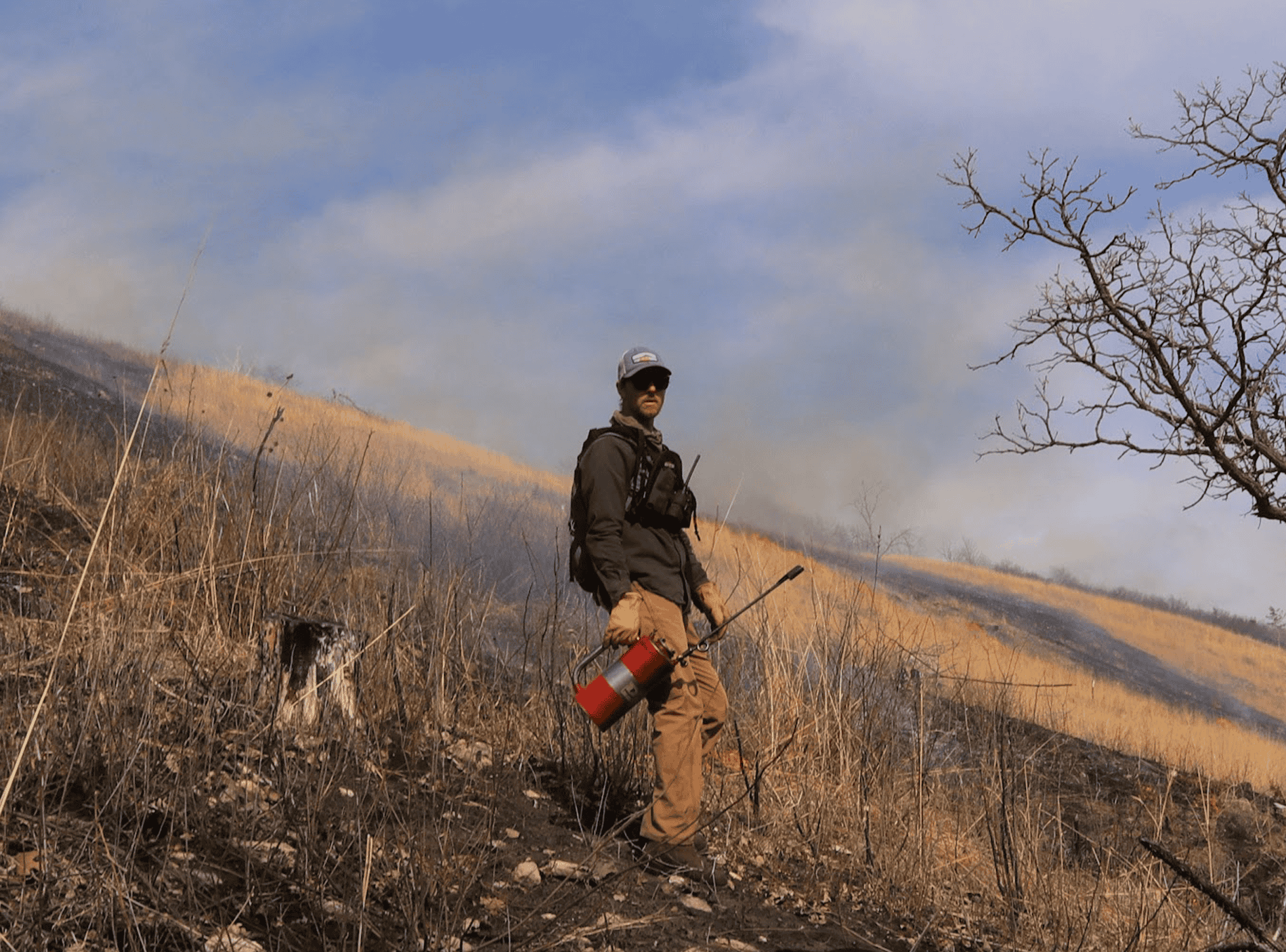
At a mid-March occasion in 2023, a diverse crew was assembled to assist Gabe with an 11-acre prescribed burn on this precipitous goat prairie. Thirty people of all ages and backgrounds, from children to seniors, joined together to conduct a safe and successful prescribed burn. Many of the participants were members of the Minnesota Driftless Chapter of The Prairie Enthusiasts, but many of the participants weren’t. A substantive way in which the Minnesota Driftless Chapter of The Prairie Enthusiasts contributed to the burn was by loaning the Chapter’s prescribed burn equipment to Gabe for the day’s burn.

The slope of this lofty bluff approaches 60% and is nothing short of intimidating. On this day, thanks to restoration efforts, the fuel-bed consisted primarily of native warm-season grasses and wildflowers, with some scattered pockets of shrubs. The climb up the mowed firebreak was grueling for the whole group. At the top, along the ridge overlooking the Mississippi River, Steve Winter having been designated as the burn boss by Gabe, provided the crew with an overview of why we burn such fire-dependent ecosystems, and he demonstrated fire behavior on steep terrain. He also highlighted numerous safety considerations, such as tumbling rocks and tripping hazards. Steve educated the group on the importance of clear communication, being familiar with the weather and environmental conditions, such as the optimal wind direction and humidity, and being aware of the safety zones and escape routes at this particular site. Once everyone confirmed they were comfortable implementing the burn, we broke into several smaller crews that were positioned along the ridge and others down the steep firebreak on the northwestern side. 


From the ridge we patiently waited for the progression of the fire from the ignition point, which was slow-going due to the calm conditions. My crew discussed strategy and stayed in contact with Steve and Gabe over the radio. We kept a careful watch as the gradually growing flames moved diagonally down the hillside. However, with barely a breeze the fire crept ever slowly, so Steve instructed me and fellow member Bill Hovell to ignite a shirt strip fire directly down the slope, which allowed the flames to spread more quickly in both lateral directions in the dense Indian grass (Sorghastrum nutans), side-oats grama (Bouteloua curtipendula), and little bluestem (Schizachyrium scoparium). Bill and I worked our way down the steep slope towards the county road on the lower edge of the prairie where we rendezvoused with our other crew members, whom I literally passed the torch to so they could get some ignition experience. It was in that moment that I watched my greener group members become less fearful, and more comfortable and excited to use fire as an ecological tool! 

In the meantime, another crew worked the line along the northern edge of the burn unit as the flames continued to consume the fuel down the slope. In the heat of the moment, the landowner, Paul Richards, was able to capture some stunning drone footage. I wondered what the children, who were positioned in a safety zone at the top of the ridge, and upwind from the fire, were thinking as they watched the fire grow from a safe distance. I’m sure this experience proved to be exhilarating, educational, and memorable for them. Along with the children, I hoped our new participants and the students that attended Steve’s burn school would also be inspired to continue with the restoration legacy. 

Volunteer Gabe Ericksen burning. Photo by Laurie Arzaga.

Our crew continued to walk along the lower edge. We eventually met up with Gabe and his partner, and we extended the line as far east as possible. As the heat intensified above us and behind us, we ducked down into the refuge of a safety zone represented by a buckthorn thicket, which had little flammable fuel on the ground, as the flames progressed through the portions of the burn unit. I turned around and gave a gleeful smile as the sweltering flames made contact with many stems of the aggressive woody plants that are constantly trying to establish in prairies such as the one we were burning that day. We then moved again to our county road safety zone farther below, which we followed back to meet the main group. Gabe once again targeted the buckthorn as he ignited the strip of vegetation along the roadside edge, allowing the fire to burn up the slope and make contact with many buckthorn stems. We allowed the fire to spread up the slope into a grove of old white oaks that will surely benefit from the fire with more space to stretch their limbs.

We met to start mopping up and to review the outcome of the successful burn. Most of the group members then left, but I was greatly impressed by those devoted enthusiasts who decided to stay well into the evening. Gabe and Josh Lallaman led this late-night effort, which was carefully supervised into the early morning hours, and they were able to effectively burn an additional 3-acre area. The night burn looked equally serene and intensely dramatic. To me, this illuminating scene was the perfect illustration of the power of fire. It showed why prescribed burning promotes creation through destruction, making it an essential tool to encourage natural rejuvenation and regrowth, which helps to maintain prairies and savannas by preventing their conversion to other vegetation communities. Once again, demonstrating that fire is the ultimate management method to set back undesirable invasive vegetation, while stimulating the growth and reproduction of native grasses and wildflowers.  

As I drove south to head home along the mighty river, I reflected on the progress of this goat prairie from its previous poor condition, choked by buckthorn, to a thriving, fully functional ecosystem that is driven and dependent on fire. Now this unique ecological community can thrive in the southwestern-facing sunshine, while supporting an array of rare plant and animal species. I contemplated the logistics and timeframe for completing restoration efforts on similar sites, since the majority of the goat prairies in the Driftless Area, along with associated oak savannas and woodlands, have become degraded in part because of altered fire regimes. I thought of the historic photos portraying a landscape where trees weren’t as abundant along the Mississippi River Valley. Those historic conditions were largely due to frequent landscape burning by Indigenous Peoples. As Indigenous Peoples were displaced by European Americans, Indigenous land stewardship practices like prescribed burning were also displaced. Fires were often viewed as harmful by European Americans, and woody vegetation increased greatly in the Driftless Area, including on Pleasant Bluff. With the increasing prevalence of woody vegetation, including invasive species such as buckthorn, we’re witnessing a correlated decline in health of rare plant communities and an overall decrease in plant diversity.

“It made me proud to be a part of such an ambitious chapter of like-minded, well-educated enthusiasts who are passionate about ecological restoration and conservation education.”

The Pleasant Bluff prescribed burn was just one example of how dedicated members of the Minnesota Driftless Chapter are eager to save ecosystems. Their tireless restoration work, outreach efforts and mentorship are also an inspiration for others. It made me proud to be part of such an ambitious chapter of like-minded, well-educated enthusiasts who are passionate about ecological restoration and conservation education.

I want to thank the Pleasant Bluff landowners, Paul and Melissa (Missy) Richards, for their ongoing involvement and enthusiasm for the restoration and management of Pleasant Bluff. Their commitment to conservation and stewardship of the beautiful bluff prairies, woodlands, and oak savannas on their Winona County property is exemplary. Missy summarizes the continual progress of their beloved prairie: “We have deep appreciation for all the collaborative work between The Prairie Enthusiasts volunteers, experts in the field, U.S. Fish and Wildlife Service and Land Spirit Design Landscaping. We recognize and appreciate being a part of something so much bigger than us. It gives us the opportunity to showcase the importance and impact of land restoration to our neighbors, family and friends. The ability to have a community partner with us on this journey makes Pleasant Bluff so much better.”


You, too, can follow their inspirational journey on the Richards’ Instagram page (@pleasantbluff_winonamn). Since the burn last spring, with help from Gabe, the Richards have continued their brush management efforts to lessen the buckthorn pressure across additional areas on the bluff. They have also documented dozens of native wildflowers on the bluff and often find new species. We encourage you to follow the Minnesota Driftless Chapter Facebook page to learn what additional prescribed burns and restoration efforts will take place.

I’ll be thrilled for the opportunity to return to this unique and productive dry bluff prairie to work once again with our devoted chapter members and these dedicated landowners, and to observe the positive and dynamic changes to this ecological gem along the river. On behalf of the Minnesota Driftless Chapter, we hope you can come join us.

Seven people and a dog gathered around a table and smiling at the camera.

Nighttime prescribed burn mop-up. Photo by Joshua Lallaman.

This article appeared in the Spring 2024 edition of  The Prairie Promoter, a publication of news, art and writing from The Prairie Enthusiasts community. Explore the full collection and learn how to submit your work here

Springtime Magic

Springtime Magic

Springtime Magic

Story and Art by Joe Maurer, Multimedia Artist, Chippewa Savannas Chapter Member

Dower Prairie Shooting Stars

Two springs ago, I got a call from Steve Hubner from the Prairie Bluff chapter. Joe you gotta get down here and see the blooms of these shooting stars.Steve specifically wanted me to create videos that would showcase the extravagant floral displays found in Butenhoff Prairie, Dower’s and Muralt Prairies, all of which had recently been burned earlier in spring of 2022.As is typical for me when I go to these landscapes, I tend to be a tad drifty. I am either hyper-focused on something or I want to see it all.A Prairie Enthusiast knows there really is no way to properly capture the life of the prairie. Its a highly personal experience.You just have to be there and let the landscape direct you.

Shooting with high frame rates to capture slow motion, I spent a lot of my time chasing queen bumblebees.With my camera on a long stick, I looked a bit like somebody with a metal detector obsession searching for treasures.Steve noticed my odd behavior and more than once remarked that I get overview shots to make sure people see and understand the expansiveness of the floral displays.”

When I got back home, I edited together footage that captured some of what I felt.The videos were good, but there was still another feeling I was trying to get to. In my restlessness to find that feeling, I printed out frames from the videos and taped them together on the walls of my art studio. I spent the next year and a half working on a dozen five-to-six-foot paintings derived from the film stills.I wanted that feeling of being at ground level where queen bees collect spring pollen and badgers forage.I am happy to share some of the outcomes of these efforts.   

My gratitude to Steve Hubner and Mary Zimmerman for the support during this project. Prairie Bluff and Southwest Chapters: thank you for keeping the magic alive in these landscape jewels we call prairies!   

Check out the videos mentioned in this article here:

Dower Prairie

Butenhoff Prairie

Muralt Prairie

To experience the magic of prairies firsthand, visit one of our protected sites.

This article appeared in the Summer 2024 edition of The Prairie Promoter, a publication of news, art and writing from The Prairie Enthusiasts community. Explore the full collection and learn how to submit your work here.

Dower’s Prairie

Nederland

Butenhoff Prairie 

Gentians of Eau Claire 

Enthusiasm for Restoration Proves Contagious on Rattlesnake Ridge

Enthusiasm for Restoration Proves Contagious on Rattlesnake Ridge

Enthusiasm for Restoration Proves Contagious on Rattlesnake Ridge

Story by Cassidy Coulson and David Myers, Chapter Support Staff

Colorful display of diverse plant life at Rattlesnake Ridge, including purple prairie clover and rattlesnake master. Photo by Sue Steinmann.

Many people in The Prairie Enthusiasts community have interesting tales to tell of chance encounters that result in new land protected, or that inspire someone to become a Prairie Enthusiast. The protection of Rattlesnake Ridge in Southern Wisconsin is just one of those stories

In the fall of 1984, Sue Steinmann and Bill Weege purchased 40 acres in Arena, WI with the intent of building a property on the land and being close to Madison where Bill taught at the University of Wisconsin-Madison in the art department and Sue attended graduate school for horticulture. They didn’t want that much property but needed enough acreage to obtain a building permit. Sue and Bill moved to the property in April. When they looked outside as spring brought blossoms to the sand barrens and the neighboring ridgetop prairie, they thought, “What the heck did we buy?!”

As the seasons progressed, Sue and Bill realized they were sitting on a prairie. “We knew what we had, but we had no experience in trying to preserve it or what we needed to do,” Sue said. “We just started reading and talking to friends.” 

With the unexpected ground cover of bird’s foot violet on Sue and Bill’s newly acquired property, they knew they needed to care for this rare place. Before moving to Arena, Sue and Bill had dabbled in conservation efforts. They met Gary Eldred and other members of The Prairie Enthusiasts, and they volunteered for the toad and frog survey for the state of Wisconsin. But this was a bigger mission they were being called to. They felt the drive to restore this rare habitat and ensure it kept thriving long into the future. 

It was Rich Henderson’s chance meeting with Sue Steinmann at the Madison farmers’ market in 1990 that ignited a decades-long commitment to prairie restoration. Sue was selling flowers at the market when Rich, a leader of The Prairie Enthusiasts and the Empire-Sauk Chapter, happened to notice that among her offerings was rattlesnake master (Eryngium yuccifolium). He asked Sue where she got them from. “They’re not very common,” Rich said. Sue explained that the plant grew on her property. It was this exchange that prompted Rich to ask if he could see her land. “She invited me out to Arena, and sure enough it was a remnant prairie,” Rich said. It was this meeting, and the uniqueness of rattlesnake master in Sue’s bouquets, that would eventually give Rattlesnake Ridge its name.

Monarch butterfly lands on rattlesnake master. Photo by Sue Steinmann.

As someone who spent nearly 40 years working as a Research Ecologist for the Wisconsin Department of Natural Resources, it is not surprising that a sighting of rattlesnake master piqued Rich’s interest. The fact that Sue and Bill took such a fervent interest in restoration work is what makes Rattlesnake Ridge such a success story. 

With help from Rich, the couple started making connections with community members who were also passionate about restoration work. They deepened their knowledge and brought others into their work at Rattlesnake Ridge. From Bill clearing cedar with one of his graduate students to Sue looking for grants through the Wisconsin DNR, they threw themselves into land stewardship. Bill put an incredible amount of work into the land and left his mark. Sue remarked, “He would just disappear for hours and say, ‘I’m going up to the prairie!’ He absolutely loved it.”

Sue and Bill eventually purchased the ridge top prairie from a neighbor, preventing the remnant prairie from being plowed and planted. They sold the property to The Prairie Enthusiasts in 2015 and were asked to stay involved as Site Stewards. Sue “of course” said yes;  however, she felt a little in over her head during the first few years of her new role. “So many preserve owners and chapter members are professionals from the DNR with an awful lot of experience,” Sue reflected. “Then come Bill and me, an artist and a horticulturist. I needed more guidance, and it took a long time for me to get confident.”  

A woman poses with several dishes of food.

Sue at home in Arena, hosting one of her famous thank-you dinners for volunteers and supporters. Photo by Beth Shannon.

According to Rich, Sue and Bill’s level of engagement was “unusual,” and was the biggest surprise to Rich as he approached Rattlesnake Ridge as a project. Despite Sue’s trepidation, she had a “knack for” stewardship. Rich said: 

Sue and Bill were very much good stewards. They took to what we were doing immediately. When you find landowners that are that engaged, that are asking questions, that’s great. Sue’s doing what we should be doing on all our sites, but we don’t always have stewards that have the interest or background or time commitment. She has thank-you events for all the volunteers and keeps reaching out through friends and connections and bringing people in who don’t even know The Prairie Enthusiasts. There’s a core group now of volunteers, either directly through The Prairie Enthusiasts or through personal connections of Sue’s, that have been brought together.

After 35 years of land stewardship, Bill Weege passed in 2020. Sue has continued on with restoration work and basks in the beauty that land stewardship brings. In the sand barrens, she experienced an eruption of lupine blooms after clearing a hillside of oak scrub. “It’s like magic,” she remarked. She has a fondness for butterfly milkweed in the sand barrens as well, and “can’t have enough purple prairie clover” on the ridge top prairie. 

The original acreage that The Prairie Enthusiasts purchased from Sue and Bill in 2015 covered 43 acres. In 2017, Sue and Bill helped The Prairie Enthusiasts acquire an additional 37 acres from a neighboring family, and in 2019, they donated another 16 acres that they bought from their neighbors.

The preserve that The Prairie Enthusiasts currently holds title on is 96 acres. Sue has another 100-plus acres that she’s working on. “It’s a pretty significant couple hundred acres there,” Rich said. “It goes down into the river valley system, with sand prairie and sand barrens from the sands along the Wisconsin River, so there’s a lot of intact habitat. There’s a lot of reptiles, like hog-nosed snakes and many more uncommon species; it’s great habitat.”

According to Rich, there’s a lot to be hopeful for in this work. Stewards are burning and clearing brush, allowing rare and endangered plants to thrive in the abundant sunlight. Rich remarked, “They can come back. It’s not all gone yet.”

Recently, Sue hosted a couple dozen supporters and volunteers for food and celebration on the property. As Rich pointed out, these gatherings are not unusual for Sue to host, underlining the joy and heart she brings to her role as a Site Steward.

When Sue and Bill first discovered they had purchased a prairie remnant back in 1985, they knew they were embarking on a special journey. sue said, “Bill and I always wanted to see the land get better and pass it on so people could enjoy it.” Through Sue and Bill’s efforts and community organizing, they have indeed achieved their mission.

Because of Sue and Bill’s decades of dedication, Rattlesnake Ridge can be enjoyed for generations to come. This habitat, like all prairies and oak savannas, will require continual stewardship, but the diversity of life there wouldn’t exist today without the couple’s care throughout the years. Bill and Sue may have started as mentees, but they became mentors. They have ignited relationships with the land and inspired a community of new land stewards, ensuring Rattlesnake Ridge will be cared for long into the future.

Anyone looking to help steward this property can contact Sue at ssteinmann6@gmail.com.

Seven people and a dog gathered around a table and smiling at the camera.

Rattlesnake Ridge supporters and volunteers gather for food and celebration on September 10, 2024. From left to right: Cupcake, Sue’s springer spaniel and Rattlesnake Ridge ambassador; Rob Baller, Prairie Enthusiast and volunteer; Darcy Kind, Wisconsin DNR Landowner Incentive Program (sitting); Sue Steinmann, Landowner and Site Steward; Jeb Barzen, Prescribed Burn Boss; Bill Moore, Land Manager and Burn Boss; Samantha Crownover, neighbor; Diane Iles, friend and supporter of Sue’s.

This article appeared in the Fall 2024 edition of  The Prairie Promoter, a publication of news, art and writing from The Prairie Enthusiasts community. Explore the full collection and learn how to submit your work here