by The Prairie Enthusiasts | Sep 27, 2020 | News
This article was a collaboration with Jeff Feece of Rochester Parks.
Prairie Crossing Park in Rochester, Minnesota is living up to its name as the park’s managers strive to restore native plants to the site. Members of TPE’s Minnesota Driftless Chapter joined the volunteer efforts there earlier this month.
Prairie Crossing is an 8.5-acre public park located on Rochester’s northern edge. Aerial photography indicates that the land was previously part of a farmstead containing 48 acres of oak savanna vegetation. This acreage was grazed on and off for decades until it was purchased for development in the 1990s. The park is all that remains of the native plant community there.
The City of Rochester acquired the park from the developer in 2005 as part of its Parkland Dedication Ordinance (which allows for the allocation of new park land as the city develops and grows). Currently, Prairie Crossing is a mixture of open-grown white and bur oaks with some dense stands of black cherry. Hackberry, basswood, and ironwood are also found on the site. When grazing ceased, invasive species such as European buckthorn and Asian honeysuckle began to dominate the understory, degrading the diversity of native plants and wildlife. However, the park is still both ecologically and culturally significant. It sits near several housing developments that would otherwise have no walking access to nature.

Restoration in progress at Prairie Crossing Park. Photo by Stephen Winter
Early in 2020, the Rochester Parks Department successfully applied for a grant through Minnesota’s Conservation Partners Legacy Grant Program to begin eradicating the invasive species, restore native vegetation, and develop the property as a “Nature Park”. The city is seeking to restore the plant community characteristic of an oak savanna. The park will be usable by people through a set of mowed walking trails and seating areas. In support of the grant application, the Minnesota Driftless Chapter of The Prairie Enthusiasts will contribute hours of in-kind volunteer labor. Areas where they will be especially helpful include vegetation surveys, management planning, and seed collecting and sowing.
More than a decade after its creation, the park is now jumping with activity! In May and June, members of the Zumbro Valley Chapter of the Audubon Society conducted bird surveys at the site. Plant surveys were completed by Joel Dunnette, a member of TPE. These surveys will be ongoing as the park develops. A sidewalk connecting the local neighborhood to the park was installed in June. In July, the Conservation Corps of Minnesota and Iowa began cutting and treating all that buckthorn.
On September 12th, seven members of the Minnesota Driftless Chapter joined with Conservation Corps volunteers to move the cut buckthorn into dozens of burn piles throughout the park. These volunteers got to know each other in the process, learning that many of them were from the greater Rochester area. They enjoyed hearing each other’s prairie and restoration stories and hope this is the start of a long and meaningful relationship between TPE and Prairie Crossing Park.

The brush piles grow with help from TPE members. Photo by Stephen Winter
Thanks to Jon Allen, Michelle Cochran, Ryan Kemmerick, Marsha Rea, David Ruff, Angela Smith, and Stephen Winter for their help! If you’re interested in lending a hand with this project, please contact Angela Smith at smithang1@gmail.com.

Volunteers after a day’s work. Photo by Stephen Winter
by The Prairie Enthusiasts | Sep 3, 2020 | News
Here’s a recap of Driftless Area phenology from the past month, written by our very own Pat Trochlell. Pat’s inspiration comes from her career as a wetland ecologist with the Wisconsin DNR. She and her husband, Ken Wade, live near and are stewards of TPE’s 30-acre Parrish Oak Savanna, a diverse woodland ecosystem of over 240 native species.
Follow our Facebook page to read Pat’s column once a week.
Chicken-of-the-woods (Laetiporus sulphureus) fungus. Photo by Pat Trochlell
6 August 2020
A cool morning this week is what saved us. Pulling invasive weeds along the side of the road, I noticed a perfectly round hole in the ground, about an inch in diameter. Soon I saw insects coming and going from this underground hole. It was a nest of yellowjackets, and the only reason we hadn’t been stung multiple times was that the cool temperatures made the resident insects slow.
Yellowjacket entering its nest hole. Photo by Pat Trochlell
At this time of year we are starting to see some very showy flowers in the wetlands. One of the “matrix” or dominant species of southern sedge meadows that is blooming now is spotted Joe-Pye weed (Eutrochium maculatum). The flowers can form a blanket of deep pink across low areas of the landscape. This species is associated with areas of groundwater springs or seeps. Where wetlands adjoin oak savannas, you can see a transition from the deeper pink of the wetland species to another species in the same genus.
Spotted Joe-Pye weed. Photo by Pat Trochlell
The woodland or purple Joe-Pye weed (Eutrochium purpureum) can also dominate the landscape in the nearby oak woodlands and savannas. The difference between these two species is fairly clear. Spotted Joe-Pye weed has spotted or purplish stems and a flatter, darker purplish flower head. Woodland Joe-Pye weed has greenish stems and a lighter pink, more domed flower cluster. As you walk through these areas, distinguishing between these two species can help you keep your feet dry.
Woodland Joe-Pye weed. Photo by Pat Trochlell
Have you ever wondered how invasive plants are spread? There are many vectors that can spread seeds and other plant propagules, including natural processes like wind and water. But people, vehicles, and animals can also be significant sources of spread. Those of you who work on invasive species removal can theorize how they are spread based on the plant growth patterns and locations where you see them. For instance, garlic mustard growing on a roadside was likely spread by mowing equipment. If it’s found at the base of a tree, that can indicate that a squirrel or raccoon was carrying seeds on its fur and a seed fell off when it climbed the tree.
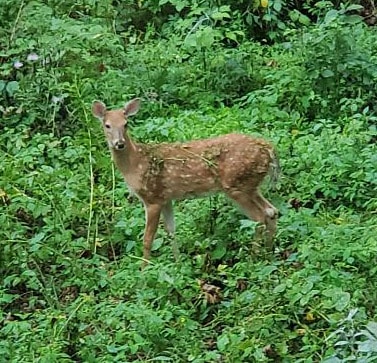
We often follow trails and deer paths when searching an area for garlic mustard and other invasive plants. But we rarely see the actual plant spread occurring. That is why it was particularly fortuitous to see two half-grown fawns with their coats covered by stickseed (Hackelia virginiana). While stickseed is a native plant, it is best to avoid, since the mature seeds are almost impossible to remove from clothes and dog fur.
Fawn covered with stickseed. Photo by Ken Wade
In addition to spreading invasive and undesirable plant seeds, we also know that higher deer numbers are associated with greater cover of invasive plants due to selective foraging. Deer will avoid eating garlic mustard but feed on other species, giving a competitive advantage to the invasive plants. We’ve anecdotally seen this as we watch the deer feed on native plants – including lilies and orchids – but eschewing garlic mustard and buckthorn.
Biologists and outdoor enthusiasts, like most of us TPE members, enjoy being outside observing nature. We tend to appreciate those aspects of nature that we can see and hear, like the bright yellow flowers of rosinweed (Silphium integrifolium) that is so dominant in the prairies now or the song of the cicadas or gray tree frogs from the tree canopy overhead.
Rosinweed glowing on the prairie. Photo by Pat Trochlell
But some species we rarely see. Many mammals are secretive or nocturnal, so we may not know they are present in an area unless we spot their dens, tracks or scat. For many small mammals, we don’t have a complete picture of their range or status. Trapping can be a key method for determining the presence and abundance of small mammals.
Small mammal trapping is usually done using a number of live traps which are set late in the day and checked the next morning. Animals are identified, measured and then released. A recent trapping survey at a TPE preserve yielded a number of individuals of several species of shrews, mice and voles. Several prairie voles (Microtus ochrogaster), were caught. The prairie vole is rare in Wisconsin, designated a State Special Concern species. Prairie voles are found in sand barrens and sand prairies, but also occurs in dry prairies, oak barrens and other dry habitat areas. Its preferred habitat seems to be native prairie sod, a rare habitat which is a target for TPE preservation and restoration efforts.
As we enjoy the late summer flowers, insects and birds on the prairie, consider the small mammals that are present but remain hidden in the grass. The special places we save also support many species we are just beginning to learn about.
Prairie vole during small mammal study. Photo by Pat Trochlell
Some flowering plants seem to attract insects more than others. One insect-attracting plant that is blooming profusely now is the cut-leaved coneflower (Rudbeckia laciniata). It’s also known as green-headed coneflower or by my favorite name, wild golden-glow. Masses of yellow flowers do seem to glow, particularly when seen growing on the edge of a shady wetland or forest edge, their favorite habitat. This species is in the same genus as black-eyed Susan, but they can grow up to 10 feet tall. They often spread by rhizome, creating large colonies.
When the flowers are in bloom they always seem to have a swarm of bees and other insects on and around them. They have been known to attract bees, wasps, butterflies, moths, some beetles and flies. Watch for the special flowers of golden-glow, which will continue to bloom for about another month.
Bumblebee on golden-glow. Photo by Pat Trochlell
by The Prairie Enthusiasts | Sep 2, 2020 | News
This article was a collaboration with Grace Vosen and is an update to an article in our August 2019 newsletter. Read the original piece here (navigate to page 5).
The New Ulm (Minnesota) area is seeing a renewed interest in prairie. Residents, and especially educators, are working to understand the history of prairies and to restore them on the landscape. Since 2017, TPE’s Many Rivers Chapter has been partnering with two local schools to create outdoor classrooms.
Our chapter has been tending to a 3/4-acre prairie planting at New Ulm’s middle school. After three growing seasons, we seem to have gained the upper hand on undesirable species left in the seed bank. This spring, Steven Gahm and I grew some seedlings and planted them in a corner of the plot that is easy to weed. We hope that these prairie plants will show passersby that the site is being tended. We also plan to re-seed the entire lot this fall.

Plant identification plot at New Ulm High School. Photo by Jim Vonderharr
Amber Gremmels, the middle school science teacher who initiated the project, has since become a member of TPE. She says that while it took hard work, the planting has played an important role in familiarizing her students with nature. “Many middle school students have the misconception that anything other than a lawn, purposefully planted garden, or landscape space is weeds,” says Amber. “My hope is that I scratch the surface as far as helping our youth understand ecosystem dynamics, and how decisions within a community impact those dynamics.” To date, Amber has used the planting for lessons in phenology, qualitative and quantitative nature observation, and edible plants.
Meanwhile, the high school prairie project looks very promising. In 2019, we worked with science teacher Matt Nelson to create plant identification plots in the learning space outside of his classroom. We planted 48 single-species plots of two feet by four feet. Because we used seedlings, this site is a ready-made display of prairie diversity. We also planted a variety of native shrubs and trees. A few were lost over the winter, but most still stand.
Both projects are off to a great start but have been slowed by CoViD-19. Students haven’t been at the schools since March, and student “sweat equity” was a big part of our plan to keep the plantings in working order. We will need to come up with a creative solution that considers the health of the students as well as the prairie.
We want to thank the New Ulm Chapter of the Izaak Walton League for helping us solve the problem of cost. Brad Gaard (also a TPE member) is our contact there who provided the funding. It should be noted that this group is in the process of developing a piece of prairie on their own property just outside of New Ulm. Thanks also to the TPE team working on these projects: Henry Panowitsch, Gary Rathman, Jim Lynch, and Jim Vonderharr. We hope to continue partnering with local institutions to make education a major goal of our operations.
 New Ulm High School’s outdoor classroom. Photo by Jim Vonderharr
by The Prairie Enthusiasts | Sep 2, 2020 | News
In 2019, the site stewards of Moely Prairie joined forces with Sauk Prairie High School to implement a summer internship program. Participants report to the prairie once a week and conduct monarch monitoring research. Not only are these exceptional students documenting meaningful data for scientists, but they are also learning about the need to preserve vanishing pollinator habitats.
 The interns head into Moely Prairie. Photo by Amy Chamberlin
The program had its start just two years ago. We at Moely were aware that monarch populations were dwindling, but I honestly didn’t know much about the specifics of their plight. In early 2018, I attended a presentation by Karen Oberhauser, monarch researcher and director of the University of Wisconsin Arboretum. She explained the myriad of reasons for the sharp decline of monarchs and spoke highly of a monitoring program that was collecting data on the species. This citizen science project was the Integrated Monarch Monitoring Program (IMMP).
Monarch monitoring and our work at Moely Prairie seemed perfectly aligned. Our restoration efforts at this remnant sand prairie in south-central Wisconsin was creating habitat for monarchs and other declining pollinators. Inspired by Dr. Oberhauser, my husband Rick and I began collecting data for IMMP that summer. We attended a local training session led by Jennifer Thieme of the Monarch Joint Venture. Soon after, we established our first monarch monitoring plot at Moely. That first year, we eased our way into the program by monitoring blooming plants and milkweed populations, both crucial for monarchs.
A generous grant from the Wisconsin Natural Resources Foundation allowed us to take on four interns in 2019. They were all students of Patrick Leigh, science teacher at Sauk Prairie High School. They conducted all levels of IMMP research. This included assessing nectar habitat, counting milkweed plants to inspect them for eggs or larvae, observing adult monarchs, and tracking parasitism.
 Monitoring monarchs at Moely. Photo by Amy Chamberlin
When our first “class” presented about their experience to the school district board in 2019, no one was prouder of them than me. As I listened to these young women talk about what they’d learned, I heard some of them say they were considering careers in science and research. Others were applying their experience to other conservation efforts, even growing native pollinator plants in their backyards.
The internship is now in its second year, largely supported by monetary donations from the local community. We’ve been fortunate to have a total of 8 students in the program since its inception. Some choose to bank volunteer hours, while others are earning science credit toward graduation. When their research ends in the fall, the students also complete presentations to various community groups, sharing the experience and knowledge gained from participating in the program.
Hands down, mentoring these students is my biggest motivation to stay involved with IMMP research. And even when the interns are done collecting data for the summer, we continue to collaborate with Sauk Prairie High School staff and administration. We, as land managers, are invited into science classrooms to give presentations about the biodiversity found in prairie ecosystems and the importance of preserving and restoring them. We also lead field trips and provide opportunities throughout the year for students to take part in hands-on restoration. These include their annual Day of Service, classroom initiatives, and our monthly work parties (where students often enlist the help of their families).
This theme of “planting seeds” of inspiration with kids and families has been a common thread woven into my career and persists even now in my retirement. Standing in the middle of a milkweed patch on a small remnant prairie in Prairie du Sac, I’m so grateful that I can continue to sow seeds with these future conservationists. For it is our young people that will carry our conservation torches forward — and to me, it’s the best investment any of us can make.

Monarch monitoring intern class of 2019 (above) and 2020 (below).
Photos by Amy Chamberlin
by The Prairie Enthusiasts | Aug 5, 2020 | News
This article was a collaboration with Pamela Eyden.
Motivated to reverse habitat loss and fragmentation, a team of private landowners (the Pleasant Valley Pollinator Corridor or PVPC Team) began this spring to work toward creating a pollinator corridor in Pleasant Valley outside Winona, Minn. These landowners have worked for many years to manage natural areas and establish native plantings on their own private properties. Creating a corridor of native habitats in the 10-mile long valley was a new step.
Restoring high-quality remnant bluff prairies and oak savannas has been an important focus. Gabe Ericksen, a longtime TPE member and owner of LandSpirit Design Landscaping, worked with the private landowners and the local Minnesota Driftless chapter of TPE to coordinate the restoration of 30 acres on Bluff Prairie. As the name suggests, this prairie is on a steep bluff that rises out of the hillside near the entrance to Pleasant Valley (see photo).
Trees and woody vegetation had encroached on the bluff; these were the first to go. The group is now re-vegetating the site with seed collected there, doing prescribed burns to manage the brush, and continuing work on the savanna below the prairie. They are also monitoring and documenting endangered species such as the rusty-patched bumblebee, endangered skipper butterflies, and race runner lizards.

Bluff Prairie at the entrance to Pleasant Valley. Photo by Gabe Ericksen
Here is a drone video of Bluff Prairie by Gabe Ericksen, taken during a spring burn in March 2020:
https://www.facebook.com/772973708/videos/pcb.10159401137478709/10159401134023709
Another view, from a workday in December 2019:
https://www.facebook.com/stephen.winter.395/videos/10159024455503709
The second focus is to add pollinator habitat on private homeowner properties throughout the valley. Led by Roberta Bumann, another TPE member and a Minnesota Master Naturalist, the team partnered with Healthy Lake Winona, a Winona-based nonprofit, to apply for a Lawns to Legumes Demonstration Neighborhood grant from the Minnesota Board of Water and Soil Resources in the spring of 2020. This Minnesota state-funded grant is available to nonprofit organizations to assist residential homeowners in creating native plantings. It aims to provide habitat for the endangered rusty-patched bumblebee (last sighted in 2018 in Pleasant Valley) and other at-risk pollinators. The PVPC Team is working with homeowners to install four types of plantings: pocket gardens, rain gardens, pollinator meadows in yards or along roadsides, and pollinator-friendly shrubs and trees. Round 1 began in the spring of 2020 and is reflected in the Project Map below. Round 2 will begin this fall with an end goal of forty residential homeowners receiving grant funds.
Besides financial assistance, the PVPC Team created resources to support the project. These include a high-diversity seed mix for meadow and roadside plantings and a native plant plan for pocket gardens that uses seeds and plants appropriate for the ecoregion. The Team recognized that education and community support are critical for homeowner success in establishing and maintaining native plant habitats. They set up a coach-led structure that uses PVPC Team members as coaches who meet with each homeowner to guide their project. They also created a website for the project at www.pvpollinators.com.
As of last month, four individual pocket gardens have been installed. More landowners are working on site preparation in advance of planting pollinator meadows this fall. The grant project will continue and be evaluated for five years.
In addition to Ericksen and Bumann, the PVPC Team is comprised of John Carrier (Wildlife Biologist), Kim Ericksen (Database Specialist), Pamela Eyden (Healthy Lake Winona), Amanda Gentry (Winona County Soil & Water Conservation District), John Howard (City of Winona Sustainability Coordinator), Joshua Lallaman (Biologist), and Kaitlyn O’Conner (Prairie Moon Nursery).
Corridors connect habitats, allowing for wildlife and plant movement. They can help reestablish populations in core habitats and after prescribed burns, help increase genetic diversity, and help create habitat large enough to sustain populations. Connecting the core habitats of the stream buffers, valleys, wooded hillsides, oak savannas, and bluff prairies in the Pleasant Valley watershed promotes the health and proper functioning of this Driftless Area ecological system. By restoring bluff prairie and oak savanna and adding pollinator-friendly habitat, the Pleasant Valley Pollinator Corridor project aims to restore and enhance the fire-dependent ecosystems in Pleasant Valley for the benefit of all living therein – pollinators, plants, wildlife, and people.
Check out more photos of the project below!

Pleasant Valley Pollinator Corridor project map. Map by Amanda Gentry
 Pollinator meadow in a valley bottom. Photo by Roberta Bumann
 Roadside pollinator meadow. Photo by Roberta Bumann

Planting a pollinator pocket garden. Photo by Gabe Ericksen

Monarch caterpillar on butterflyweed (Asclepias tuberosa). Photo by Roberta Bumann

Rusty-patched bumblebee on Culver’s-root. Photo by Gabe Ericksen
by The Prairie Enthusiasts | Aug 5, 2020 | News
The Many Rivers Chapter was recently featured on the Minnesota DNR’s Prairie Pod podcast. Chapter chair Henry Panowitsch represented TPE on the episode titled “A Legacy of Love for the Prairie Landscape: A Landowner’s Perspective.”
Henry kicks off the discussion by pointing out that “it’s never too late to do the right thing.” He shares some lessons learned from decades of volunteering and strategies to involve all generations in restoring the landscape. You will also hear what motivates Henry and his fellow Prairie Enthusiasts, and why he feels that “the ‘P’ in ‘prairie’ stands for ‘patience’.” Don’t miss it!

Henry Panowitsch at the Many Rivers Chapter’s solstice bonfire.
Photo by Steven Gahm