The Monarch Monitors

The Monarch Monitors

In 2019, the site stewards of Moely Prairie joined forces with Sauk Prairie High School to implement a summer internship program.  Participants report to the prairie once a week and conduct monarch monitoring research.  Not only are these exceptional students documenting meaningful data for scientists, but they are also learning about the need to preserve vanishing pollinator habitats.

The interns head into Moely Prairie. Photo by Amy Chamberlin

The program had its start just two years ago.  We at Moely were aware that monarch populations were dwindling, but I honestly didn’t know much about the specifics of their plight.  In early 2018, I attended a presentation by Karen Oberhauser, monarch researcher and director of the University of Wisconsin Arboretum.  She explained the myriad of reasons for the sharp decline of monarchs and spoke highly of a monitoring program that was collecting data on the species.  This citizen science project was the Integrated Monarch Monitoring Program (IMMP).

Monarch monitoring and our work at Moely Prairie seemed perfectly aligned.  Our restoration efforts at this remnant sand prairie in south-central Wisconsin was creating habitat for monarchs and other declining pollinators.  Inspired by Dr. Oberhauser, my husband Rick and I began collecting data for IMMP that summer.  We attended a local training session led by Jennifer Thieme of the Monarch Joint Venture.  Soon after, we established our first monarch monitoring plot at Moely.  That first year, we eased our way into the program by monitoring blooming plants and milkweed populations, both crucial for monarchs.

A generous grant from the Wisconsin Natural Resources Foundation allowed us to take on four interns in 2019.  They were all students of Patrick Leigh, science teacher at Sauk Prairie High School.  They conducted all levels of IMMP research.  This included assessing nectar habitat, counting milkweed plants to inspect them for eggs or larvae, observing adult monarchs, and tracking parasitism.

Monitoring monarchs at Moely. Photo by Amy Chamberlin

When our first “class” presented about their experience to the school district board in 2019, no one was prouder of them than me.  As I listened to these young women talk about what they’d learned, I heard some of them say they were considering careers in science and research.  Others were applying their experience to other conservation efforts, even growing native pollinator plants in their backyards.

The internship is now in its second year, largely supported by monetary donations from the local community.  We’ve been fortunate to have a total of 8 students in the program since its inception.  Some choose to bank volunteer hours, while others are earning science credit toward graduation.  When their research ends in the fall, the students also complete presentations to various community groups, sharing the experience and knowledge gained from participating in the program.

Hands down, mentoring these students is my biggest motivation to stay involved with IMMP research.  And even when the interns are done collecting data for the summer, we continue to collaborate with Sauk Prairie High School staff and administration. We, as land managers, are invited into science classrooms to give presentations about the biodiversity found in prairie ecosystems and the importance of preserving and restoring them.  We also lead field trips and provide opportunities throughout the year for students to take part in hands-on restoration.  These include their annual Day of Service, classroom initiatives, and our monthly work parties (where students often enlist the help of their families).

This theme of “planting seeds” of inspiration with kids and families has been a common thread woven into my career and persists even now in my retirement.  Standing in the middle of a milkweed patch on a small remnant prairie in Prairie du Sac, I’m so grateful that I can continue to sow seeds with these future conservationists.  For it is our young people that will carry our conservation torches forward — and to me, it’s the best investment any of us can make.

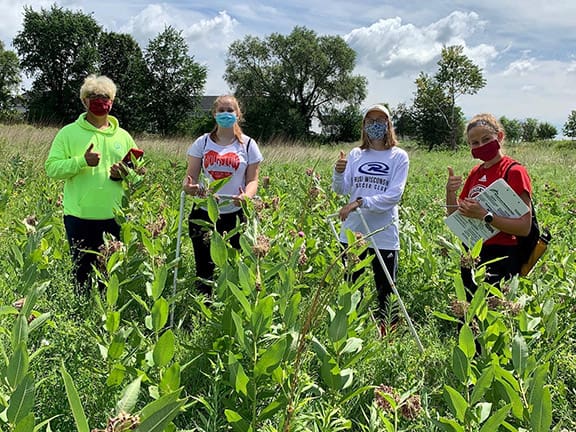
Monarch monitoring intern class of 2019 (above) and 2020 (below).

Photos by Amy Chamberlin
2020_Monarch_Interns_1_by_Amy_Chamberlin.jpg

The Monarch Monitors

Pleasant Valley Pollinator Corridor

This article was a collaboration with Pamela Eyden.

Motivated to reverse habitat loss and fragmentation, a team of private landowners (the Pleasant Valley Pollinator Corridor or PVPC Team) began this spring to work toward creating a pollinator corridor in Pleasant Valley outside Winona, Minn. These landowners have worked for many years to manage natural areas and establish native plantings on their own private properties. Creating a corridor of native habitats in the 10-mile long valley was a new step.

Restoring high-quality remnant bluff prairies and oak savannas has been an important focus. Gabe Ericksen, a longtime TPE member and owner of LandSpirit Design Landscaping, worked with the private landowners and the local Minnesota Driftless chapter of TPE to coordinate the restoration of 30 acres on Bluff Prairie. As the name suggests, this prairie is on a steep bluff that rises out of the hillside near the entrance to Pleasant Valley (see photo).

Trees and woody vegetation had encroached on the bluff; these were the first to go. The group is now re-vegetating the site with seed collected there, doing prescribed burns to manage the brush, and continuing work on the savanna below the prairie. They are also monitoring and documenting endangered species such as the rusty-patched bumblebee, endangered skipper butterflies, and race runner lizards.

Bluff Prairie at the entrance to Pleasant Valley. Photo by Gabe Ericksen 

Here is a drone video of Bluff Prairie by Gabe Ericksen, taken during a spring burn in March 2020:

https://www.facebook.com/772973708/videos/pcb.10159401137478709/10159401134023709

Another view, from a workday in December 2019:

https://www.facebook.com/stephen.winter.395/videos/10159024455503709

The second focus is to add pollinator habitat on private homeowner properties throughout the valley. Led by Roberta Bumann, another TPE member and a Minnesota Master Naturalist, the team partnered with Healthy Lake Winona, a Winona-based nonprofit, to apply for a Lawns to Legumes Demonstration Neighborhood grant from the Minnesota Board of Water and Soil Resources in the spring of 2020. This Minnesota state-funded grant is available to nonprofit organizations to assist residential homeowners in creating native plantings. It aims to provide habitat for the endangered rusty-patched bumblebee (last sighted in 2018 in Pleasant Valley) and other at-risk pollinators. The PVPC Team is working with homeowners to install four types of plantings: pocket gardens, rain gardens, pollinator meadows in yards or along roadsides, and pollinator-friendly shrubs and trees. Round 1 began in the spring of 2020 and is reflected in the Project Map below. Round 2 will begin this fall with an end goal of forty residential homeowners receiving grant funds.

Besides financial assistance, the PVPC Team created resources to support the project. These include a high-diversity seed mix for meadow and roadside plantings and a native plant plan for pocket gardens that uses seeds and plants appropriate for the ecoregion. The Team recognized that education and community support are critical for homeowner success in establishing and maintaining native plant habitats. They set up a coach-led structure that uses PVPC Team members as coaches who meet with each homeowner to guide their project. They also created a website for the project at www.pvpollinators.com.

As of last month, four individual pocket gardens have been installed. More landowners are working on site preparation in advance of planting pollinator meadows this fall. The grant project will continue and be evaluated for five years.

In addition to Ericksen and Bumann, the PVPC Team is comprised of John Carrier (Wildlife Biologist), Kim Ericksen (Database Specialist), Pamela Eyden (Healthy Lake Winona), Amanda Gentry (Winona County Soil & Water Conservation District), John Howard (City of Winona Sustainability Coordinator), Joshua Lallaman (Biologist), and Kaitlyn O’Conner (Prairie Moon Nursery).

Corridors connect habitats, allowing for wildlife and plant movement. They can help reestablish populations in core habitats and after prescribed burns, help increase genetic diversity, and help create habitat large enough to sustain populations. Connecting the core habitats of the stream buffers, valleys, wooded hillsides, oak savannas, and bluff prairies in the Pleasant Valley watershed promotes the health and proper functioning of this Driftless Area ecological system. By restoring bluff prairie and oak savanna and adding pollinator-friendly habitat, the Pleasant Valley Pollinator Corridor project aims to restore and enhance the fire-dependent ecosystems in Pleasant Valley for the benefit of all living therein – pollinators, plants, wildlife, and people.

Check out more photos of the project below!

Pleasant Valley Pollinator Corridor project map. Map by Amanda Gentry

    Pollinator meadow in a valley bottom. Photo by Roberta Bumann

                                                                                        Roadside pollinator meadow. Photo by Roberta Bumann

Planting a pollinator pocket garden. Photo by Gabe Ericksen


Monarch caterpillar on butterflyweed (Asclepias tuberosa). Photo by Roberta Bumann

Rusty-patched bumblebee on Culver’s-root. Photo by Gabe Ericksen

The Monarch Monitors

“Prairie Pod” Features Henry Panowitsch

The Many Rivers Chapter was recently featured on the Minnesota DNR’s Prairie Pod podcast. Chapter chair Henry Panowitsch represented TPE on the episode titled “A Legacy of Love for the Prairie Landscape: A Landowner’s Perspective.”

Henry kicks off the discussion by pointing out that “it’s never too late to do the right thing.”  He shares some lessons learned from decades of volunteering and strategies to involve all generations in restoring the landscape.  You will also hear what motivates Henry and his fellow Prairie Enthusiasts, and why he feels that “the ‘P’ in ‘prairie’ stands for ‘patience’.”  Don’t miss it! 

Listen to the Prairie Pod (navigate to Season 3, Episode 4)


Henry Panowitsch at the Many Rivers Chapter’s solstice bonfire.
Photo by Steven Gahm

The Monarch Monitors

June Prairie Reflections

Summer is here and the time it right for many species on the prairie. The Prairie Enthusiasts take pride in restoring biodiversity to our Midwestern prairie and oak savanna communities. Here are a few images that captured our attention this past month. Hope they remind you to get out on the prairie. There is so much to see and share.

Monarch Butterfly (Danaus plexippus).  Photo by Amy Chamberlin

Pale purple coneflower (Echinacea pallida).  Photo by Stephen Winter

Looking for a nest site: snapping turtle (Chelydra serpentina).  Photo by Stephen Winter 

Sulphur cinquefoil (Potentilla recta) with unidentified beetle and caterpillar. Photo by Joe Rising

Bitter Milkwort (Polygala polygamy) and Eastern Hognose Snake (Heterodon platirhinos). Photo by Pamala Maher 

Brown Thrasher (Toxostoma rufum), found on Moely Prairie.  Photo by Amy Chamberlin

Monarch Butterfly caterpillar found on Moely Prairie.  Photo by Amy Chamberlin

Tuberous Grass-pink (Calopogon tubersous) found at Crex Meadows, Burnett County, Wisconsin. Photo by Joe Rising 

Purple Prairie Clover (Dalea purpurea) at Crex Meadows.  Photo by Joe Rising

Leadplant (Amorpha canescens) at Crex Meadows.  Photo by Joe Rising

Prairie Rose (Rosa arkansana) at Crex Meadows.  Photo by Joe Rising

Harlequin Blueflag Iris (Iris versicolor) at Crex Meadows. Photo by Joe Rising

American Water-Lily (Nymphaeca odorata) at Crex Meadows.  Photo by Joe Rising

Prairie Road at Crex Meadows, Burnett County, Wisconsin. Photo by Joe Rising

Crex Meadows, Burnett County, Wisconsin.   Photo by Joe Rising

The Monarch Monitors

Early Highlights from the Landowner Services Program

The new Landowner Services program is up and running, and though the program is in its early days, it’s already yielding some noteworthy botanical finds and conservation opportunities. Given the myriad threats that our natural communities face and the pervasive, visibly obvious distress of the landscape, I’m heartened to come across irreplaceable elements of biodiversity hanging on—sometimes even thriving.

Early visits have already yielded excellent opportunities to conserve and restore two remnant southern sedge meadows, two remnant dry prairies, a calcareous fen, two oak savannas, and a xeric oak woodland. I’m encouraged by the curiosity and dedication of landowners, and I feel very fortunate to have stepped into a position where I get to support people in their critical work of carrying forward our natural heritage.

Southern sedge meadow remnant at the Nayar property in Iowa County, WI. (Photo by Dan Carter)

Southern sedge meadow and calcareous fen at the Holtz Farms property in Waukesha County, WI. Calcareous fen here is distinguished by abundant sterile sedge (Carex sterilis), shrubby cinquefoil (Dasiphora fruticosa), northern bog violet (Viola nephrophylla), and swamp thistle (Cirsium muticum). (Photo by Dan Carter).

Left to right: Barb Holtz, Alice Mirk, Walter Mirk, and Dan Carter in front of oak savanna at the Holtz Farms property in Waukesha County, WI. (Photo by Beth Gastineau)

Remnant dry prairie recently cleared of red cedar and other woody vegetation at the Procknow property in Iowa Couty, WI. This remnant prairie supports short green milkweed (Asclepias viridis), wood lily (Lilium philadelphicum), Richardson’s sedge (Carex richardsonii), prairie turnip (Pediomelum esculentum), and many other prairie species. (Photo by Dan Carter)

For the plant nerds among us, I’ll expand on this a bit by delving into sedges. Sedges often have an awful lot to say about the history and potential of a place. Our regional sedge biodiversity and the specialization among our species are astounding, and to know only the sedges in their largest genus (Carex) is on par numerically with knowing all of our regional breeding birds. Already, I’ve had a few pleasant sedgey surprises.

The first was at the seepy margin of a southern sedge meadow in Iowa County. A few years ago, Pat Trochlell told me about smooth-sheathed sedge (Carex laevevaginata), a rare sedge that had been found in Iowa, Dane, and Monroe counties. This Wisconsin-endangered sedge has only been collected eight times in the State, and is nearly identical to the very common awl-fruited sedge (Carex stipata), with which it often occurs. I’d been looking out for it since that time to no avail. Serendipitously, a large population in the hundreds or more, potentially the largest population in Wisconsin, turned up on my second landowner services site visit.

Smooth-sheathed sedge from the southern sedge meadow at the Nayar property. Left: Inflorescence similar to awl-fruited sedge. Right: The thickened, intact summit of the leaf sheath, which lacks a distinctive cross-wrinkling pattern like corrugated cardboard, distinguishes this species from otherwise similar sedges. (Photos by Dan Carter)

The second is a species that I’m astounded to have seen twice already. Savanna sedge (AKA Swan’s sedge, Carex swanii), is a Wisconsin special concern species. Like smooth-sheathed sedge, it has very few occurrences in Wisconsin (nine collections from seven locations). Unlike smooth-sheathed sedge, savanna sedge is very distinctive. It’s covered with hairs, and there are very few hairy sedges, particularly among those that grow in uplands and have narrow leaf blades. In Wisconsin, savanna sedge is found mostly in the southeast, but also in the Central Sand Hills ecoregion, where it typically occurs in sandy savannas, often just above wetlands. I wasn’t too surprised, then, to find some in a sandy savanna above the transition to a degraded alder-carr in Waukesha County. I was, however, caught completely off-guard when I came across savanna sedge again just a couple weeks later with Jim Rogala while visiting his property in La Crosse County. There savanna sedge grows on a sandy hillslope cleared of sumac just below a remnant hill prairie, which Jim has been working to expand. This natural occurrence is over one hundred miles from the nearest known occurrences to the east and south. Our understanding of natural species ranges is a work in progress.

Savanna sedge at the Rogala property in La Crosse County, WI. (Photo by Dan Carter)

Other botanical highlights include the Wisconsin-endangered purple milkweed (Asclepias purpurascens, two separate properties in Grant County, WI), Wisconsin special concern purple-stem cliff-brake fern (Pellaea atropurpurea, Grant County, WI), clasping milkweed (Asclepias amplexicaulis, Trempealeau County, WI), Richardson’s sedge (Carex richardsonii, Iowa County, WI), eastern prickly pear cactus (Opuntia cespitosa, Grant County, WI), and a good population of short green milkweed (Asclepias viridflora, Iowa County, WI). A site visit also led to the detection and control of an occurrence of the highly invasive Chinese bushclover (Lespedeza cuneata) in Waukesha County, WI.

Left: Chinese lespedeza (AKA sericea lespedeza, Lespedeza cuneata) invading an old hay field in Waukesha County. Right: a close-up of stem and leaves. The native round-headed bush clover

(Lespedeza capitata) branches much less when fully mature and has larger leaves and leaflets. The rare native prairie bush clover (Lespedeza leptostachya) has much narrower leaflets. Keep an eye out for this one. (Photos by Dan Carter)

I’m looking forward to what future visits have in store. If you are interested in a landowner services site visit to your property, don’t hesitate to contact me (landowners@theprairieenthusiasts.org).

The Monarch Monitors

Field Trips – What’s Next?

Our community of prairie enthusiasts is just as resilient as the prairies and savannas. However, there’s no doubt about it – as grassroots volunteers and leaders, we’re likely all asking ourselves “What’s next?” What’s next for those of us who want to share these special places with others? How do we show-n-tell about the exciting work that we’re doing – the successes, trials, errors, and what we are learning along the way? How do we connect others to the places we love during these challenging times?

While we have been following “Safer at Home” orders, we all want to get outside, take a breath of fresh air, listen to the birds sing, see the prairie flowers blooming and feel warm sunshine on our skin. We especially know the positive impact on our wellbeing when we are out in the natural communities that we care so much about – or connected to them in some way.

Being in nature, or even viewing scenes of nature, reduces anger, fear, and stress and increases pleasant feelings. Exposure to nature not only makes you feel better emotionally, it contributes to your physical well-being, reducing blood pressure, heart rate, muscle tension, and the production of stress hormones. It even reduces mortality, according to scientists and public health researchers. Connections with nature are fundamentally important for our health and happiness, something that few of us would argue with. (A brief, amusing interlude for your viewing pleasure, Nature Rx).

My boss (Scott Fulton) insisted I take a trip up to a nearby TPE Preserve for some very much needed mental health therapy after a very long day in my home office.  Photo by Diane Hills

Field trips are a core component of fulfilling TPE’s mission – education about prairies and savannas. Guided tours provide great opportunities to appreciate and showcase the results of TPE’s efforts and share these special places that we love. They provide a way for people to connect to the healing qualities of being in nature as well. In a sense, we also provide a health service.

TPE has been working on ways to offer field trips during these uncertain times. The organization has published a practical guide to safely lead field trips (and work parties), COVID-19 Guide for Event Leaders. We are looking for people to lead field trips now that we can do them safely.

These times also beckon us to be creative, to think outside the box.

For example, a couple of field trip leaders are planning to offer guided walks by appointment, limited to members of one household. The Empire-Sauk Chapter is recommending that people use a long walking stick as a pointer as well as a distancing tool. They have even acquired 6 foot, lightweight plant stakes to loan out. Or maybe, rather than leading a trip that naturally requires people to cluster closely when pointing to a particular species, such as an insect or plant, choose a different theme. Instead, focus on aspects of the larger prairie and savanna landscape, geology and hydrology, sunrise, sunset or full moon night “soundscape” tours. Or perhaps focus on doing photography or art together on the prairie.

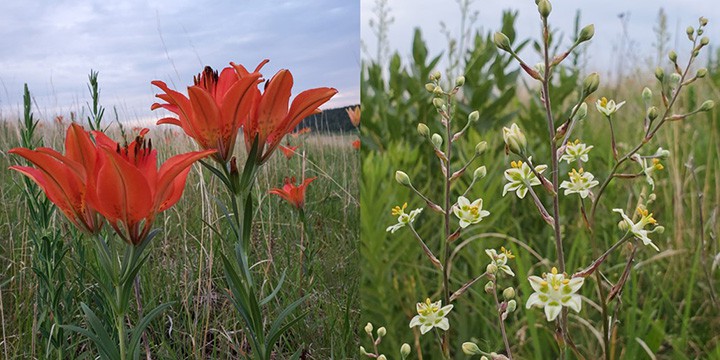
Wood lily (Lillium philadelphicum) and death camas (Zigadenus elegans) at a TPE preserve in Dane County, Wis.   Photos by Diane Hills

In addition to offering “real world” field trips, what other ways can we educate, show-n-tell our achievements, and connect people with native prairies and savannas? Here are a few possibilities:

  • Offering a virtual field trip (live or aired online followed by Q&A with the leader) for those that are unable to leave the house, due to the coronavirus or some other physical limitation
  • Developing an online workshop, followed by individual field assignments/explorations
  • Produce a slide show or video with a narrative (a story, educational, etc.) or put to music
  • Creating educational prairie games (that may or may not also require onsite prairie visits)

Whether it’s using your smart phone or enlisting someone else’s technical help, the results do not have to be perfect. We are all learning and venturing outside the box together as an organization. And who doesn’t love a good “prairie home video”?

The events of the past few months have only strengthened my deep appreciation for what you all do to preserve and share our native prairie and savanna communities and why it’s so important. I’m reminded of what I’ve learned about TPE – we are a community of passionate, dedicated people who care deeply about one another and about our natural world. Now how do we share that with others?

Please contact me if you have any suggestions, need support, or want to “think outside the box” together.