
by The Prairie Enthusiasts | Apr 8, 2020 | News
The 2020 TPE burn season was dramatically shortened but was not a complete bust. Just as the season was getting underway the COVID-19 outbreak hit, with stay-at-home orders issued in late March for Illinois, Wisconsin and Minnesota. State, county and local authorities also issued burn bans in some places, and TPE made a recommendation to stop burning with volunteer crews on March 24.
Everyone in TPE understands that getting regular fire back onto the land is one of the most important things we do to help the natural communities in our care. We have also been planning, preparing and looking forward to getting together for this annual task, so the shutdown of the season was a huge disappointment for all of us. We reached out to all the chapters to find out what they had been able to accomplish this year.
Prescribed fire conducted in March 2020 by the Coulee Region Chapter. Photo by Stephen Winter

In the southern chapters, the season got underway around March 21. Several chapters (Empire-Sauk, Prairie Bluff, Coulee Region, and Minnesota Driftless) were able to get a small number of burns in each before the shutdown. The season starts considerably later for the more northern chapters, who were not able to get anything done. St. Croix Valley worked on burn breaks on March 21 with the intention of getting at least a few burns in right away but had a significant snowfall on March 22. By the time things melted, the ban was in place.
Ecologically, it is usually not important to get an established prairie or savanna burned in any particular year. However, as several people pointed out, when seeds were sown into established cool season grasses the previous fall or winter (so-called “inter-seeding”), it is important to burn the following spring to give the seeds an opening in which to successfully germinate and grow. Inter-seeding is becoming a common tactic for expanding remnants on many sites, and the potential loss of those seeds in terms of cost and/or volunteer time is a big one. Several people reported that this year they focused intensely on getting as many inter-seeded units burned as they could.
Burning has not completely stopped in all places. The Wisconsin Prescribed Fire Council is looking into getting permission to allow small professional crews to be able to burn smaller sites. Some property owners are also managing to continue. Mike Mossman, the noted naturalist and an Empire-Sauk Chapter member in Sauk County, WI wrote “We’re fortunate here at Stumphenge (his family property) to have a family of three that works well as a team, and with a little extra time on our hands. We’ll continue to burn patches of our property nightly, I think, in suitable pieces, perhaps until we get everything done that we want. It goes slow, with all the needed burn-breaks, but its working so far and we’re honing our team skills. Another advantage of this is that we are working at a scale where we can coddle oak plantings where we are converting some of the prairie to savanna, and can also incorporate plenty of refugia, like for Sedge Wren and perhaps for Sandhill Crane and American Woodcock nests, and who-knows-what-other species.”
We all remain hopeful that we will be able to get back out there in the fall, and certainly in the spring of 2021!
by The Prairie Enthusiasts | Apr 7, 2020 | News
 Introducing a new phenology series. Pat Trochlell, author of ‘This Week in the Driftless Area’ will bring us on a virtual tour of what is happening in our native habitat through her new column. We hope to post this series weekly on our TPE Facebook page, found at https://www.facebook.com/ThePrairieEnthusiasts/ Look for her updates on Thursday afternoons. Pat’s inspiration comes from her career as a wetland ecologist with the Wisconsin DNR. Pat and her husband, Ken Wade, live near and are stewards of TPE’s 30-acre Parrish Oak Savanna, a diverse woodland ecosystem of 240 native species.
Prairie smoke emerging at Moely Prairie, Prairie du Sac, WI. Photo by Amy Chamberlain
This Week in the Driftless Area #1 – 31 March 2020
Hazelnuts are now blooming. Look for these shrubs in oak savannas and oak woodlands. The male and female flowers are separate. Male flowers are drooping catkins. Female flowers occur toward the ends of branches. Female flowers are tiny but brilliant – red tentacle-like pistils which open to pick up pollen drifting from the male catkins. Female flowers are less than ¼ inch in size, and are best observed with a hand lens.
Equisetum species are also known as horsetails or scouring rush. A species we often see, Equisetum hyemale, remains green throughout the year, but the green color changes. In winter, it is dull olive but in a single day it can brighten up to a true kelly green, which happened this past week.
Winter Wrens are migrating through southern Wisconsin now. Look for them in low brushy areas, often near streams. Their song is a long, complex series of beautiful musical trills. It is certain to lift spirits if you are lucky enough to hear it.
It’s the time of year when many species of birds are first observed migrating to and through the state. Look for those that pass through, like the Winter Wren, and also those that will stay and nest. Watch for breeding bird behavior, like Wood Ducks landing in large oak trees and checking for possible nest cavities.
Frogs are starting to sing. Check out any shallow ponds, which warm faster. Chorus frogs and spring peepers are vocal when the water temperature rises above around 50 degrees Fahrenheit.
This Week in the Driftless Area #2 – 7 April 2020
Warm spring temperatures have lead to more plants emerging. Early wildflowers of the prairies and oak woodlands are starting to bloom. Early buttercups (Ranunculus fascicularis) and pasqueflower (Anemone patens) are blooming in prairies and round-lobed hepatica (Anemone americana) and bloodroot (Sanguinaria canadensis) are blooming in woodlands (see my photo above). Early blooming woodland wildflowers are called spring ephemerals because they need to bloom before the trees leaf out to take advantage of the light. They become dormant later in the growing season.
 Bloodroot flowers emerge before the leaves. They are in the poppy family and have large white flowers with petals in multiples of four (see the picture I took at left). Bloodroot is named for the red-orange juice in its roots and stems that was historically used medicinally and as a dye.
Many sedges of the Carex genus also emerge early. Early bloomers include Richardson’s sedge (Carex richardsonii) and Pennsylvania sedge (Carex pensylvanica). The new green leaves of these and other sedges are nutritious and are often eaten by grazers – from deer to mice. Grazing in general doesn’t harm the plants.
Look for DeKay’s brownsnakes (Storeria dekayi), which are active now, brought out by the warm weather. They often sun in the middle of paths and roadways. Unfortunately, they are most often seen after an encounter with a bike or car. This species inhabits a variety of habitats from prairies to wetlands.
by The Prairie Enthusiasts | Mar 13, 2020 | News
The Annual TPE Prairie Conference came and went without a hitch. As usual, there were a lot of moving pieces that fit together into a working harmony. Like with any natural prairie community, we needed the elements to come together, and they did. Looking back, it was a close call. Large groups on a college campus are presently a thing of the past. You can look back here and feel assured that TPE is in synch with the environment.
by The Prairie Enthusiasts | Mar 13, 2020 | News
It is with mixed emotions that we report on March 1 the TPE Board of Directors decided to begin a nationwide search for a new Executive Director to replace Chris Kirkpatrick. Chris has graciously agreed to work with us on the transition process until March 31. The Executive Committee of the Board (Jerry Newman, Alice Mirk, Jim Rogala, and me) is selecting a search consultant and will oversee the process (with the help of a few other members) as a Transition Task Force until a new Executive Director begins work. The Executive Committee has asked me to assume the additional role of Acting Executive Director to manage the staff and operations of TPE during the transition, and I have accepted that task.
This was not an easy decision, nor was it taken lightly. Chris has served TPE as Executive Director for nearly 8 years, and during that time has overseen a major transformation of the organization. Our professional staff, while still quite small, has grown significantly. We have put in place a very strong financial management infrastructure. Our outreach and communications efforts have also grown significantly, resulting in a significant increase in both contacts and new members, as well as a much stronger public profile. Chris also directly led the process of achieving accreditation by the Land Trust Alliance, which has greatly improved our land protection processes. The land we protect by ownership or easement has grown from 2,500 to 4,000 acres. We give Chris thanks for all his many efforts during his tenure and wish him well in his future endeavors.
The primary driver for making this leadership change is a set of exciting new opportunities and challenges that are emerging for TPE. As many of you are aware, we have received a major three-year grant from the National Fish and Wildlife Foundation (NFWF) to develop a new program of direct outreach and services to private working and recreational landowners for pollinator habitat restoration and improvement. We are hiring a new, full-time Landowner Services Coordinator to provide ecological assessments to landowners, to help develop management plans, and to assist landowners obtaining the funding, professional resources and appropriate seeds needed for selected projects.
The NFWF grant also funds half a staff position to develop and execute a program of outreach targeted at building interest among landowners in pollinator habitat projects. The Board decided to supplement that funding and hire a new full-time staff member to work with the rest of the staff and chapter leadership on integrated outreach, development, and services program for both landowner outreach and building the general membership and volunteer engagement in the chapters. We will have more about these new staff positions and strategic directions in future blog postings.
On a personal note, I am both excited and more than a bit daunted by the challenge of assuming a new, expanded role in the leadership of TPE during this important transition. Having just finished visiting all eleven of our chapters since the first of the year and discussed these opportunities and changes with many of you in considerable depth, I am deeply impressed by the engagement and thoughtfulness of the leaders and members across the organization. There is a strong sense of hope and even optimism about our future, but there is also a very realistic and well-considered understanding of the significant challenges we will face. I do feel very well supported by the Board, staff, chapter leadership and our members, and ask for all your help in working together through this transition process.
As always, please let me know what you think at president@ThePrairieEnthusiasts.org.
Scott Fulton, President and Acting Executive Director
by The Prairie Enthusiasts | Mar 13, 2020 | News
Nearly 260 prairie enthusiasts gathered Feb. 29 on a beautiful leap-year day at UW-Platteville campus for the 32nd annual TPE Conference and Banquet.
Hosted by the Southwest and Prairie Bluff chapters, with coordination by Chapter Support staff, the team gained access to the building at 6:30 a.m. and scrambled to open for continental breakfast, raffle ticket sale and silent auction displays by 8 a.m.
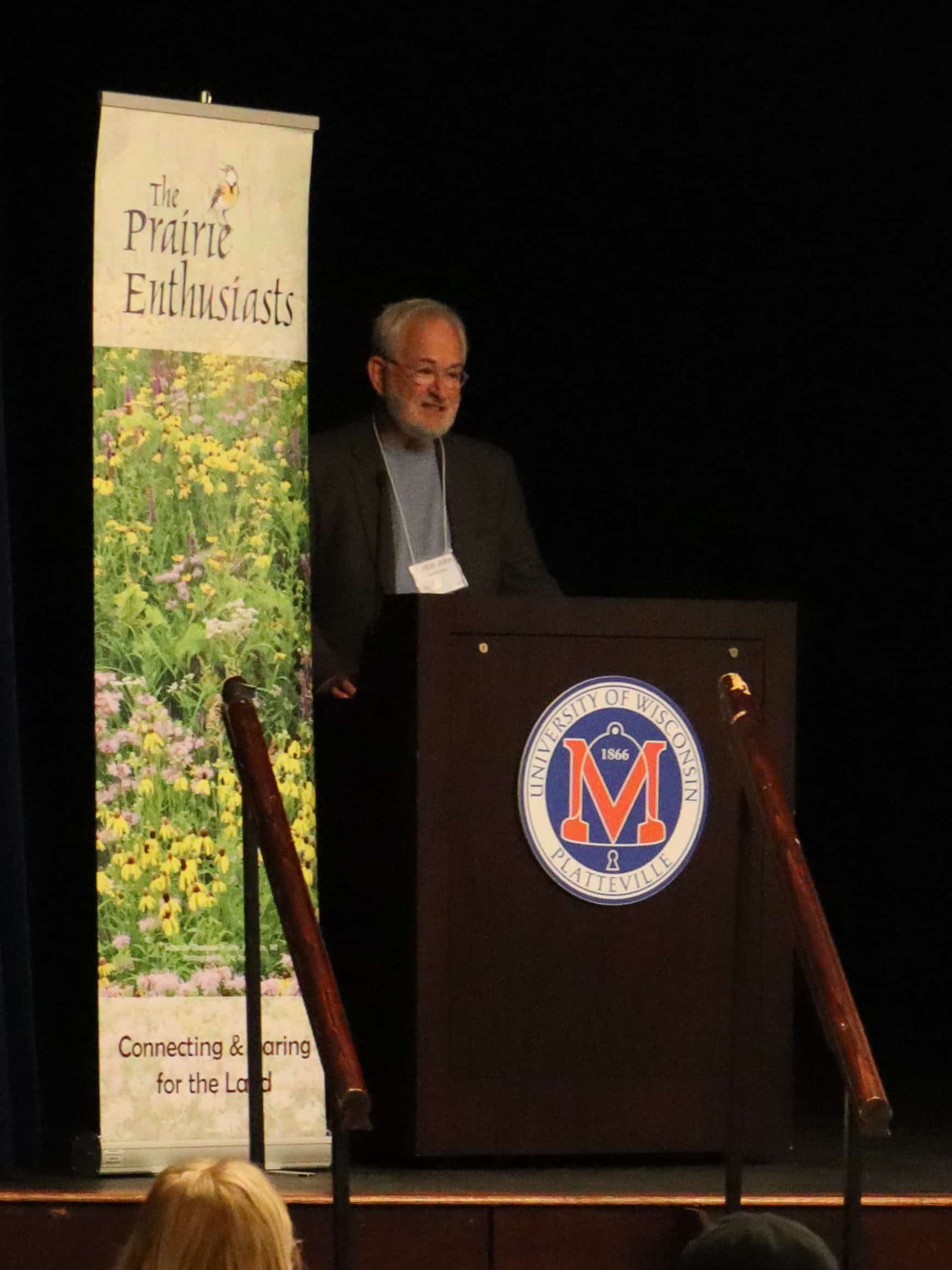
The keynote address, “Following Flames from Prairie Bluffs to Backwater Pines,” by Dr. Lytton John Musselman, Professor of Botany at Virginia’s Old Dominion University in Norfolk, peppered humor and research as he compared Midwest prairies and savannas with Virginia’s long-leaf pine ecosystem. Both are fire dependent.
Breakout sessions followed in the morning and after lunch. Attendees had three options each hour. Topics included control of invasives, building conservation communities, turtles, timber rattlesnakes and more. In the afternoon, participants had a choice of panel discussions: “Common problems and solutions among conservation organizations,” and “Planting seeds: Using programs and social media to foster a love of prairies among all generations.”
Everyone appreciated the live music of John Peterson during lunch.
Time was allotted for socializing, exploring exhibits, bidding on silent auction items, and strategically spreading raffle tickets among dozens and dozens of items. According to Evanne Hunt, Board member, the silent auction brought in $3,469, the raffle $2,832, with a grand total of $6,301 to be shared among host chapters.
The banquet dinner included pasta bar followed by the popular chocolate fountain. In the evening, a representative from each chapter gave a brief account of it activities for the 32nd Annual Conference & Banquet year. Executive Director Chris Kirkpatrick spoke to the group about the new initiatives TPE plans with a US Wildlife Services grant of $245,000. He also described the new capabilities of the recently acquired NationBuilder computer program.
The winner of this year’s photo contest was Sue Steinmann’s
“The Beauty of the Burn.”

The Conference Haiku challenge winner was Madison Belland with:
They speak, I listen
A strong voice for the voiceless
“Restoryation”
Volunteers were honored through the night’s program. Three chapters awarded “Volunteers of the Year” – EmpireSauk chose Ron Endres, Minnesota Driftless honored Gabe Erickson, and Southwest celebrated Martha and Steve Querin-Schultz.
Awards continued with overall TPE Chapter Volunteer of the Year Award given to Sue Steinmann and Bill Weege for their tireless work in protecting the Rattlesnake Ridge Preserve. The program ended with Gary Eldred surprising Scott Fulton with a Jonathan Wilde original painting in appreciation of his extraordinary service to the organization during his tenure as Board President.
John Peterson performed beautifully on the guitar and mandolin during lunch. (Photos by Jerry Newman)

Keynote speaker Dr. Lytton John Musselman, professor of botany at Old Dominion University, Norfolk, Va.
Greg Schmidt, private lands’ biologist with Iowa DNR, presents on the timber rattlesnake.

Board President Scott Fulton presents TPE Chapter Volunteer of the Year Award to Sue Steinmann (and Bill Weege, not pictured) for their work protecting the Rattlesnake Ridge Preserve.