Fifty Years of Fire: Stewarding Muralt Bluff Prairie

Fifty Years of Fire: Stewarding Muralt Bluff Prairie

Fifty Years of Fire: Stewarding Muralt Bluff Prairie

Story by Kysh Lindell, The Prairie Enthusiasts AmeriCorps Member
April 2, 2025

From left to right Fred Ochsner, Reynold Zeller, Jonathon Wilde, Deanne DeLaronde and John Ochsner manage the first burn at Muralt Bluff on April 13, 1975. Photo by Gary Eldred.

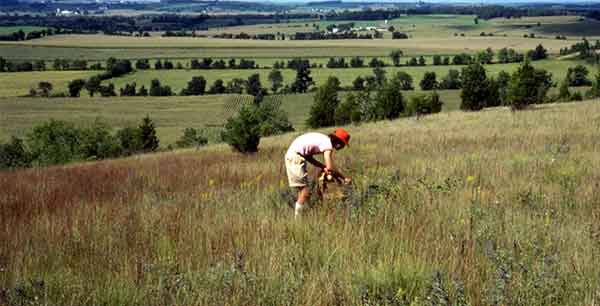
This April marks the historic 50th anniversary of the first prescribed burn on Muralt Bluff Prairie by early Prairie Enthusiasts—an event that would serve as a catalyst for grassroots prairie conservation in Wisconsin and beyond. But why revisit Muralt Bluff? What does this story have to teach us today?

In the early 1970s, two Albany, WI locals independently discovered a dry, bluff prairie remnant near their hometown in Green County. The site was part of an old cow pasture owned by the Muralt family and had been lightly grazed, but never plowed. Gary Eldred—a young outdoorsman who had previously hunted on the bluff—was working as a seasonal employee with the Wisconsin DNR at the time. While helping build the Sugar River State Trail, Gary grew intrigued by the rare and beautiful native plants he encountered in prairie remnants along the trail and soon blossomed into an amateur naturalist under the guidance of his Wisconsin DNR supervisor, Reynold Zeller. Gary spent much of his spare time traveling the backroads of Green County searching for prairie plants. It was the glowing blades of Indian grass and the curious purple spikes of blazing stars at Muralt Bluff that first drew him in, but the realization that these plants were a tangible connection to an ancient world kept him coming back.

John Ochsner, the son of a local cheesemaking family, met the Muralt Bluff prairie in a more unexpected way. Living just down the road from the property, John frequented the Muralt family’s farm on his milk route. One spring day in 1973, John spotted a group of college students and their professor—famed UW-Madison botanist Hugh Iltis—gathered for a field trip at nearby Abraham’s Woods State Natural Area. Tagging along out of curiosity, he followed as the group visited two UW Arboretum properties—Abraham’s Woods and Oliver Prairie—identifying native plants as they went. Fascinated, like Gary, by the presence of these unfamiliar plants so close to home, John repeatedly returned to Oliver Prairie to identify prairie plants. When he moved into the farmhouse at the base of Muralt Bluff that fall, he began to recognize some of the same native grasses and forbs he had come to know. To his delight, John had found another prairie remnant.

Professor Hugh Iltis (center) shows UW-Madison botany students a Pasque flower at Muralt Bluff in 1975. Photo by John Ochsner.

Journalist George Bachay and John Ochsner walk Muralt Bluff, 1974. Bachey was the outdoor writer for the Janesville Gazette for more than 20 years, providing early media coverage about Muralt Bluff and the importance of prairies. Photo by Gary Eldred.

Gary and John independently deepened their connection to Muralt Bluff until one serendipitous day in 1974 when the two happened to meet. Discussing their passion for prairie and Muralt Bluff, it became clear that they shared a mission: to protect the Muralt Bluff prairie, to help those fascinating plants thrive and to share this special place with others who could appreciate its value. Shared curiosity bled into a true prairie partnership as the two secured permission to manage the prairie from the landowners and began informal workdays at the site. Allies emerged from the local conservation community, including members of the Green County Conservation League and assorted friends. These newly fledged Prairie Enthusiasts felt called to act and transform Muralt Bluff with fire. And act they did.

On April 13, 1975, a small group gathered at the southeast corner, eager to coax a fire through this ancient prairie remnant for probably first time since early settlement. The crew consisted of Gary and John, Reynold Zeller, and friends Dan Hazlett, Jonathon Wilde, Deanne DeLaronde, Chuck Philipson, Tim and Peggy Hammerly, and John Ringhand. They were hardly the well-equipped, thoroughly trained burn crew you might meet at a burn today. Most had minimal knowledge or experience with burning, and their firefighting tools consisted of a few shovels, brooms, burlap sacks and two questionable water packs. But the rare chance to bring fire back to a prairie compelled swift action.

Intending only to conduct a test burn on a manageable 1/20th of an acre that day, the crew proceeded with little plan or pretense. John raked a thin line in the dry grass across the north end of the unit—a cursory firebreak—and Reynold unceremoniously dropped a match as the group stood leaning on their tools and chatting. Within thirty seconds, the southerly wind had carried the fire north and over the break, roaring uphill and toward the red cedars that dotted the slopes. “There she goes,” remarked Jon Wilde, and the crew scattered to respond.

Activity was panicked as the crew—and a few spectators—scrambled to contain the escaped fire. Snow shovels were pulled from the back of pickup trucks as makeshift flappers, and shirts and jackets shed in an attempt to swat out the flames. The fire raced through the grassy fuels, leaving a striking black scar and dramatically torching many of the cedars in its path. Terrifying on one hand, but practical on another: “I wasn’t really sure whether I should keep it going or put it out,” recalls Dan Hazlett. In seconds, the fire scorched many of the woody invasive plants that the group had been working to remove from the site.

Despite the initial mayhem, Jon Wilde managed the fire’s west flank well, and the fire soon ran out of fuel as the rest of the crew worked to tamp down the last of the flames. All told, the burn lasted just 20 minutes and consumed five or six acres. The only casualties were a few articles of clothing and $50 owed to the Monticello Fire Department, who had responded to a neighbor’s wildfire call after the burn had already been contained.

After an experience like that, would they ever burn again? “That was without question,” smirks Eldred in response, “we would just be more prepared.”

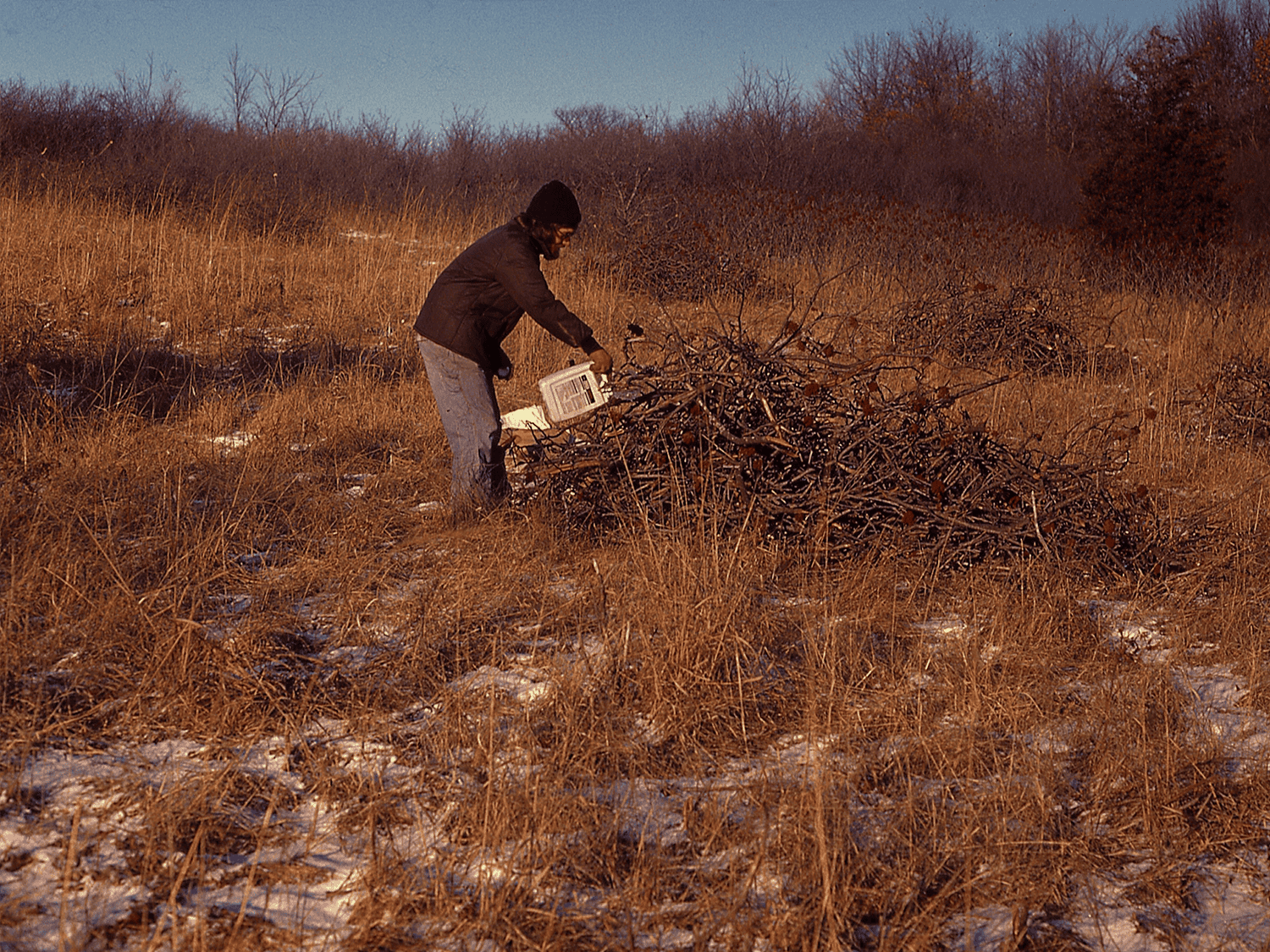
John Ochsner lighting a brush pile on the slopes of Muralt Bluff, February 1975. Photo by Gary Eldred.

From left to right: Dan Hazlett, Cliff Kohl, Fred Ochsner and Chuck Philipson extinguishing the last of the flames with unconventional tools. April 1975. Photo by John Ochsner.

What might have traumatized some exhilarated these self-described “prairie freaks.” A chaotic burn was still a burn—an essential, revitalizing process that the Muralt Bluff prairie had not experienced in a very long time. In that instant, the crew became committed to this place, as friends and as stewards. They were the first people since settlement who were willing to learn what this piece of land needed and able to put in the hard work to deliver it. They recognized the incredible history bound deep in the roots of these plants and their responsibility to care for that legacy. The burn was not a failure, but another chance at renewal.

Both the land and the local community responded to the fire remarkably well. As Gary remembers, the spring after that first burn “we had whole hillsides of shooting stars and blazing stars. The whole thing just responded to that fire like a huge breath.” Photos of the striking displays of native flowers and the enthralling story of the burn found their way into the local press thanks to several writers who were connected with the Muralt Bluff crew, including burn crew member Chuck Philipson who wrote for the newspaper in nearby New Glarus.

More than passing publicity, this effort to share the Muralt Bluff story became a grassroots public education campaign on the history and importance of prairies. Wielding a powerful combination of community connections and undeniable enthusiasm, the crew introduced local residents to native prairie plants and wildlife through stories and interviews, photos and illustrations, volunteer days and field trips. Some residents were encountering these native flora and fauna for the very first time in the local paper or on the slopes of Muralt Bluff. Others were renewing an interest in the flowers and insects they had once glimpsed in childhood, but lost sight of as southern Wisconsin’s prairies gave way to pasture, agriculture and development. Soon enough, one could almost guarantee that everyone in Green County had read or seen something about prairies, and many were on board with seeing them managed as prairies—even when that included the somewhat unfamiliar practice of prescribed burning.

By the summer of 1976, Prairie Enthusiasm proved contagious in Green County. Thanks to collaborative efforts to educate the public about prairies and advocate for the protection of this profoundly important natural area, members of the Green County Parks Committee paid a visit to Muralt Bluff to evaluate it for purchase. Thoroughly impressed by the prolific bloom of rough blazing stars and the Muralt Bluff crew’s dedication to caring for this piece of land, the Green County Board of Supervisors soon agreed to purchase and protect the 62.4-acre property using a combination of state and county funds.

An unusually spectacular bloom of blazing stars and goldenrods at Muralt Prairie, 1989. Photo by Gary Eldred.

Regal fritillary butterfly feeding on wild bergamot, 2017. Photo by Gary Eldred.

As with every site The Prairie Enthusiasts protect, the tale of Muralt Bluff does not end with the inked check. The success at Muralt Bluff spurred these and other early Prairie Enthusiasts to double down on their efforts to find and protect remnant prairies across the Upper Midwest, to form groups of volunteers dedicated to stewarding land and to keep spreading a passion for prairie. All the while, there stood Muralt Bluff—challenging its stewards to experiment, teaching them how to listen to the land and ever urging them to renew their shared commitment to this place.

Though the Green County Board originally assigned official stewardship responsibilities at Muralt Bluff to the Wisconsin DNR, members of the original burn crew and a growing core of Green County prairie-lovers remained the site’s most dedicated volunteers. Ownership of the site was transferred to The Prairie Enthusiasts in 2013, and the Prairie Bluff Chapter continues to steward Muralt Bluff today. Over the last 50 years, Muralt Bluff’s devotees have faced nearly every predicament familiar to prairie practitioners: invasions of sumac, cedar, cherry and plum, burn restrictions, funding challenges, conflicting management styles, disappearing flora and fauna and questions about when, where and how often to mow, cut, treat and burn on the prairie. While some issues could be solved with time, trial and lots of error, others proved mysteries.

While discouraging losses of rare prairie plants, insects and habitats have played out at Muralt Bluff over the years, so too have natural wonders that could renew the curiosity of even the most downtrodden Prairie Enthusiast. Following a drought in 1988, Muralt Bluff exploded in a profusion of rough blazing star (Liatris aspera) and showy goldenrod (Solidago speciosa) beyond belief. “I’ve been going up there for 50 years,” reminisces Gary, “I never knew that those plants were there. There’s hundreds and hundreds of them and they’re blooming, so that indicates they were mature plants. God knows how long those root systems have been lying dormant in that soil before the drought shook them up enough to sprout. I was absolutely flabbergasted. It’ll never look like that again in my lifetime, so what is the secret there? How long have those blazing stars been dormant?”

When you stick around long enough, as Muralt Bluff’s devotees have, prairies have a way of surprising you like this. A rare plant emerges, blooms once and folds itself back into the soil, never to be seen again by the same eyes. New grassland birds find tiny pockets of prairie in a sea of corn and soy, making themselves at home as if they have always lived there. Amidst extreme weather events and a rapidly changing climate, the prairie dips into its well of resilience and acts.

This and Muralt Bluff’s many other mysteries bring into focus our role as Prairie Enthusiasts: to recognize what we are losing, and the immense power of what we still have. “Your whole perspective on who we are and what we’re here for changes when you visit Muralt Bluff,” says Prairie Bluff Chapter volunteer Jerry Newman. To steward this place is to humbly return to it with respect, curiosity and wonder, putting in the difficult work to restore a place, all the while knowing that the prairie holds a wisdom much older than you. Like that first burn, prairie conservation is a chaotic, dynamic and deeply collaborative process. The important thing is to keep trying at it, even when the fire jumps your breaks.

In many ways, the Muralt Bluff story endures as the model for The Prairie Enthusiasts’ land protection efforts today. We understand that if we want to save the prairies around us, we must act, and we must do so holistically. Like those early Prairie Enthusiasts, we build trust with landowners and local communities. We share land management knowledge and take initiative to steward land, embracing uncertainty and failures. We connect people with prairies through field trips, work parties, education and art. We find creative ways to raise funds and collaborate with others to further our impact. We do not let our enthusiasm dwindle, even after 50 years. This is a resilient method of conservation because it depends, at its core, on people loving the land enough to want to protect it and make it better. This enthusiasm is alive and well at Muralt Bluff and everywhere there are prairie people, and that is something to celebrate.

20th anniversary of the first burn, 1995. From left to right: Tim Hammerly, John Ochsner, Peggy Hammerly, Gary Eldred, Dan Hazlett. Photographer unknown.

30th anniversary of the first burn, 2005. From left to right: Jonathon Wilde, Dan Hazlett, John Ochsner, Gary Eldred (front). Photographer unknown.

40th anniversary of the first burn, 2015. From left to right: John Ochsner, Dan Hazlett, Gary Eldred, Jonathon Wilde, Chuck Phillipson. Photographer unknown.

Invasive red cedar on fire during first burn, April 1975. Photo by Gary Eldred.

This article appeared in the Spring 2025 edition of The Prairie Promoter, a publication of news, art and writing from The Prairie Enthusiasts community. Explore the full collection and learn how to submit your work here

About The Prairie Enthusiasts 

The Prairie Enthusiasts is an accredited land trust that seeks to ensure the perpetuation and recovery of prairie, oak savanna, and other fire-dependent ecosystems of the Upper Midwest through protection, management, restoration, and education. In doing so, they strive to work openly and cooperatively with private landowners and other private and public conservation groups. Their management and stewardship centers on high-quality remnants, which contain nearly all the components of endangered prairie communities. 

Tiny But Mighty Hummingbird

Tiny But Mighty Hummingbird

Tiny But Mighty Hummingbird

Poetry by Jim Daubert

Hummingbird on hill’s thistle by Gary Eldred

Suddenly, I saw what looked like a gigantic Bumble Bee.  Yet, its flight patterns convinced me this unique flyer wasn’t an insect.  Its beautiful colors/movements suggested: “A Hummingbird”!  Standing in awe, frozen in my tracks….. yet too far away to see her vibrant colors…..still amazed by her fancy flight patterns which delightfully captured me and held me in the present moment!

Like seeing the Northern Lights…..a sense of wonder engulfed me!  Content, relaxed….. was truly appreciating this beautiful, inspiring bird sent by Mother Nature. These gorgeous godly birds bring us….. hope, love, beauty, joy and happiness!

Adroit with great flying skills, these birds can flap their wings from 50 to 120 times per second, go straight up/down, sideways and can even fly backwards! Their skills help protect them from predators. Predators include larger birds like the Bluejay,  and other large birds, wasps and even domestic /feral cats.  For protection, they nest in Cooper’s Hawk  and goshawk neighborhoods Hawks chase away aggressive Bluejays.

Hummingbirds fly across the gulf of Mexico without stoping to winter in southern Mexico.  One could put 8 Hummingbirds in an envelope and send them through the mail for the cost of just one postal stamp.

We are indebted to the hummingbird for their hard work in pollinating flowers/plants.  Our food supply could be greatly diminished, if these endangered birds went extinct.

I now can better understand why our great writers and poets like Robert Frost (Poem:  “A Prayer in Spring”,  and Emily Dickinson (Poem:  A Route of Evanescence) chose Hummingbirds as their subject. These small but powerful diplomats for Mother Nature captivate the mind and soul of millions!

Ruby throated hummingbird by Eric Preston

Painting of Western broad-tailed hummingbird by Jim Daubert

ACROSTIC HUMMING BIRD POETRY


Humming sounds from—rapidly moving wings

Underestimated talent, worth to humanity

Messenger of love, joy, good fortune

Miraculous flying patterns and skills

Intensely focused on pollinating plants and flowers

Nesting in unique quarters

Great addition to world’s beauty


Blissful searching for flowers/plants

Interesting, fascinating, pleasing

Rests little but effectively-enters a state of torpor

Demands much from wings (Moves wings 50-120 times per second)

Agaski Bluff

Agaski Bluff

Agaski Bluff Deserves to Be Protected  

Story by Sarah Barron. Photos by Eric Preston
October 11, 2024

“We just really felt like we needed to protect this place,” says Eric Preston.

Eric and Kim pictured above.

Standing on the steep slope of Agaski Bluff in 2021, Eric Preston and Kim Kreitinger took in picturesque rock outcroppings and a sweeping view of the valley below and considered the opportunity before them. This was a rare bluff prairie with the largest population of State Endangered pale false foxglove (Agalinis skinneriana) in Wisconsin, where it is known to persist in just five locations. Invasive species like honeysuckle, buckthorn and spotted knapweed were moving in fast and pushing out a remnant ecosystem that would soon be lost to neglect. They looked out and pictured a house in the valley and a labor of love restoring this land for the rest of their lives. It was the realization of a long-held dream they shared. They made an offer on the property that night.

As lifelong conservationists and avid volunteers with The Prairie Enthusiasts, Eric and Kim got busy right away, using their knowledge and connections to rally partners, resources and community around their restoration efforts. Their progress has been extraordinary. Agaski Bluff sits on 38 acres where they have cleared cedar, planted prairies, conducted prescribed burns and begun restoring oak woods and savanna.

But as they made progress and saw the land respond, they began to question the impact of building a home on the site. Agaski Bluff is immediately adjacent to The Prairie Enthusiasts 12-acre Swenson Bluffs. It was a difficult, even heartbreaking realization, but they became convinced the best thing would be for The Prairie Enthusiasts to own and manage their land as part of a contiguous 50-acre preserve for generations to come.

More than 140 native plants have been documented at the site, including three State Special Concern species and the State Endangered Agalinis skinneriana that gave Agaski Bluff its name. This is an already diverse ecosystem of native plants, insects, wildlife and birds that will continue to thrive with ongoing stewardship.

“It’s hard to learn about the natural world when you don’t have biodiversity around you,” Eric rightly observed. They have watched their son, Anders, grow into a budding Prairie Enthusiast who gets excited when he discovers a snake, an interesting caterpillar or some other species that’s new to him.

The biodiversity at Agaski Bluff evolved over thousands of years, and without our community of Prairie Enthusiasts, the rare plants, insects and other species there could easily disappear. Eric and Kim stepped in and saved one of our last remaining prairies from development or neglect. Now it is our turn to protect it for future generations.

Wisconsin State Endangered, pale false foxglove

American lady caterpillar

About The Prairie Enthusiasts 

The Prairie Enthusiasts is an accredited land trust that seeks to ensure the perpetuation and recovery of prairie, oak savanna, and other fire-dependent ecosystems of the Upper Midwest through protection, management, restoration, and education. In doing so, they strive to work openly and cooperatively with private landowners and other private and public conservation groups. Their management and stewardship centers on high-quality remnants, which contain nearly all the components of endangered prairie communities. 

Catching the Prairie Bug

Catching the Prairie Bug

Catching the Prairie Bug!

Photos and Story by Jonathan Rigden

This story was featured as a guest column in The La Crosse Tribune. 

View of the Mississippi River from Marowski Bluff Prairie

Zoerb Prairie in Hixon Forest in August with rough blazing star blooming in the foreground. 

Do you know that prairies and oak savannas once filled much of the landscape in western Wisconsin and that only a tiny fraction remains? And that this tiny fraction is disappearing fast? Some readers may have heard of a group called The Prairie Enthusiasts. This organization is a nonprofit land trust that has chapters in Wisconsin, Minnesota, and Illinois and works throughout the tristate area to save as many of these relics from the past as possible. In doing so, we hope to preserve and grow this unique ecosystem that supports an abundance of special plants and animals. The Coulee Region Chapter of the Prairie Enthusiasts includes the counties of La Crosse, Vernon, Monroe, Buffalo, Trempealeau, and Jackson.


A prairie can escape the attention of those who have never been exposed to and noticed its wonders. But something out of the blue can spark an interest, like seeing a beautiful prairie flower for the first time or colorful bees hovering over a native thistle. Then, some susceptible individuals “catch the prairie bug” and a cycle begins. They identify the flower and one of the bees. On the next hike, they see another amazing flower with a delicate butterfly feeding on its nectar, look them up, and there you have it, they’re hooked! A cascade is launched- interest leads to learning leads to knowledge leads to more interest, learning, and knowledge and so on. And a fun-filled adventure awaits!

But all the beauty of the flowers, grasses, insects, birds, and other critters on the prairie can escape our interest without a spark. Like the fires that keep the prairies healthy, something must start this process. Fire is said to need three components to become self-perpetuating- fuel, oxygen, and heat. But you can have all the fuel, oxygen, and heat in the world and there won’t be a fire until a spark ignites the system. Our hikes, work events, and educational programs might be just the spark needed to set the your cycle in motion and, as we say, “Ignites your relationship with the land”!


Many of you might have noticed the cleared and sometimes burned areas on some of the bluffs in our area, including in Hixon Forest. The Coulee Region Chapter has been involved in many of these efforts while teaming up with other groups such as Friends of the Blufflands, the Mississippi Valley Conservancy, and the Wisconsin DNR. Despite this significant progress, there is still much to be done. Many bluff prairies in the Driftless Area continue to be taken over by red cedars or invasive nonnative plants like buckthorn. In a perfect “prairie world” all of these sites would be saved. That, of course, is unrealistic, but many can and should be saved before they are gone forever. This restoration and maintenance work could come from landowners, contractors, and volunteers but the effort needs to be guided and coordinated. In our six-county area, we hope that the Coulee Region Chapter can help lead this effort.  


So, as a new year begins and some of us think about our goals, perhaps one of them could be getting out, investigating the prairies near you, catching the prairie bug, and supporting the Coulee Region Chapter of The Prairie Enthusiasts by becoming a member and volunteering on our work days. Check out our chapter HERE and follow us on Facebook. 


Happy New Year!

We All Have Mentors

We All Have Mentors

We All Have Mentors

By Scott Weber

November 13, 2023

Konrad collecting seed for the International Crane W Foundation at Muralt Bluff prairie, fall of 1980
We all have mentors in nearly everything we do, and restoration ecology is no exception. My mentor, Konrad Liegel, is a person you probably don’t know, but he had a profound influence on prairie restoration and reconstruction in both Minnesota and Wisconsin. He and I were both students of the late Dr. Paul Jensen who taught ecology, evolution, and field biology at Carleton College in Northfield, Minnesota. Paul convinced the college to buy McKnight Prairie, one of the best remnant prairies in western Goodhue County, to serve both as an ecology laboratory and a seed source for restoration projects. Konrad, a student from Plain, Wisconsin, wrote a thesis, “A Guide to the Carleton Arboretum Restoration Project,” a fairly comprehensive work. He, along with other enthusiastic students, began restoring a brome grass field, Hillside Prairie, with a combination of seed plots, seedling transplants, and a sod transplant experiment with the UW Arboretum’s Curtis and Greene prairies as models.

I was introduced to the prairie project in the spring of 1979 by volunteering for a burn. Back then, we had no burn permit, no official burn plan, and no equipment other than matches, rakes, water jugs, and wet burlap to use as fire swatters, but we did have a general notion of backfires and head-fires and which one to light first. By summer of 1979, the project consisted of two seed plots, 1978 and 1979 spring plantings about an acre a piece, plus the sod transplant area of much smaller size. Konrad graduated in spring of 1978, as did many of the student volunteers, so we were very dependent on the help of Dr. Jensen and Konrad’s thesis. I also checked out The North American Prairie, by Dr. John Weaver, and tried to use that to identify the grasses in the new prairie, not realizing that most of it was still brome grass. That is a revelation that most of us have had at some point: virtually all of the vegetation on our roadsides and farmland is not native to North America. Suddenly every prairie remnant, from McKnight to the big bluestem along the railroad right of way, was precious.


A geology professor, Dr. Ed Buchwald, became the first Arboretum Director and began hiring two to three students in the summer as Arboretum assistants in 1978, and I jumped at the opportunity to work in the Arboretum with my coworker, Dick Mertens, for the summer of 1979. We repaired the trail network from the erosion caused by runoff from the fields the college rented out but also pulled parsnip in the postage stamp prairie remnants, collected seeds for future plantings, watered transplants, and did other maintenance. As far as prairie restoration went, we were greenhorns. By spring of 1980, I was the “burn boss,” having completed only one other burn in my life, and no one else was primed to take over the project, so I needed some guidance. Dr. Jensen helped us identify plants and locate seed sources, but none of us had much experience starting a prairie from scratch, so I went in search of Konrad. I needed some education from the guy who wrote the book.


Konrad returned to Wisconsin after graduation to work for the Aldo Leopold Reserve (now Aldo Leopold Foundation) to construct a pre-European settlement vegetation map of the reserve. He also worked at the nearby International Crane Foundation (ICF) planting the first seed plots on ICF’s newly purchased farm. Konrad’s friend, Charlie Luthin, convinced ICF to include habitat restoration as part of their conservation message, and Charlie planted ICF’s first prairie at their old site closer to Baraboo. A crane disease outbreak at their first site accelerated ICF’s need for a new home, and the new site was a great opportunity to do some major restoration of prairie, oak savanna, and wetlands. Our Carleton Natural History Club visited ICF in March 1980, and I asked Konrad if I could be his intern for fall of 1980.


I took the summer of 1980 off from the Arboretum job at Carleton, backpacking with my roommate in the Grand Tetons and North Cascades, and arrived at ICF in mid- August. Konrad assigned me the task of completing the herbarium collection for the site, helping his summer intern, Shelly, finish mapping the oak woodland, writing a guide to prairie seed germination and storage, and, most importantly, collecting and cleaning seed for both a fall 1980 and spring 1981 planting. Konrad kept me very busy!


Back then fall plantings were very experimental and rarely done, so Konrad was taking a big chance, especially since future funding and dedication was never guaranteed. Then, as now, speed matters, and warm season grasses and black-eyed Susans come fast in a spring planting. Fall of 1980 was a wet season, and we harvested a bumper crop of prairie dropseed and many other species from Avoca Prairie, Muralt Bluff, Spring Green and Lone Rock remnants, the UW Arboretum, and wherever else we could find seed. Fortunately, being a non-profit, we had access to seed sources normally off limits to private individuals. If we had known then what we know now, the entire five acres should have been planted in the fall, not just the one-acre plot. The dropseed and most forbs, including the gentian seed collected at Avoca, have done very well there, whereas the spring planting became dominated by tall grass. In retrospect, we wasted a lot of good dropseed and forb seed by planting most of it in the spring.


I returned to Carleton and worked in the Arboretum again in the summer of 1981 with my coworker, Sue Peterson. Armed with all the knowledge that Konrad bestowed upon us, we not only did trail repair but also sampled the 1978 and 1979 seed plots, learning that brome grass percentage will decrease with fire and competition. We collected seed for another hillside planting, and, based on Konrad’s example at ICF, turned our attention to oak savanna. Saving all the savanna oaks suddenly became a top priority. Converting crop land to prairie before government programs like the Conservation Reserve Program (CRP) and government cost-sharing was difficult since the college needed the rental income, so Sue and I were free to hack away at the buckthorn and non-oak species in an opening Dr. Jensen’s students had studied and managed. That oak opening was the epicenter of the savanna project. Many thanks to Ed for letting us do that at the expense of some trail work.


We completed another seeding, about 1.5 acres, on Hillside Prairie and tilled up another acre or so to prepare for another. We contracted all the tillage work to local farmer, Palmer Fossum. Unfortunately, we didn’t have the results from the ICF fall planting, so we planted in spring. There are leadplants and other nice forbs still present after 40 years, but few, if any, dropseed or gentians in those plantings. Eventually the Arboretum Director became a full- time position with several students hired each year, but I’m not sure if Carleton would have as extensive a project as it has now without the vision and commitment of students like Konrad and professors like Paul and Ed. They deserve credit for getting the project going before the college could make a major financial investment.


Konrad also worked on other projects in Sauk County, especially the prairie along Highway 12 in front of the Badger Army Ammunition Plant as a member of the Sauk County Natural Beauty Council (SCNBC), part of a nationwide highway beautification program started by Lady Bird Johnson. After I graduated from Carleton, I worked for the Aldo Leopold Reserve, ICF, the Wisconsin Conservation Corp, and volunteered for the SCNBC board. I was either working for Konrad or following his footsteps. I learned almost every important lesson in prairie reconstruction then: the importance of good seed sources, the diversity of fall plantings, how quickly prairie species establish in nutrient poor soil, and the importance of record keeping. Konrad was also very humble; he knew that each of us is just a temporary link in a long chain of human interactions with our environment. We all have to pass the torch and move on at some point.


Unfortunately for prairies and ecological restoration, Konrad left his job with ICF to go to law school at Cornell and, soon after, moved to Seattle with his sweetheart, Karen, to gain experience in environmental law, and our paths diverged. Conservation has one of the highest education- to- pay ratios of any occupation, so law was probably the best career choice for Konrad, but not a field that I was suited for. I wanted to spend my time out on the prairie collecting seeds forever!

Meet a prairie mentor by attending one of our events! No experience necessary, and it’s a great opportunity to learn and connect with others that love the land.

Gneiss to Meet You

Gneiss to Meet You

Gneiss to Meet You

Exploring a Rare Prairie Growing Upon Some of the World’s Oldest Rock

Story and Photos by Addeline Theis

July 25, 2023

Pulling up at the edge of a gas station parking lot in the small town of Morton, Minnesota, I had to double check if this was the correct way to enter the prairie. A small foot path leading up through hipheight sumac bushes was visible from my car.  It was a sign that others before me have taken this way to view the historical outcroppings. Obviously, this was my first ever visit to Morton Outcrops Scientific Natural Area (SNA). Unknowingly, I scrambled up some boulders to find myself above the landscape, overlooking the amazing river valley. Below my hiking boots were dark slabs of granite that were covered in encroaching lichen. Finding a lichen-less portion of the rock, I noticed distinctive swirling of the pink and black bands. This was the 3.6-billion-year-old Morton Gneiss (pronounced “nice”) dry prairie that the site was preserved around.

This site is one of Minnesota’s largest and highest quality examples of Crystalline Bedrock Outcrop Prairie, defined as a dry, open, lichen-dominated plant communities on areas of exposed bedrock. Woody vegetation is sparse within this prairie type, and vascular plants are restricted to crevices, shallow soil deposits and rainwater pools. Shallow soils found on the margins of the bedrock exposures host plant species that are adapted to this drought-prone microhabitats. This prairie system is quite different from the wet prairie potholes that developed all around this river valley and the species found at this dry prairie showcase the difference. As a botanist, finding the native Brittle Prickly Pear Cactus (Opuntia fragilis) thriving out of the knobby exposure was exhilarating. The idea of such an arid plant flourishing in this site is one of the driving forces that led me to investigate the natural history of this site further.


For geologists, the glacial history of southwestern Minnesota tallgrass prairie region usually does not draw up much interest. The last glacial period left this area covered in thick glacial till, covering up any bedrock for one to investigate. For soil scientists, this thick glacial till was the original parent material for developing the thick rich Mollisols soils that the prairies are known for.   

What draws geologists into this area is the events that happened after the glaciers melted. After the Des Moines lobe of the Laurentide Ice sheet retreated from southern Minnesota and the global temperature began to rise, meltwater began to collect in large inland lakes throughout southern Canada and the northern Midwest. The largest of these lakes was ancient Lake Agassiz. Varying water levels led to the lake overflowing a moraine ice dam near present day Browns Valley, creating an outlet river. Called Glacial River Warren, this outlet river was a prehistoric river that drained Lake Agassiz between about 13,500 and 10,650 BP (Before Present) years ago. The strength and power of Glacier River Warren carved out the valley that is now known as the Minnesota River Valley.

This violent history impacted the landscape of southern Minnesota as well as affected how plant communities would development within the valley. The tremendous power of Glacial River Warren cut through layers of glacial till and clay-rich deposits of weathered bedrock all the way down to scour some of the oldest bedrock in North America. Some of the bedrock exposed on the valley floor is as old as 3.6 billion years old. It is called Morton Gneiss (pronounced “nice”), and it formed deep in the earth’s crust, where extreme heat and pressure changed, or metamorphosed, an earlier kind of rock. The beautiful and distinctive banding of colorful minerals within the Morton Gneiss makes it an attractive building stone, which is used around the world. There are just a few similar exposures of Morton Gneiss in Minnesota, all in the Morton Area.  
This place is also an amazing story of private landowner conservation, Carl Colwell was instrumental in the site’s preservation. After completing a career in the military, Carl returned home to Morton, Minnesota where he served as Renville County Historical Society director for six years. He purchased 10 acres as a private citizen in 2009.  

Today the land is protected as a Scientific Natural Area (SNA) managed by the Minnesota Department of Natural Resources. Colwell reflects:  

When I was a boy, the Dakota story I heard was that the rock was the keeper of all knowledge. It had seen everything since the beginning of time, and if someone would ask in the correct way, they would learn the answer. It was almost like a library. I, of course, didn’t believe that story at the time. Once I started escorting geologists, anthropologists, and “ists” of all sorts through the site, I started to hear the same story repeatedly. The rock has seen everything since the earth cooled. If we look carefully and study hard, we will learn the answer to our questions. 

Before returning to my vehicle, I took a few final moments on the ancient rocks, remembering that these rocks perhaps do have the answers to our questions. But only if we ask the right questions. I can only be thankful for the efforts of those that have contributed to the conservation and preservation of this site so that future generations can witness this library of knowledge within the Minnesota River Valley. 

If you’re interested in dry prairies, visit one of our sites, like Muralt Bluff Prairie.