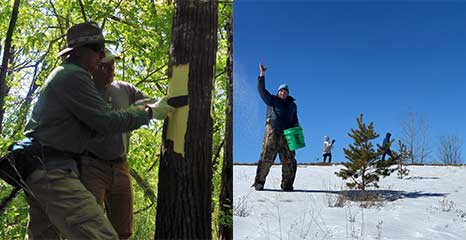
Controlling clonal tree species by double-cutting

Controlling clonal tree species by double-cutting

Controlling Clonal Tree Species By Double-Cutting

By Jim Rogala

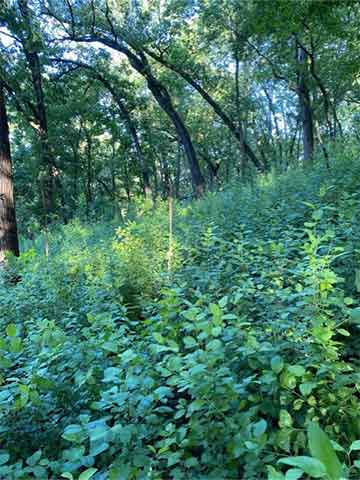
Continuing on the theme of herbicide-free control methods, I’ll talk about my experience with double-cutting. Again we look to the anatomy and physiology of the species to be controlled to understand how this works [for those of you that know why double cutting works, or don’t care why it works, you can skip the next three paragraphs]. Clonal species form what looks like many plants when in fact it is a single plant with many stems. These clusters of stems often have larger older stems toward the center and smaller younger stems on the perimeter. No matter what the control method you use (mechanical or chemical), all stems of the clone need to be treated. Cutting off the stems in the winter results in the formation of new stems from adventitious nodes the next spring.  Where there were tens (or hundreds) of stems prior to cutting, you might have hundreds (or thousands) after a winter cutting.

When to Cut

Cutting any plant when most of the energy stored in the roots has been translocated to above ground plant parts is advantageous. For most trees, this translocation occurs throughout the spring and early summer when it is building structures to 1) produce new energy, 2) to add to its size, and 3) for reproduction (leaves, trunk/branches, and flowers/fruit, respectively). After this annual use of energy from the roots is done, the tree begins translocating energy back to the roots at higher percentage. So, to deliver maximum hurt to the tree, cutting before energy starts going back to the roots is a good strategy. This maximum damage also minimizes prolific sprouting from adventitious nodes.

Even with a well-timed cutting, a tree still has enough energy in the roots to produce more above ground structure to assure it lives on. Here’s where the double-cutting comes in. After the first cutting, the tree needs to again use the remaining energy in the roots to build all new structures for the purpose of gaining energy (reproduction is put on hold under these stressful times). Similar to the first cutting, this second cutting is timed to coincide with maximum translocation of energy from the roots, but again not waiting past the period where a lot of energy is translocated to the roots.

I read about doubled-cutting years ago and have used it quite a bit. I generally follow the July 1 and August 1 timing for cutting but have varied it a little depending on growth in a given year (e.g., first cutting for sumac is usually after flowering). I’ve done the “cutting” with a variety of methods. I’ve used a mower if clones are large, where mowing is feasible, and the clone is not in a high-quality prairie. The point related to high quality prairie is that multiple years of repeated mowing can have negative effects on some desired species. I’ve found mowing to not be as effective, as it reduces shading of resprouts because everything gets cut. I’ve used a handheld brushcutter in native prairie areas, cutting each stem individually. It’s not as quick as mowing, but less damaging to other prairie species and better than using hand loppers to cut each stem. Loppers are effective for small clones. I’ve found that with sumac, you can actually snap off the stems in many cases (but be prepared to have the juices stain anything it gets on). Depending on the size of the stems, a Parsnip Predator can be used to cut the stems.

Where to Cut

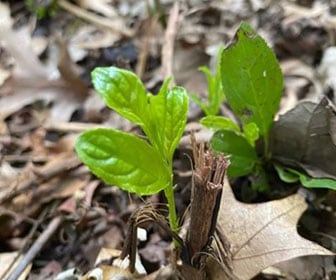
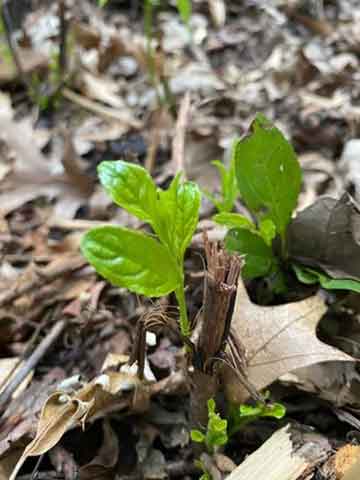
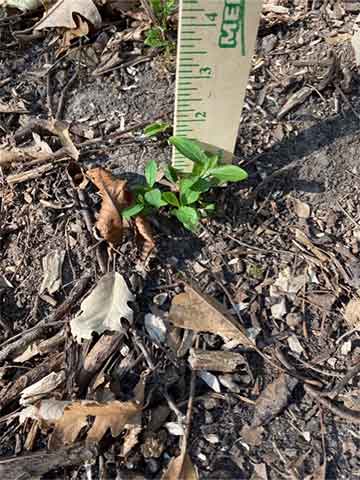
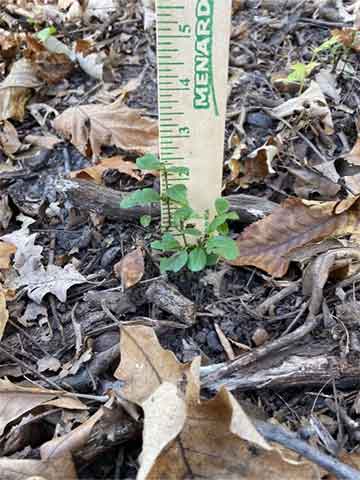
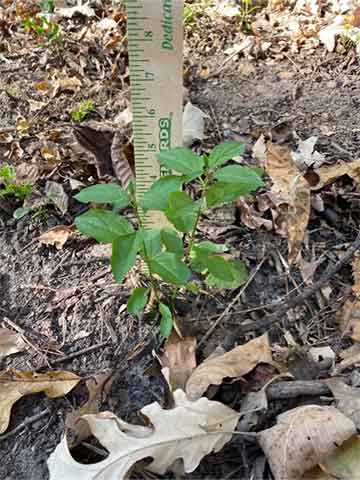
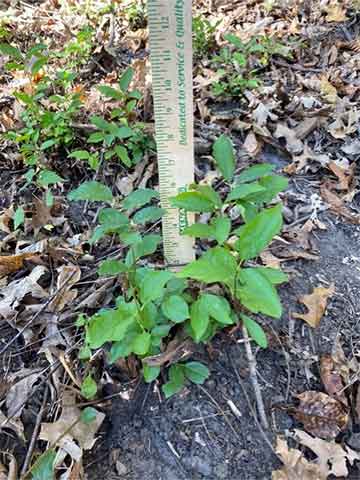
Another variable to consider is the height of the cut. I’ve varied this as well, from ground level to 2-3 foot high. Cutting to ground level results in fleshy resprouts that can easily be second-cut with a Parsnip Predator. The really high cut was done to encourage resprouting only on the stem and to test if you get less new stems from the roots. This method allowed a second cut of a single stem, rather than the cluster of resprouts that come from the base. With this method, I found that the stem sprouts can sometimes just be snapped or stripped off, especially with sumac. The disadvantages are that some of the energy in the stem is retained, and the resprouts are not shaded by other vegetation. The method seemed to work as well as cutting lower on the stem in areas of sparser vegetation.

But Does it Work?

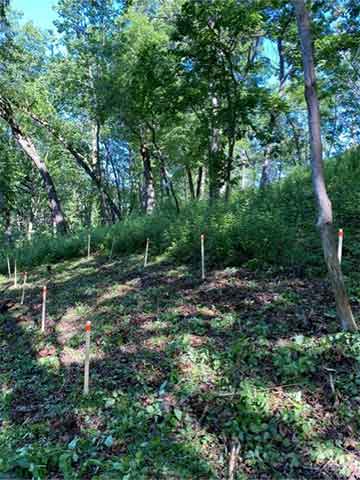
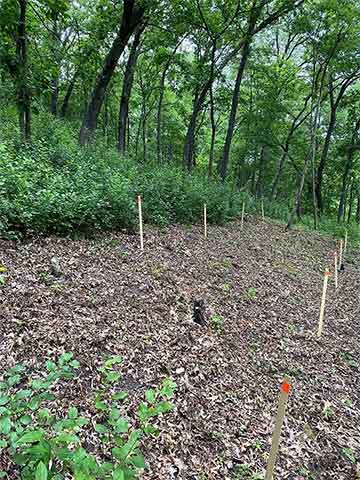
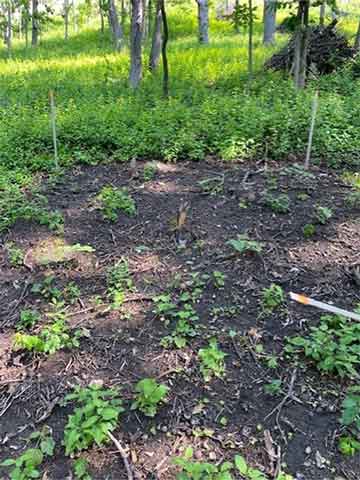
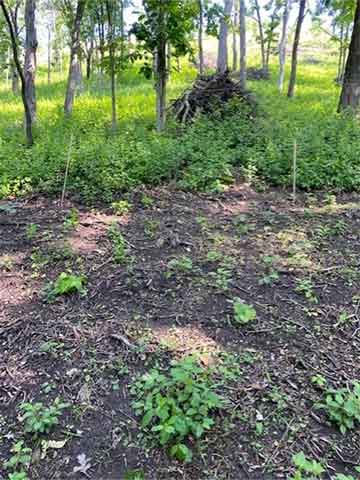
How effective is double-cutting on clonal species? I use it only on aspen and sumac; it’s been found to be ineffective on black locust. Because these two species are native, I’m not really all that concerned with eradication. However, I have eradicated many clones using double-cutting (with no herbicide), but most of those required several years of double-cutting. In one case, a single double-cutting killed a sumac clone. This was an older clone, so include that as one of the variables that might contribute to success when using double-cutting.

You might consider herbicides if you want more certainty in eradication. However, as Tom Brock pointed out in his management work (read here), even with herbicide it is a multi-year effort. For myself, I like the opportunity to control a native invading species without the use of chemicals. However, for the double-cutting to be effective, you must be timing the cuttings correctly, be cutting all of the stems in the clone, and continue the process as long as needed.

Read about other non-herbicide management techniques like using a Parsnip Predator, or girdling.

Controlling biennial invasives without herbicide using a Parsnip Predator

Controlling biennial invasives without herbicide using a Parsnip Predator

Controlling Biennial

Invasives Without Herbicide

Using A Parsnip Predator

By Jim Rogala

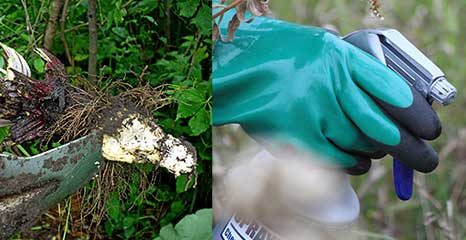
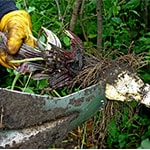
Predator and burdock root - PC Rob Baller

My recent blog post on girdling got me thinking about other herbicide-free invasive species control methods. For biennials, there are three common mechanical control methods: mowing, pulling, and cutting below the root crown. Mowing is favored for large infestations because of the daunting task of methods used on individual plants. Pulling or root severing is feasible on small infestations. For some biennials, such as sweet clover, pulling works if conditions are right. However, there are some species where pulling is not that effective, and in those cases, root severing is a better method. In this post, I’ll discuss using root severing as a method to control biennials.

How it Works

As with girdling, the control of biennials also takes advantage of the plant’s anatomy and physiology to kill plants without using herbicides. In this case, we take advantage of the inability of many biennials to re-sprout if cut at some depth below ground level. These plants typically have taproots with all the adventitious buds (the source of re-sprouting) near the soil surface, thus allowing all the buds to be removed with below-ground cutting. Technically, many of these can live more than two years (they live until they flower), but without resprouts they are dead. Typically, cutting 2” or more below the root crown will suffice, but in some cases, I’ve found it successful at even less than 2”. There are many factors that affect resprouting, such as growth stage, nutrient storage, and other simultaneous stressors (e.g., shading), so keep these in mind as you decide how deep you need to go.


How to Cut the Crown

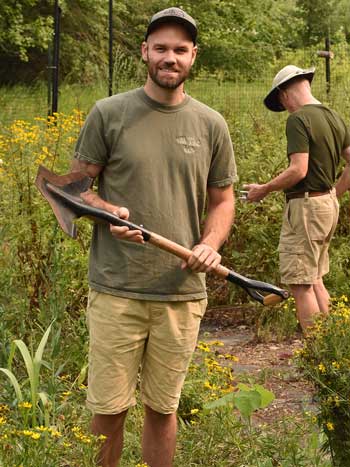
So, how does someone efficiently cut a root under the ground? The Parsnip Predator is a modified shovel that was designed specifically for this purpose by The Prairie Enthusiasts Prairie Bluff Chapter. Though obviously designed for wild parsnip, I’ve used it on other biennials such as sweet clover, burdock, and biennial thistles. I also find it handy to use on some annuals to minimize seed production, and for some perennials to set them back. I even use it for above ground severing of young tree sprouts when I’m double-cutting species such as aspen and sumac. I actually seldom use it as one would typically use a shovel, but rather just thrust the blade into the ground at an angle through the root of biennials or through the stems of perennials (and tree resprouts).

There are some advantages of root severing as opposed to other mechanical methods. As opposed to mowing, the severing allows the surrounding vegetation to stay intact, therefore not only leaving desirable species unharmed but providing shading of the potential resprouting biennial. Even though the repeated thrusting of the shovel is hard on the body, I find it less abusive than the constant bending over to pull biennials. And when it comes to parsnip, I like the idea of not having to grab a plant that has harmful juices in it! It can also be done under most soil moisture conditions, whereas pulling works best in moist soils.

The next time you need to address problems with biennials, consider using root severing to your potential management approaches and add a Parsnip Predator (or two!) to your toolshed.

Get Your Parsnip Predator Today!

Nate Lee holding a Parsnip Predator - Photo by Sarah Barrona

Watch this video to see the Parsnip Predator in action!

Spring is the time for girdling

Spring is the time for girdling

Jim Rogala

The intense transfer of materials within a tree at this time of the year makes for efficient girdling. Girdling is simply the removal of the “bark” to kill a tree. I use girdling as my go-to method for killing aspens clones. The method works best on clones where stems are at least an inch or two, although it can be used in combination with double cutting of the smaller stems (a topic for another post). It is critical to girdle all stems of a clone. I use it on a number of other species, including birch, but it doesn’t work on all species (e.g., box elder).

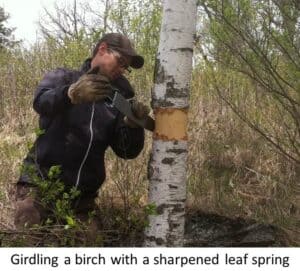
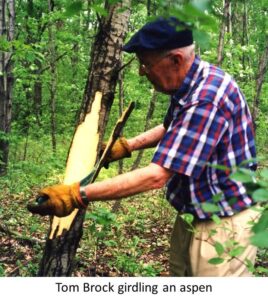
The key to successful girdling without using herbicide is to remove the outer layers (inner and outer bark) of the truck without injuring the innermost parts. I’ll bore you with the plant anatomy and physiology details in a later paragraph, but the details are really unneeded to accomplish the mission at this time of year. There is an obvious break between these layers when the tree is translocating a lot of materials upward, which is happening now. A person can simply run a tool between these layers around the entire circumference with a span of at least 6 inches wide. There’s no need to have clean cuts on the upper and lower ends of the separation, with the end-product often being somewhat banana-peeled looking.

There are a variety of tools that can be used to girdle, but from the description of the process above it’s obvious that a chainsaw is not one of them. For smaller trees, I often use a somewhat dull wide-bladed wood chisel. For larger trees, I use a flat pry-bar or a leaf spring cut to a manageable size and sharpened on one end. First I use the tool vertically to open an area to access the location between the layers, but this should be done without cutting too deeply into the tree. Then, put the tool between the layers horizontally and work it around the tree.

For those of you that are curious, here’s why this method works. There is a lot of specificity in the cells of a tree. There are those that transport materials upward in the inner layers (the xylem), and those that transport materials downward in the outer layer (phloem). Products stored in the roots, along with water, are sent upward. Products generated by photosynthesis in the leaves are sent downward. By removing the outer layer, the plant starves to death without the translocation of nutrients to the roots. You might be thinking that just cutting the tree might serve the same purpose. Well, that’s true for some species (such as cedars), but most trees have a strategy that includes resprouting from the base (or, like aspen, from rhizomes) when the xylem is disturbed. Be patient when looking for the results, as the tree will appear fine until the need for nutrients from the roots becomes great in the following spring. Sometimes it might take two years for the tree to die.

More information on girdling can be found by searching the web, but be careful to look for methods similar to what I’ve described here that don’t use herbicide. Tom Brock has a section on this topic on the Pleasant Valley Conservancy website (http://pleasantvalleyconservancy.org/brushandtrees.html). This method is not only effective, but minimizes the use of herbicides, which is attractive to me.

The Potential of Pastures and Oak Woods

The Potential of Pastures and Oak Woods

If you have an old field that you would like to plant to prairie or a stand of oak you would like to restore, don’t rush into it. Understand the history of the land and take time to observe and learn whether anything important remains. Very often degraded lands still harbor irreplaceable elements of biodiversity, and these have their own stories to tell about what a place was and could be. The tools we use in restoration can encourage these elements or extinguish them. By recognizing and preserving remnant populations of native species and their genes, we can counteract biotic homogenization[i], and sometimes we can reduce project complexity and expense in the process.

Many landowners with prairie planting projects in old fields or retired pastures already have important elements of the biodiversity they are trying to restore, many of which are commercially unavailable. Occasionally remnant populations of rare plants persist. Even areas that were formerly cultivated often support good prairie, savanna, and oak woodland species that have recolonized from the edges, or perhaps a neighboring oak savanna that has since become forest. In many cases as many desirable native species remain as would be required for a seed mix planted under a cost-share program! I have included a table with upland species often encountered in old fields and pastures; there are many more. It is not uncommon to encounter five to fifteen of these species in an old field and ten to twenty of them in a retired pasture.

In cases where there are some good things present, start by managing these areas as though they were still prairie. Selectively control encroaching woody vegetation and any patches of broad-leaved herbaceous weeds. Burn for a couple consecutive years during the dormant season to encourage anything good that might be suppressed by the thatch. See what happens and go from there, which will usually mean integrating inter-seeding, a lot of burning, and patience.

Many landowners with wooded ground have land that was once oak woodland, oak savanna, or oak barrens. Oak woodlands are conservation-worthy and rare, but they are sometimes mistaken for forests or inappropriately treated as savannas[i] or barrens. It is far more common to encounter structurally intact ground layer vegetation in heretofore unrestored woodlands than open savannas. In oak woodlands, good cover of Pennsylvania sedge or dry-spiked sedge often remains, and species that tend to favor dappled light vs. deep shade or full sun—poke milkweed, pale vetchling, yellow pimpernel, broad-leaved panic-grass, bearded shorthusk, purple Joe-pye weed, Carolina vetch, etcetera—are often still present. Even where oak woodlands have become shadier, that change has usually been more gradual and less in degree than in savannas. This has allowed more of the woodland vegetation to hang on.  Where a low sedgy or grassy ground layer remains, restoration might only involve modest brush work, removal non-oak understory hardwoods, non-oak overstory thinning/girdling, restoration of fire, and modest inter-seeding of missing species over time. Savanna restoration is critically important where true opportunities still exist, but good opportunities to restore oak woodland seem to be more common than savanna.

If you have an open area of cool-season grass or a stand of oak, I encourage you to take a closer look. You might discover there is more opportunity, or a different opportunity, than you initially thought. If you are looking for cost-share, go shopping for assistance that helps to build on what remains. Doing so should result in projects that conserve more community, species, and genetic diversity on the landscape.

Rich Henderson’s presentation “Converting Pasture to Prairie” on YouTube is an excellent resource.

______

i- Biotic homogenization is the process by which spatially separate ecological communities become more similar over time as the result of extinctions and invasions (or introductions).

ii- I use ‘savanna’ here in place of ‘oak opening’ for relatively open communities with mostly widely spaced, open-grown oak trees with prairie vegetation in-between.

______

Species Common Name and Notes
Andropogon gerardii Big bluestem
Antenneria spp. Pussytoes
Aristida spp. Three-awn grasses
Asclepias amplexicaulis Clasping-leaf milkweed, sandy sites
Asclepias syriaca Common milkweed
Asclepias tuberosa Butterfly milkweed, sandy sites
Asclepias verticillata Whorled milkweed
Besseya bullii Kittentails, P
Bouteloua spp. Gramma grasses, P
Carex brevior Great Plains oval sedge
Carex gravida Heavy sedge
Carex normalis Greater straw sedge
Carex umbellata Parasol sedge
Cirsium discolor Prairie thistle
Crocanthemum spp. Frostweeds, sandy sites
Desmodium canadense Showy tick-trefoil
Desmodium illinoense Illinois tick-trefoil
Dichanthelium spp. Rosette panic-grasses
Erigeron pulchellus Robin’s plantain
Fragaria virginiana Virginia wild strawberry
Gentiana alba Cream gentian
Lathyrus venosus Veiny Pea, P
Lechea spp. Pinweeds, sandy sites
Lespedeza capitata Round-headed bushclover
Lithospermum caroliniense Hairy puccoon, sandy sites
Lobelia spicata Pale-spiked lobelia, P
Lysimachia lanceolata Lance-leaved loosestrife, sandy sites
Monarda fistulosa Bergamot
Oenothera perennis Small sundrops, P
Packera paupercula Balsam ragwort, P
Penstemon gracilis Lilac beardtongue, sandy sites
Primula meadia Midland shooting star, P
Pycnanthemum virginianum Mountain mint
Ranunculus fascicularis Early buttercup, P
Ratibida pinnata Yellow coneflower
Rudbeckia hirta Black-eyed Susan
Schizachyrium scoparium Little bluestem
Solidago juncea Early goldenrod
Solidago nemoralis Old field goldenrod
Solidago rigida Stiff goldenrod
Solidago speciosa Showy goldenrod
Sorghastrum nutans Indiangrass
Symphyotrichum oolentangiense Sky-blue aster, P
Tradescantia ohiensis Ohio spiderwort
Verbena stricta Hoary vervain
Viola sagittata Arrow-leaved violet

‘P’ used for species more often found in pastures than old fields

[i] I use ‘savanna’ here in place of ‘oak opening’ for relatively open communities with mostly widely spaced, open-grown oak trees with prairie vegetation in-between.

The Parsnip Predator: Handy and Homegrown

The Parsnip Predator: Handy and Homegrown

If you’re not familiar with the Parsnip Predator, you’re missing out!

Invented and produced by members of The Prairie Enthusiasts’ Prairie Bluff Chapter, the Parsnip Predator is a tool designed for prairie invaders like wild parsnip (Pastinaca sativa) and burdock (Arctium minus). It has gone through a few changes over the years, but it’s still just as useful for tackling taproots.

Now’s the time to “gear up” for another season of restoring healthy prairies. Visit our eStore and get your own Predator in time for the first wave of parsnip!

Thanks to The Prairie Enthusiasts volunteer Nick Faessler for the use of his workshop to create these useful tools, and for these photos showing the process.

Volunteer Gary Kleppe sharpens the notched blade of a Predator.

Once the Predators are branded, they’re ready to go!

Safe Burning, Safe Learning

Safe Burning, Safe Learning

This article was a collaboration with Jeb Barzen. 

Interested in pitching in to save our fire-dependent ecosystems? The Prairie Enthusiasts’ next prescribed burn crew training will be an online-only class on Wednesday, February 12, 2025 (the first day of our annual conference). Instructors Rob Baller, Scott Fulton, Rob Schubert and Andy Sleger from the Empire-Sauk Chapter will lead this all-day event. Visit the conference page to learn more.

More fire safelyand effectivelyon the ground.

That’s the wish of educator and Wisconsin Prescribed Fire Council member Jeb Barzen. “In Wisconsin we are currently burning 5-10% of our fire-adapted communities that require periodic fire management,” notes Jeb, who is also a site steward for The Prairie Enthusiasts. “The longevity of these remnant ecosystems, that intelligent tinkerers wish to save, is vanishing. Concurrently, we have more landowners (both private and public) that want burning to be done than we have resources to respond.”

To develop more trained fire ecologists, Jeb and co-instructors Rob Nurre, Rob Baller, and Scott Fulton have organized a series of annual prescribed burn classes over the last five years. In 2020, The Prairie Enthusiasts’ Prairie Sands Chapter sponsored two basic burn training sessions in October and November. Despite the unusual circumstances, both classes were a success.

Each class was held outside and followed The Prairie Enthusiasts’ guidelines for events during COVID-19. Class sizes were limited to eight masked students representing a range of ages and backgrounds. The students took notes from lawn chairs spaced apart in the grass while the instructors taught at a distance, using a whiteboard to diagram burn scenarios. Interspersed with these lectures were field explorations of how fuel types relate to fire behavior and weather. Whether or not the weather would allow actual fire was a lesson in itself.

Burn_1.jpg

Outdoor lecture. Photo by Rob Baller

Friends and members of The Prairie Enthusiasts generously offered the use of their private properties for these classes. The October 31 class convened at Cassell Savanna in Sauk County. On this cold and windy Halloween day, the students wore thick hats and long underwear. By the time the second class (at Prairie Hill Farm in Marquette County) rolled around a week later, the weather had changed to 70°F with all sunshine.

Field training at Cassell Savanna. Photo by Rob Baller

Despite the difference in temperature, both weekends were made more complicated by high winds. Live fire was at a minimum; only the students in the second class could practice burning breaks, and only in the shelter of the woods. Even so, the students remained engaged, socially distant, and open to the lessons that these conditions provided.  Students later described the class as “interesting, engaging, enjoyable” and even “the best of the [burn classes] that I’ve taken”.

Nevertheless, two small classes alone won’t solve the problems facing fire ecologists. More frequent and widespread training is required. “Just a few unsafe fires can greatly inhibit our overall ability to burn because the public will not support risky ventures,” Jeb observes. “Ineffective fires also waste limited resources that we can ill-afford to squander… Sponsors of prescribed burn courses provide both fire practitioners and pyroecologists the very basis necessary to succeed at conservation.  We need to do more.”

Field training at Prairie Hill Farm. Photo by Rob Baller