Smith-Reiner Drumlin Prairies

Smith-Reiner Drumlin Prairies

Smith-Reiner Drumlin Prairies

This special 40-acre preserve located in eastern Dane County, WI encompasses two dry upland remnants of original prairie on drumlin hills with massive displays in August of cylindrical and rough blazing stars. The site harbors over 100 native prairie species including stunning displays of early spring wildflowers and a healthy population of the federally-threatened prairie bush-clover. Since the preserve is all in grassland cover, many grassland birds use it for nesting, including eastern meadowlark, field sparrow, dickcissel, grasshopper sparrow and (outside of breeding season) short-eared owl.


Blazing star on Smith-Rainer Drumlin Prairies. Photo by Moua Yang.

Smith-Reiner Drumlin Prairies

Blazing star on Smith-Rainer Drumlin Prairies. Photo by Moua Yang. 

This special 40-acre preserve located in eastern Dane County, WI encompasses two dry upland remnants of original prairie on drumlin hills with massive displays in August of cylindrical and rough blazing stars. The site harbors over 100 native prairie species including stunning displays of early spring wildflowers and a healthy population of the federally-threatened prairie bush-clover. Since the preserve is all in grassland cover, many grassland birds use it for nesting, including eastern meadowlark, field sparrow, dickcissel, grasshopper sparrow and (outside of breeding season) short-eared owl.

Access & Directions

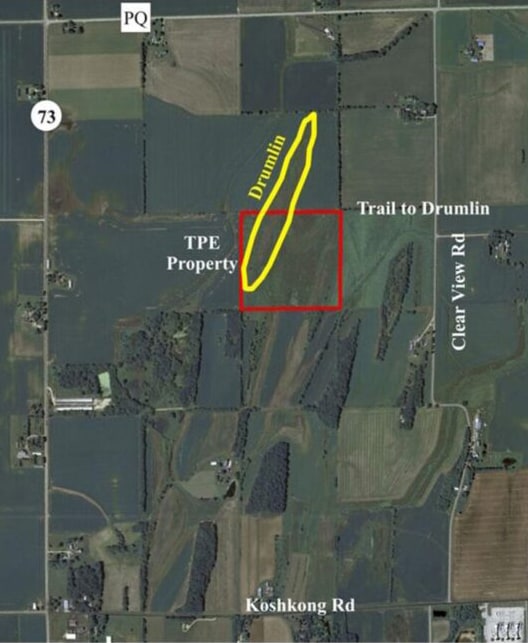
From the intersection of Highway 12/18 and Highway 73 (two miles west of Cambridge, WI) go south on Highway 73 for 1.5 miles, then east on County Highway PQ for 1 mile, then south on Clearview Road for 0.5 mile. Park in the small parking lot off of Clearview Road and walk west .25 miles on an old farm lane into the natural area.

Google Map

Site Stewards

Connect with the site stewards to see how you can care for this rare habitat at an upcoming work party.

This site is managed by The Prairie Enthusiasts Empire-Sauk Chapter.

Site Steward: Gary Birch: (608) 873-8837 or (Email) and Jane Graham (Email)

Upcoming Events Here

How to Enjoy This Site

Allowed:

  • Hiking
  • Bird Watching
  • Research by permit only
  • Hunting White Tailed Deer (all seasons; no permit or reservation required)
  • Hunting Ring-necked Pheasant (all seasons; no permit or reservation required)

    Not Allowed:

    • Vehicles, including bicycles
    • Camping, campfires, or picnics
    • Pets (except for dogs for pheasant hunting)
    • Horseback riding
    • Collecting seeds, flowers, plants or rocks, or any natural items

    Please clean boots and clothes before entering to help limit introduction of invasive species.

    How to Enjoy This Site

    Allowed:

    • Hiking
    • Bird Watching
    • Research by permit only
    • Hunting White Tailed Deer (all seasons; no permit or reservation required)
    • Hunting Ring-necked Pheasant (all seasons; no permit or reservation required)

    Please clean boots and clothes before entering to help limit introduction of invasive species.

      Not Allowed:

      • Vehicles, including bicycles
      • Camping, campfires, or picnics
      • Pets (except for dogs for pheasant hunting)
      • Horseback riding
      • Collecting seeds, flowers, plants or rocks, or any natural items


        Summer on Smith-Reiner Drumlin Prairies. Photo by Joshua Mayer.

        What Makes Smith-Reiner Drumlin Prairies Special

        The Prairie Enthusiasts and Wisconsin Department of Natural Resources have ranked Smith-Reiner Drumlin Prairies as a top-tier prairie remnant. The term drumlin is from an Irish word meaning “little hill.” Drumlins are long, narrow whale-shaped hills that were formed by glaciers and are composed of the till (rock, gavel, and sand) pushed along and ground up under the ice. The last glacier to move across southeast Wisconsin did so in a northeast to southwest direction, thus the setting orientation of the hills.

        The site contains two linear, parallel, drumlin hills formed by the passing of the last glacier more than 11,000 years ago. Such glacially sculpted ridges or drumlins are a common feature between Madison and Milwaukee, and they once were covered with prairie and savanna. Southern Wisconsin is world famous for its rare drumlins. In the 1840s, Smith-Reiner Drumlin Prairie was part of a 7,000-acre treeless prairie that had been in place for 4-5 thousand years.

        The drumlins are composed of glacial till (subglacial rock soil debris) including deposits of sand and gravel, making for a blend of dry, dry-mesic, and even a few pockets of mesic prairie of varying soil pH. The east drumlin has a sandier soil with a lower pH level (acidic) and the west drumlin soil contains dolomitic limestone bedrock slopes with a higher pH level (alkaline). Agriculture was unsuited to grow croplands on drumlins due to their gravelly consistency. The preserve’s prairie remnants were grazed until sometime in the early 1950’s, thus they are not pristine. The berms evident along the base of the hills were constructed in the 1960s, as part of a federal soil conservation practice that has since fallen out of use. Today, the driest portions of the preserve are now once again high quality prairie, and more mesic areas are recovering nicely with a good population of native species.

        When European settlers first came to this area, they found a vast sea of grasses and wildflowers that were part of a continuous tallgrass prairie ecosystem stretching west to the Great Plains. These prairies had many species of grasses such as big and little bluestem and Indian grass that grew to heights of five to six feet, limited tree cover, and hundreds of species of wildflowers. Frequent fires that occurred either naturally, through lightning strikes, or through the actions of Native Americans, limited the encroachment of most trees and shrubs. Some trees such as bur oaks could survive frequent fires due to their fire-resistant bark, but only in low numbers. Fires also stimulated growth of prairie grasses and wildflowers. The deep roots of prairie plants develop rich, fertile soils that were eventually prized by European settlers for agricultural use. When the invention of the mould board plow allowed the native prairie sod to be busted and converted to crop fields, over 99% of original tallgrass prairie was lost. As a result, many species that relied upon prairies are now rare. Of the prairie and grassland species found in Wisconsin, 41 are listed as endangered or threatened.

        Today, the preserve’s hills are still covered with their original sod of prairie plants (13 acres) which have been in place for at least 4-5 thousand years. The remnants are imbedded within productive cropland (28 acres) which have been enrolled in the USDA Conservation Reserve Program (CRP) since 1988.  Originally, planted to smooth brome grass, The Prairie Enthusiasts is now converting these fields to prairie vegetation with the first seeding done in the fall of 2013.

        Prairie dropseed is a type of now uncommon prairie grass that is important to many prairie species of leafhoppers, including Memnonia panzeri, a State Special Concern species that feeds exclusively on this plant. Both the grass and the rare leafhopper are present on this preserve.

        A few pockets of deeper soil on the drumlins support species such as this prairie lily (Lilium philadelphicum) compass plant and rattlesnake master that are more typical of mesic (deep soil) prairies. Prairie lily plants will grow on both acid and high pH soils and grow best in dry-mesic to mesic habitat. It takes seven to eight years before a prairie lily plant growing in the wild will get big enough to bloom.

        Plant Communities

        Early season blooming forbs: 

        • bird’s foot violet (Viola pedata)
        • prairie violet (Viola pedatifida)
        • blue-eyed grass
        • hoary puccoon (Lithospermum canescens)
        • prairie smoke (Geum triflorum)
        • spiderwort

        Mid-summer blooming forbs:  

        • black-eyed Susan (Rudbeckia hirta)
        • common milkweed (Asclepias syriaca)
        • whorled milkweed (Asclepias verticillata)
        • compass plant (Silphium laciniatum)
        • flowering spurge (Euphorbia corollata)
        • lead plant (Amorpha canescens)
        • pale purple coneflower (Echinacea pallida)
        • prairie coreopsis (Coreopsis palmata)
        • prairie dock (Silphium terebinthinaceum)
        • prairie lily (Lilium philadelphicum)
        • purple prairie clover (Dalea purpurea)
        • rattlesnake master (Eryngium yuccifolium)
        • wild rose
        • yellow coneflower (Ratibida pinnata)

        Last season blooming forbs:

        • cylindrical blazing star (Liatris cylindracea)
        • rough blazing star (Liatris aspera)
        • downy gentian (Gentiana puberulenta)
        • flax-leaved aster (Ionactis linariifolia)
        • heath aster (Symphyotrichum ericoides)
        • silky aster (Symphyotrichum sericeum)
        • sky-blue aster (Symphyotrichum oolentangiense)
        • smooth blue aster (Symphyotrichum laeve)
        • prairie sunflower (Helianthus petiolaris)
        • western sunflower (Helianthus occidentalis)
        • common goldenrod (Solidago canadensis)
        • Missouri goldenrod (Solidago missouriensis)
        • old-field goldenrod (Solidago nemoralis)
        • showy goldenrod (Solidago speciosa)
        • stiff goldenrod (Solidago rigida)

        Cool season grasses:  porcupine grass, early panic-grass, prairie panic-grass and Scribner’s panic-grass

        Warm season grasses:  little and big bluestem, Indian grass, prairie dropseed, switchgrass The Prairie Enthusiasts has recently planted into the CRP (former cropland) areas some species that were not present as remnant populations on the site (hence missing from the plant list), but which have a high probability of having been present in pre-settlement times, based on what is known about the region’s flora and ecology. The introduced species are mostly ones characteristic of deep soil mesic to wet-mesic prairie communities that were lost from the site following introduction of agriculture to the land, plowing of the deep soil and grazing of the un-plowed prairie remnants. The site’s remnants represent only the dry soil end of the prairie community continuum, and thus lack many deep soil species. Past grazing may also have eliminated some species.

        Insects, Birds & Animals

        The majority of prairie forbs rely on pollinating insects to transfer pollen from one plant to another to insure abundance of flower seed and plant generation. Pollinators are a key to the health and vigor of the prairie. Prairie provides bees and other pollinators with a continuity of food resources throughout the season. Large patches and massive swirls of flowers allow bees more efficient access to the blooming plants. Monarda, common and whorled milkweed, mountain mint, Culver’s root, prairie clover and pasture thistle are good foundation plants for pollinators.

        Insects: red-headed thatching ant, prairie leafhopper, clay-colored leaf beetle, goldenrod soldier beetle, black swallowtail, tiger swallowtail, silver-bordered fritillary, monarch, skipper, spring azure, pearl crescent butterfly, ten-spotted skimmer dragonfly, katydid, milkweed leaf beetle, small milkweed bug, red milkweed beetle, milkweed tussock larva, shield bug, bumble bee, weevil

        Birds: dickcissel, bobolink, yellowthroat, eastern meadowlark, field sparrow, grasshopper sparrow, chipping sparrow, song sparrow, tree sparrow, house sparrow, yellow cuckoo bird, bluebird, cedar waxwing, cat bird, gold finch, brown thrasher, indigo bunting, kingbird, ruby throated hummingbird, killdeer, morning dove, robin, downy woodpecker, redwing blackbird, sandhill crane, ring-necked pheasant, wild turkey and (outside of breeding season) short-eared owl

        On November 24, 2013, Gary Birch and Rich Henderson observed a short-eared owl at Smith-Reiner Drumlin Prairies, and again on December 21 of that year. This owl is a rarely seen specialist of open grasslands. It was flushed at midday out of knee-high grass where it had been roosting. This interesting species, with a wingspan of 33-to- 43 inches, requires large, treeless areas of grassland, sedge meadow, or marsh habitat to establish breeding territories (it nests on the ground) and for hunting areas. Short-eared owls hunt mostly at night but sometimes also during the day. They are most often seen at dawn and dusk sitting on fence posts or flying low over open ground using a low, slow, graceful flight reminiscent of a butterfly and locating prey by ear. They hunt small mammals such as voles, shrews, mice, rabbits and, occasionally, birds. The preserve is not currently large enough to ever hope to entice the owls to nest there, but the grassland habitat is clearly sufficient to provide critical feeding and resting habitat during spring and fall migrations.

        Mammals: American badger, coyote, meadow jumping mouse, red fox, thirteen-lined ground squirrel, white tail deer, woodchuck

        Amphibians: eastern gray treefrog
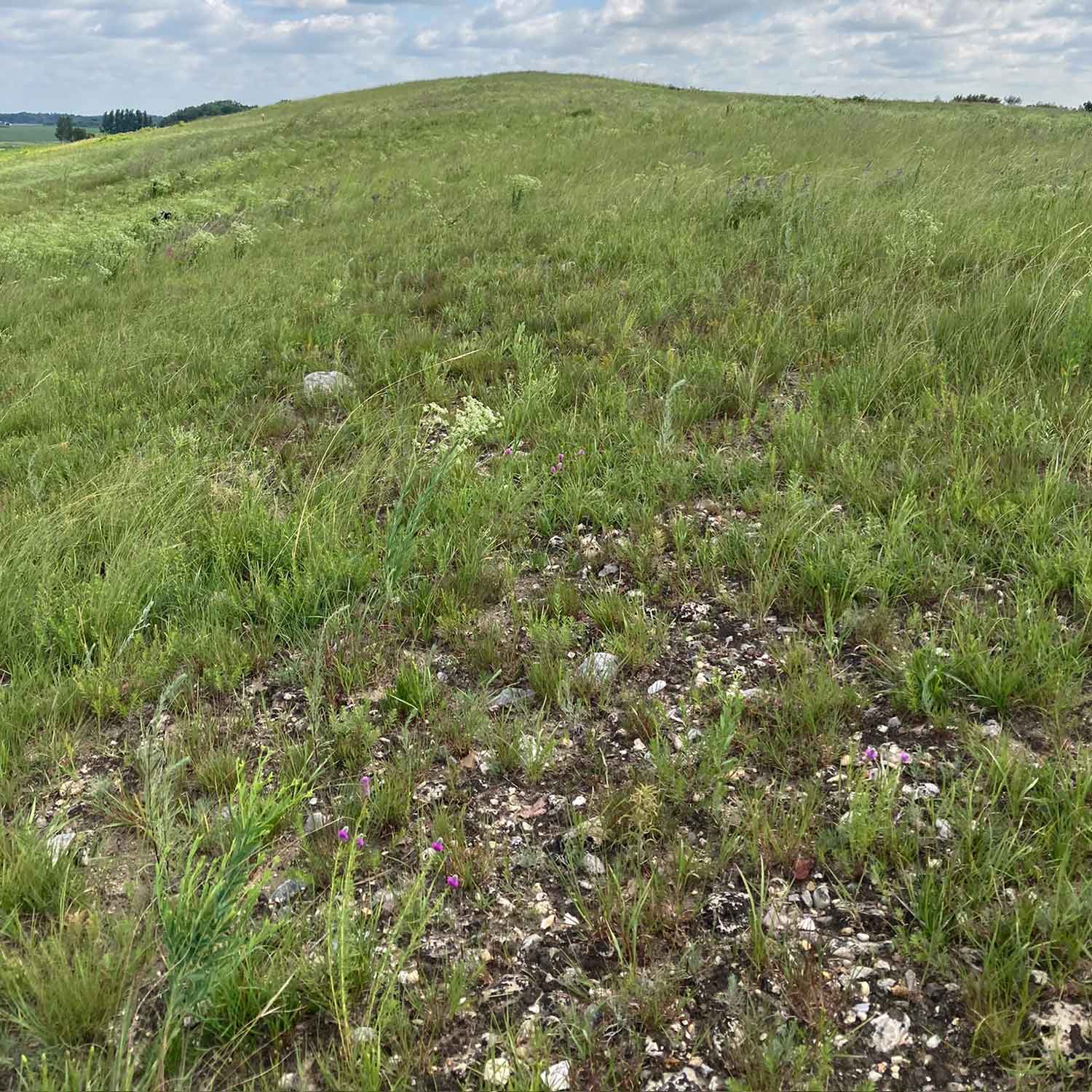
        A view of Smith-Reiner Drumlin Prairies and the “little hill.” Photo by Dan Carter.
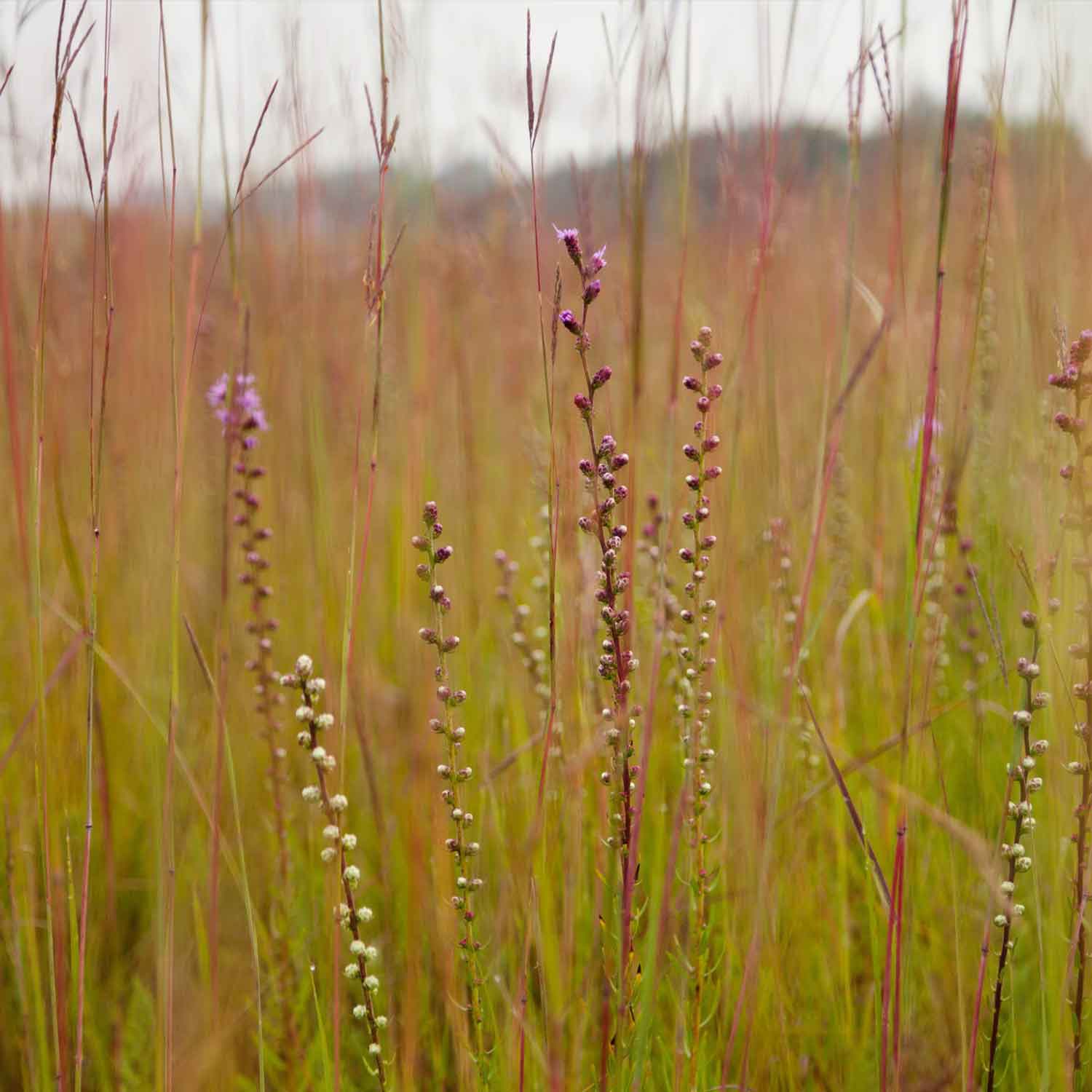
        Grasses and wildflowers at Smith-Reiner Drumlin Prairies. Photo by Moua Yang.
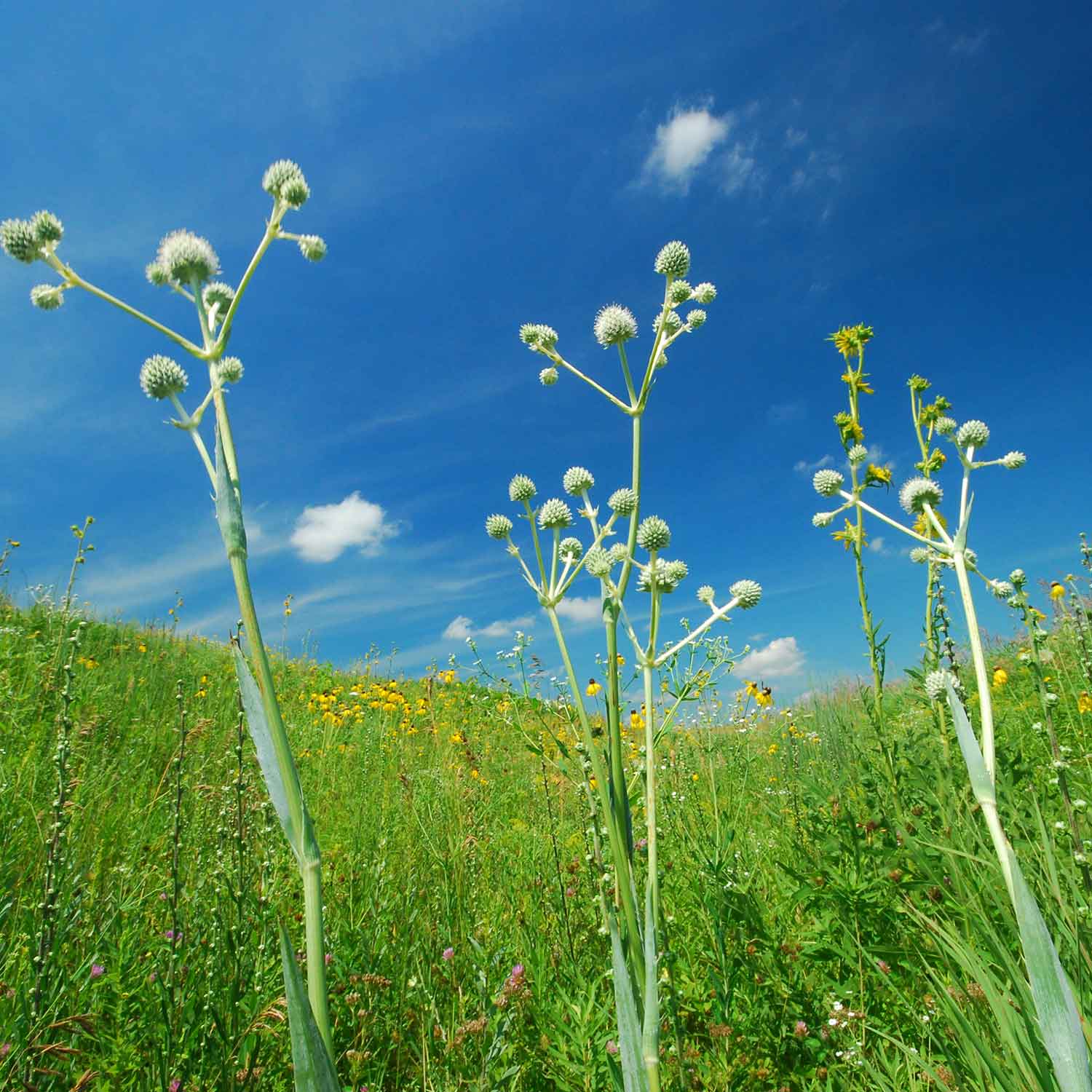
        Rattlesnake master at Smith-Reiner Drumlin Prairies. Photo by Joshua Mayer.
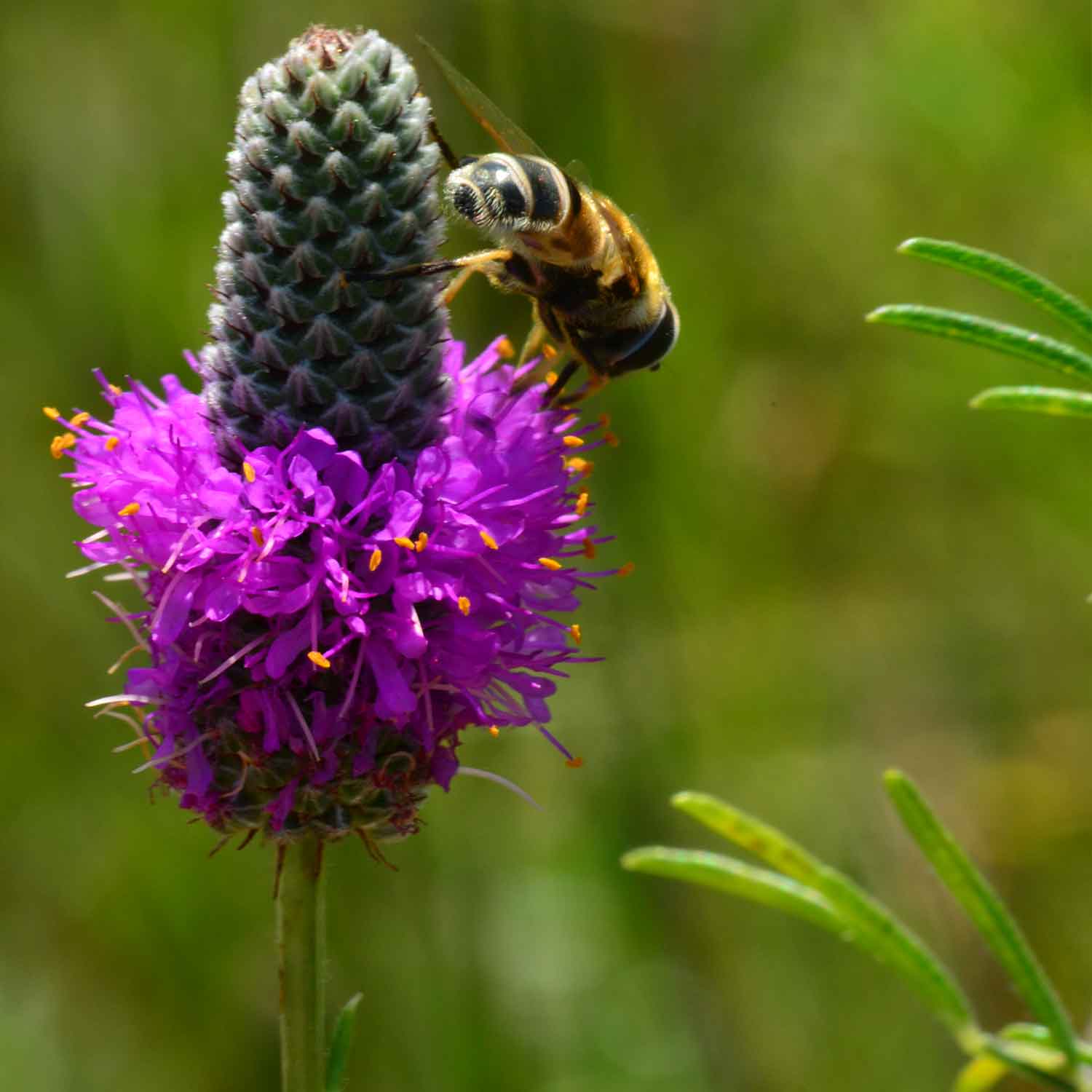
        Purple prairie clover with a bee visitor at Smith-Reiner Drumlin Prairies. Photo by Joshua Mayer.

        How was Smith-Reiner Drumlin Prairies Protected

        In 2011, on the day before Thanksgiving, Glenn Smith, long-time member and supporter of The Prairie Enthusiasts, permanently protected his drumlin prairies with the sale of his 40 acres to The Prairie Enthusiasts. Funding was provided by grants from the USFW Service and the Dane County Conservation Fund. The Smith-Reiner family owned this land since the 1920s. The preserve was named in honor of Glenn’s mother, Phyllis Reiner Smith. Prior to The Prairie Enthusiasts’ involvement, the Dane County Environment Council recognized the family with a certificate of appreciation in 1984. Glenn recalls:

        “As a boy, my grandmother would take us to the hills on the family farm to see the early spring Wind (Pasque) flowers and late summer Blazing Star (Liatris). We didn’t know about drumlins and thought prairies were elsewhere. We just knew that the drumlins on the farm were too rocky to plow.

        Decades later I returned to the farm to give my mother Phyllis Reiner Smith a hand. A chance meeting with Rich Henderson who was representing The Prairie Enthusiasts at the Madison Garden Expo permitted me to inquire about ways to preserve and protect the prairie drumlins. I was surprised to find that he had been on our prairie and was very interested in getting involved.

        Rich met many times with my mother and me, and alleviated her fears about removing trees. Over the next 10 years TPE volunteers cataloged plants, animals, birds and insects, removed trees and invasive species, and burned parts of the drumlins each year. A long term management plan was developed. Shirley Ellis, a volunteer who spent hundreds of hours working on the drumlins discovered the very rare Prairie Bush Clover, which enhanced the prairie’s value for preservation.

        It finally became apparent that the drumlins needed permanent stewardship. The opportunity arose about five years ago for The Prairie Enthusiasts to purchase the property. It is now protected, designated as a State Natural Area and open to the public for all to enjoy.”

        In 2003, Shirley Ellis, local conservationist, discovered five plants of the federally-threatened prairie bush clover, Lespedeza leptostachya. By 2010, after brush clearing and prescribed burns by The Prairie Enthusiasts volunteers, the prairie bush clover population had increased to 113 plants. The U.S. Fish and Wildlife Service provided funding to help acquire the site because of the presences of this threatened species. It is restricted to original prairie sod, and is known only from four states:  Iowa, Illinois, Minnesota and Wisconsin. Loss of habitat is the main reason for its rarity.

        In 2005, another rare plant, pale purple coneflower (Echinacea pallida, threatened in WI) was introduced to the site using seed from a native population near Cross Plains, WI in western Dane County.

        Phyllis Reiner Smith, whose family were previous owners of the land, remembered looking for spring wildflowers on the drumlin hills as a child (ca. 1929-1935), especially the pasque flowers which are present at Smith-Reiner Drumlin Prairie.

        Smith-Reiner Drumlin Prairies is now managed by the Empire-Sauk Chapter as a Wisconsin State Natural Area.
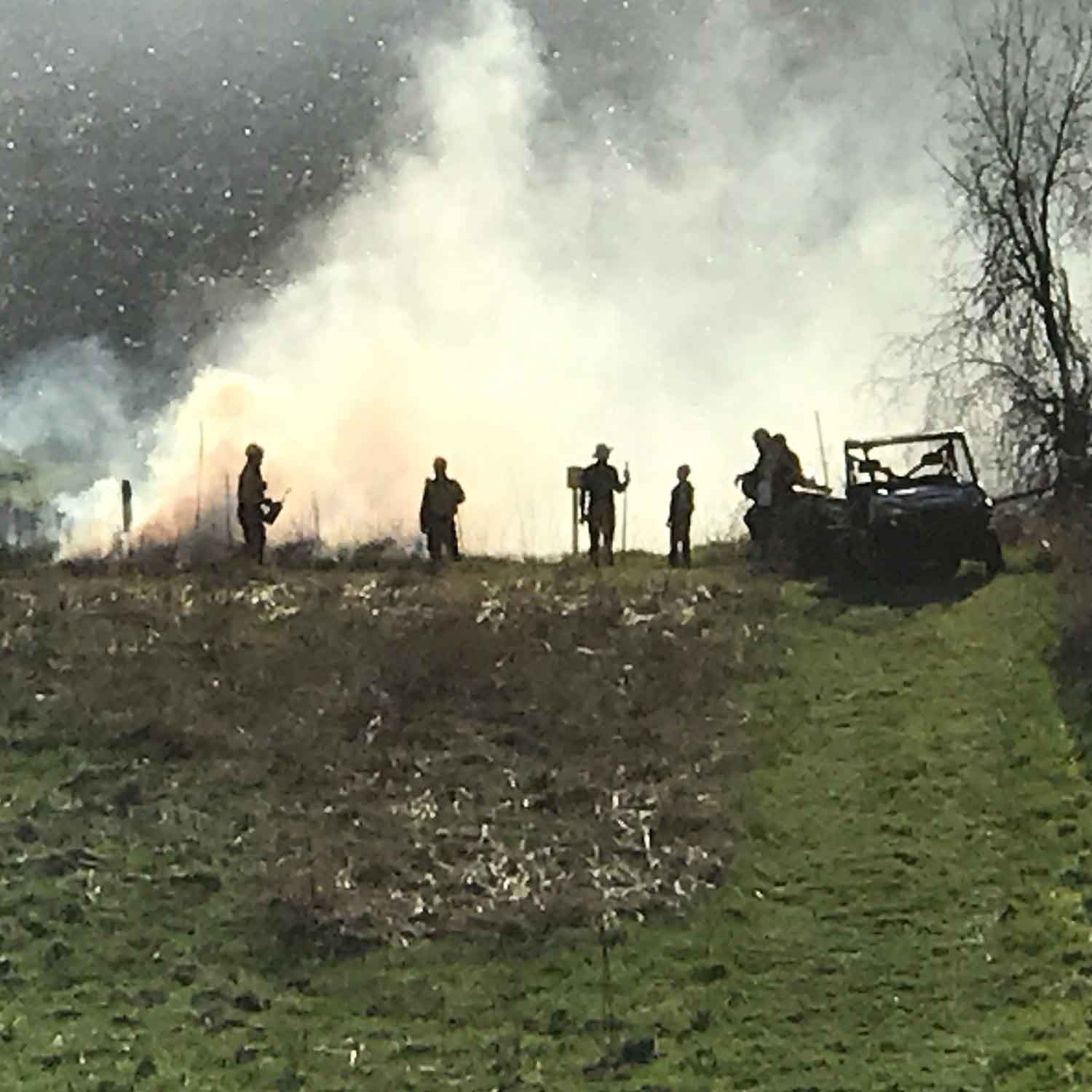
        Prescribed burn at Smith-Reiner Drumlin Prairies. Photo by Jane Graham.

        How You Can Help Smith-Reiner Drumlin Prairies

        In 2000, The Prairie Enthusiasts began habitat management at Smith-Reiner Drumlin Prairies under an informal management agreement with the landowner, Phyllis Reiner Smith, to restore and care for their prairie remnants. The U.S. Fish and Wildlife Service Private Land Office provided grants during that time to clear trees and brush.

        In the late 1980s and in 1992 the Wisconsin Department of Natural Resources wildlife managers burned the western most prairie remnant. Management activities have continued with selective prescribed burnings. In 2013, the agricultural lands of 28 acres were planted into native grasses and forbs by The Prairie Enthusiasts. The long-term management goals for Smith-Reiner Drumlin Prairie are to restore the site, as much as feasible, back to the original prairie ecosystem that was present 170 years ago, to provide critical habitat for rare and declining species, and to provide opportunity for people to experience and enjoy the area’s prairie heritage.

        Volunteers are the backbone of the restoration and management work being done at Smith-Reiner Drumlin Prairies. If you are interested, we welcome help with activities such as seed collecting, processing and planting, invasive plant and brush control, prescribed burning, citizen science like Monarch Larva Monitoring Project, conducting plant/bird/wildlife surveys, photographing events and more.

        Check out our Events Calendar to see upcoming work parties or contact the site steward to get involved.
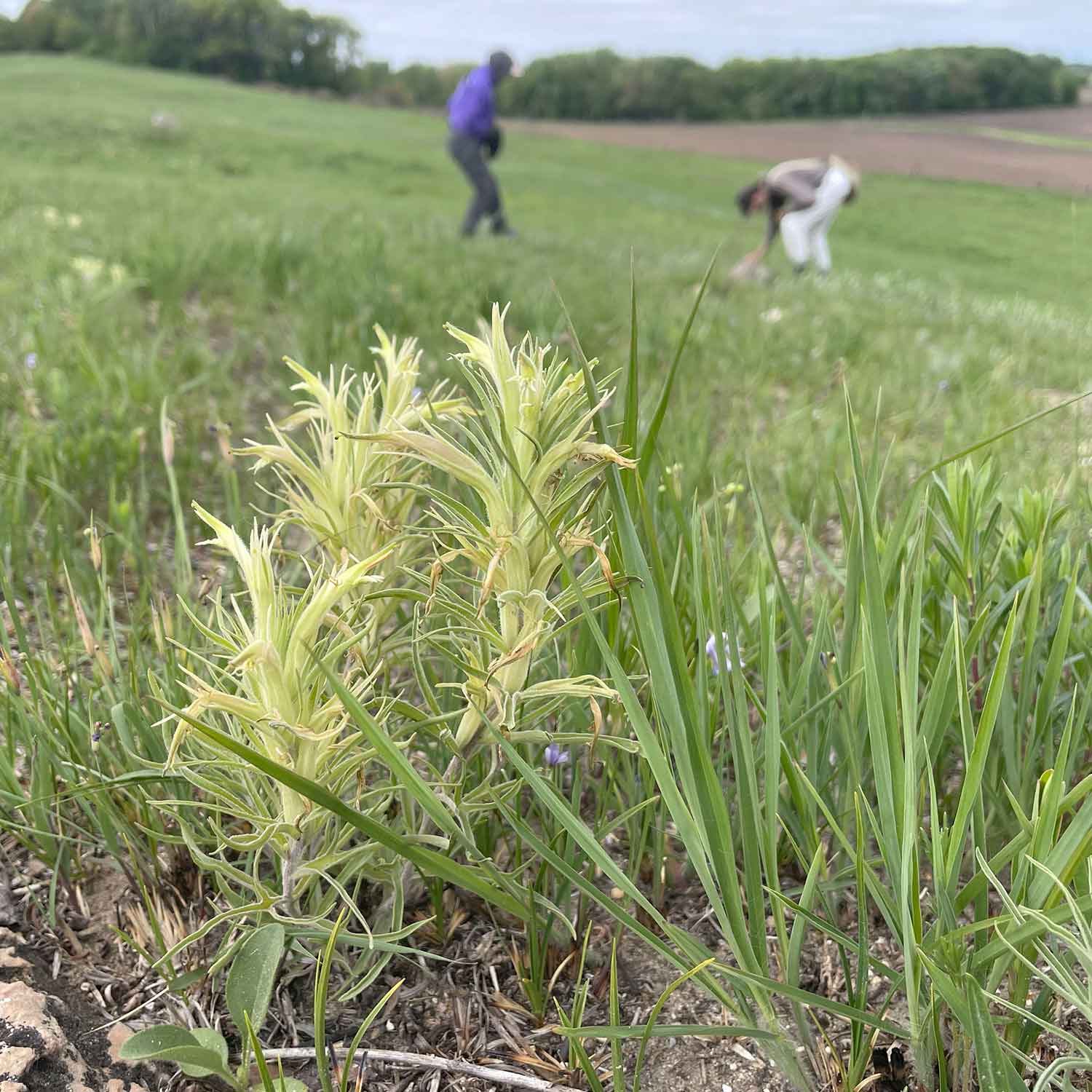
        Volunteers exploring at Smith-Reiner Drumlin Prairies. Photo by Rob Baller.

        Schluckebier Sand Prairie

        Schluckebier Sand Prairie

        Schluckebier Sand Prairie

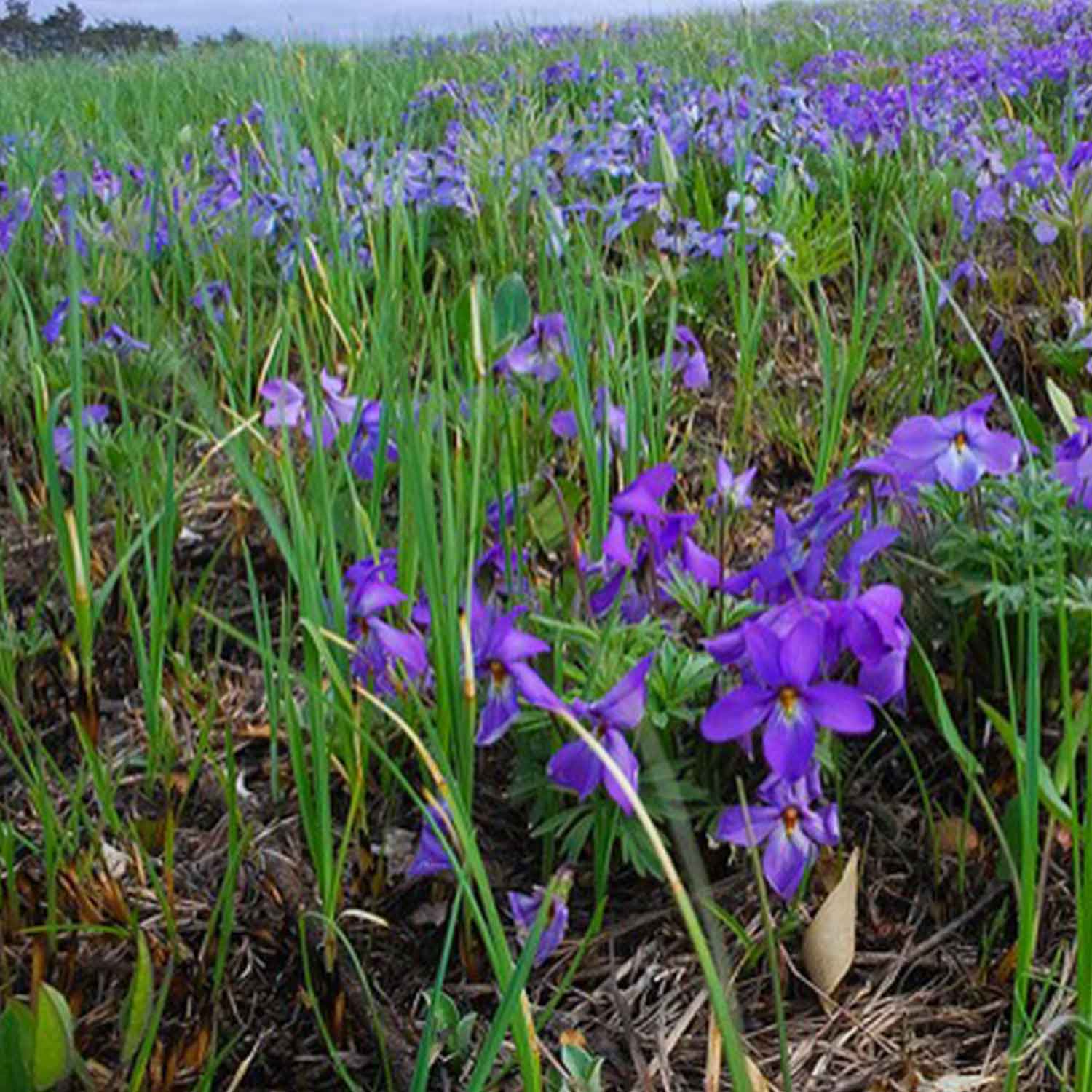
        This site is one of the last surviving remnants of the 14,000 acre Sauk Prairie, a vast grassland that covered the area prior to European settlement. The small dry to dry-mesic prairie is situated on part of an old Wisconsin River terrace. The prairie supports a good diversity of native plants and insects including plants such as little bluestem, June grass, Virginia dwarf dandelion, short green milkweed, bird’s-foot violet, pasque flower, prairie smoke, flowering spurge, spiderwort, and rough blazing-star.


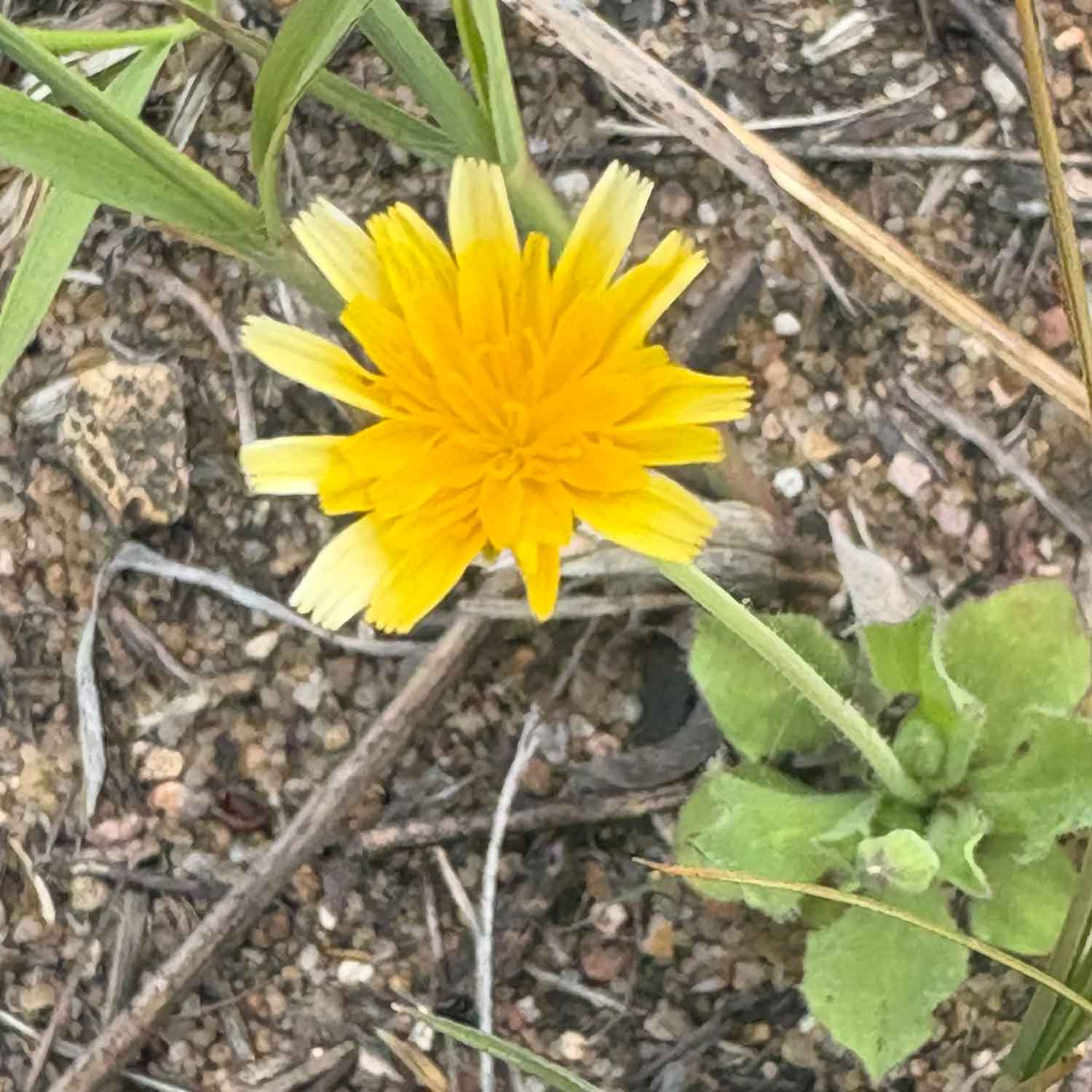
        Yellow blooms on Schluckebier Sand Prairie. Photo by Dan Carter.

        Schluckebier Sand Prairie

        Yellow blooms on Schluckebier Sand Prairie. Photo by Dan Carter.

        This site is one of the last surviving remnants of the 14,000 acre Sauk Prairie, a vast grassland that covered the area prior to European settlement. The small dry to dry-mesic prairie is situated on part of an old Wisconsin River terrace. The prairie supports a good diversity of native plants and insects including plants such as little bluestem, June grass, Virginia dwarf dandelion, short green milkweed, bird’s-foot violet, pasque flower, prairie smoke, flowering spurge, spiderwort, and rough blazing-star.

        Access & Directions

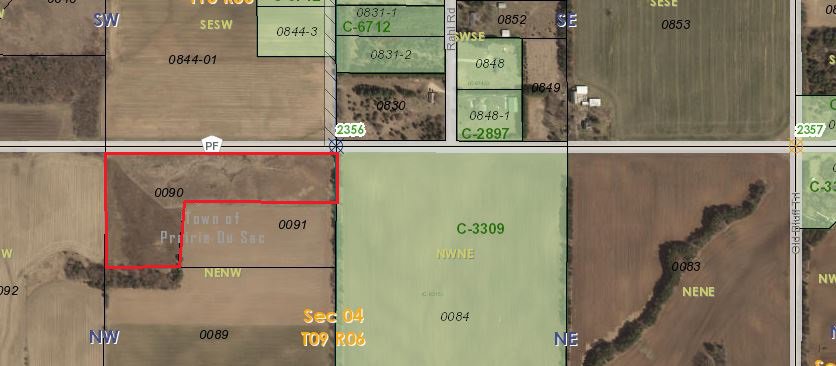
        Take US Highway 12 west of Sauk City until you get to the light at County PF.  Turn left (west) onto Co. PF and travel 1.5 miles, at which point there is a dirt lane immediately beyond a row of trees on the left.  Turn left (south) into the lane and look for the small mowed parking area about 100 down the lane.

        Google Map

        Site Steward

        Connect with the site steward to see how you can care for this rare habitat at an upcoming work party.

        This site is stewarded by The Prairie Enthusiasts Empire-Sauk Chapter.

        Site Steward: Brandon Mann: (413) 427-4099 or (Email)

        Upcoming Events Here

        No event found!

        What Makes Schluckebier Sand Prairie Special

        Schluckebier (SCHLUCK-e-beer) is a German name meaning “drink a beer”.

        The prairie supports a good diversity of native plants and insects.

        Notable Species:

        • prairie bush-clover (Lespedeza leptostachya)
        • little bluestem (Schizachyrium scoparium)
        • June grass (Koeleria macrantha)
        • Virginia dwarf dandelion (Krigia virginica)
        • short green milkweed (Asclepias viridiflora)
        • bird’s-foot violet (Viola pedata)
        • pasqueflower (Anemone patens)
        • prairie smoke (Geum triflorum)
        • flowering spurge (Euphorbia corollata)
        • spiderwort
        • rough blazing star (Liatris aspera)

        Sand prairie is a dry native grassland community dominated by grasses such as little bluestem, junegrass, panic grasses, and poverty-oat grass. Common herbaceous associates are sand cress, field sage-wort, western ragweed, several sedges (e.g., Carex muhlenbergii, Cyperus filiculmis, and Cyperus schweinitzii), flowering spurge, frostweed, round-headed bush-clover, western sunflower, false-heather, long-bearded hawkweed, stiff goldenrod, horsebalm, and spiderwort. Drought-adapted fungi, lichens, and mosses are significant components of sand prairie communities.

        Virginia dwarf-dandelion at Schluckebier Sand Prairie. Photo by Dan Carter.

        How was Schluckebier Sand Prairie Protected

        The site is owned by The Prairie Enthusiasts and was designated a State Natural Area in 2006.

        Violets at Schluckebier Sand Prairie. Photo by unknown photographer.

        How You Can Help Schluckebier Sand Prairie

        Except for a few small patches on slopes and along the edges, it is believed that the entire site had been plowed as early as the 1850s. An area to the south was also grazed until 1969. Because of its sandy soil and rapid depletion of nutrients, the site was abandoned for cultivation purposes and native species that had disappeared were able to recolonize the prairie. Also present, perhaps due in part to human disturbance, are sand blows that provide microhabitats for specialists like false heather, a pioneer plant that helps stabilize the sand blows. Today, with a management regime of prescribed fire, brushing, and invasives control the condition of the prairie is improving.

        Check out our Events Calendar to see upcoming work parties or contact the site steward to get involved.

        View of Schluckebier Sand Prairie. Photo by Dan Carter.

        Shea Prairie

        Shea Prairie

        Shea Prairie

        This 103-acre preserve is located within the dissected, un-glaciated landscape of southwest WI. It lies within what was once a large prairie that extended north to the Military Ridge, covering many thousands of acres. The preserve is within the 50,000-acre Military Ridge Prairie Heritage Area (MRPHA). The MRPHA has been identified as one of the best opportunities in Wisconsin for prairie/grassland conservation on a landscape scale. In addition to grassland bird use of the area, there are three state-listed plant species at the site: prairie turnip (Pediomelum esculentum), Richardson’s sedge (Carex richardsonii), and Hill’s thistle (Cirsium pumilum).


        Walking through Shea Prairie during wetland monitoring. Photo by Rob Baller.

        Shea Prairie

        Walking through Shea Prairie during wetland monitoring. Photo by Rob Baller.

        This 103-acre preserve is located within the dissected, un-glaciated landscape of southwest WI. It lies within what was once a large prairie that extended north to the Military Ridge, covering many thousands of acres. The preserve is within the 50,000-acre Military Ridge Prairie Heritage Area (MRPHA). The MRPHA has been identified as one of the best opportunities in Wisconsin for prairie/grassland conservation on a landscape scale. In addition to grassland bird use of the area, there are three state-listed plant species at the site: prairie turnip (Pediomelum esculentum), Richardson’s sedge (Carex richardsonii), and Hill’s thistle (Cirsium pumilum).

        Access & Directions

        In Brigham Township, Iowa County, Wisconsin (T6N, R5E, Section 26, W 1/2 of SW ¼). The preserve lies along the east side of Mounds View Road, ¾ miles south from the intersection of Mounds View and Prairie Grove Road. Address is: 3095 Mounds View Road, Barneveld, WI. This site is part of Mounds View Grassland.

        Google Map

        Site Steward

        Connect with the site steward to see how you can care for this rare habitat at an upcoming work party.

        This site is stewarded by The Prairie Enthusiasts Empire-Sauk Chapter.

        Site Steward: Rich Henderson: (608) 845-7065 or (Email)

        Upcoming Events Here

        No event found!

        How to Enjoy This Site

        Allowed:

        • Outdoor Recreation
        • Hunting: Ring-Necked Pheasant (all seasons; no permit required)
        • Hunting: Wild Turkey (spring only; no permit required)
        • Hunting: Waterfowl (all seasons; no permit required)
        • Hunting: White Tailed Deer (bow, crossbow, muzzleloader; no permit required)
        • Hunting: White Tailed Deer (Rifle, Shotgun; permit required)

        How to Enjoy This Site

        Allowed:

        • Outdoor Recreation
        • Hunting: Ring-Necked Pheasant (all seasons; no permit required)
        • Hunting: Wild Turkey (spring only; no permit required)
        • Hunting: Waterfowl (all seasons; no permit required)
        • Hunting: White Tailed Deer (bow, crossbow, muzzleloader; no permit required)
        • Hunting: White Tailed Deer (Rifle, Shotgun; permit required)


            Exploring Shea Prairie on a hike. Photo by Rob Baller.

            What Makes Shea Prairie Special

            Of the 103 acres, it currently has 7 acres of good quality dry & dry-mesic remnant prairie, 6 acres of unplowed mesic prairie sod over-grown by trees & brush and severely degraded by grazing, 11 acres of cold water trout stream and stream bank habitat, 2 acres of degraded spring seeps, ephemeral pond, and organic (peat/muck) wet soil, and lastly 36 acres of Federal Conservation Reserve Program (CRP) grassland.

            At the time of the original land survey in 1832, the preserve was entirely prairie, including sedge meadow in the wettest areas. The property is traversed from north to south by William’s Creek, and there are several areas of ground water discharge (seeps), including a small ephemeral pond, where the valley floor meets the uplands. In the SE corner of the preserve, the land rises quickly to over 100 ft above the valley bottom. This high ground is where the prairie sod is located. The substrate is composed of Platteville and Galena dolomites, with a band of St. Peter’s sandstone near the base of the slope. The latter formation is exposed at the surface in places. The soils across the Property are predominantly silty to silt loam in texture. There is a layer of thin silt loam on the high ground and deep (> 4 ft thick) silty alluvium in the valley bottom. There is a deposit of wet organic (peat/muck) soil east of the stream that is approximately 2 acres in size.

            The preserve is significance for its remnant prairie vegetation and associated rare insects, and as wildlife habitat at both local and state levels. In fact, it may play a critical role in prairie ecosystem conservation in Wisconsin, for it lies within the 50,000-acre Military Ridge Prairie Heritage Area (MRPHA). The MRPHA has been identified by the Wisconsin Department of Natural Resources (DNR) as one of the best opportunities in the state for prairie/grassland conservation on a landscape scale. Due to the area’s importance, there is a formal partnership of over a dozen public and private conservation organizations and agencies focusing resources into the MRPHA in an attempt to maintain and restore prairie and grassland habitat within a matrix of working farmland. The MRPHA currently supports critical habitat for many grassland dependent birds such as western meadowlarks, grasshopper sparrows, Henslow sparrows, dickcissels, bobolinks, northern harriers, and upland sandpipers that have been in decline in recent decades. It is also home to a major concentration of the state-endangered regal fritillary butterfly (Speyeria idalia) which requires large tracts of prairie sod, as well as many other rare and endangered prairie insects and plants.

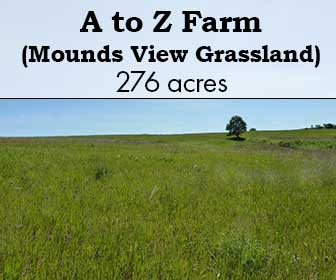
            Specifically, the Shea Prairie is part of a sub area within the MRPHA called the Mounds View Prairie Complex, which is one of the three most significant concentrations of prairie sod and grassland bird habitat within the MRPHA. The Shea Prairie Preserve is immediately adjacent to, or within 1/4 mile of, important tracts of high quality prairie remnants with rare and declining species and extensive acres of grasslands enrolled in CRP. The property connects to the 276-acre A to Z tract which was recently protected by TNC, and is soon to be transferred to The Prairie Enthusiasts for management. With continued restoration and management, the Shea Prairie’s 62 acres will provide important habitat for many area-sensitive grassland birds and other rare and declining prairie species.

            Much of the high ground in the SE corner of the property is too rocky and thin-soiled to have been tilled. Thus, it supports original unplowed prairie sod which ranges from dry to mesic in soil moisture on W and NW facing aspects. The remnant sod is in varying stages of degradation due to both brush/tree invasion in recent decades and past livestock grazing. However, grazing has been absent for at least 32 years, and approximately half the prairie sod (the drier half of the moist spectrum) has rebounded to a state of moderate to good quality prairie vegetation. In the past few years, the recovery has been accelerated by active management through a management. The remainder of the original unplowed prairie sod is dry-mesic to mesic in nature, and is extremely degraded by heavy tree/brush invasion and past grazing. The most level portion of this area may have been plowed a long time ago, but there is no cleared evidence of old plow lines to confirm this.

            Based on original land survey records and current conditions, the entire bottomland of the preserve was likely mesic to wet prairie with pockets of sedge meadow at the time of settlement. Most of it is retired cropland, seeded in brome, that has been enrolled in the CRP. The stream running through the property supports trout and is of very good water quality according to a Biotic Index based on stream invertebrates collected by the DNR. It has areas of sand and gravel bottom, and rock riffles, with natural oxbows present. There is some very limited native wet prairie and sedge meadow vegetation along parts of the stream and in a few of the wettest pockets away from the stream. Some of these pockets have organic soil, with native wetland vegetation starting to reestablish, and a small ephemeral pond with breeding frogs (chorus frogs, spring peepers, Cope’s gray treefrogs, and toads) in the spring. Willow and other tree invasion has been occurring along the stream over the past 50 or more years. Along the east edge of the lowland where it meets the uplands, there is a small area of raised peat that appears to have been a perched a fen. Now, it is overgrown with boxelder and is beginning to oxidize. Some bluejoint grass, Jacob’s ladder, and a few other fen associates are still evident, but extremely limited. There is another small groundwater discharge area near the base of the north end of the prairie remnant hill, with sedges and other wet meadow species reestablishing. The entire bottomland area has great potential as grassland bird habitat, and, with prairie restoration, it will eventually provide critical refuge for the state-endangered regal fritillary butterflies during dry years. The property’s cold water stream and spring/seep wetland areas are significant for the MRPHA, for they provide important habitat diversity to this generally dry upland landscape.

            Thorough biological surveys of the property have yet to be done, but some information is available. Birds observed at the site include the State-Threatened Bell’s vireo and various other grass & brush land species such as woodcock, eastern meadowlark, grasshopper sparrow, sedge wren, field sparrow, brown thrasher, willow flycatcher, clay-colored sparrow, and the Northern shrike. Three state-listed plant species have been found: prairie turnip, Richardson’s sedge, and Hill’s thistle. There are strong displays of rough blazingstar, hoary puccoon, shooting star, and cream Baptisia on the better remnant sod. The state-threatened regal fritillary butterfly moved onto the property two years ago, from adjacent land, as trees and brush were removed and fire reintroduced.

            Pond at the wetland found at Shea Prairie. Photo by Joshua Mayer.

            How was Shea Prairie Protected

            Bordner’s 1936 Land Use Economic Inventory listed the upland prairie areas of the Shea Prairie Preserve as pasture and the lowlands as a combination of pasture and cleared cropland. John and Diane Shea moved on to the farm in 1974, but they never pastured the prairies. They grew crops in the bottomlands along William’s Creek until enrolling the fields in the Conservation Reserve Program in 1998. The non-cropland portions of the bottomland were burned once sometime in the 1980’s. The remnant prairie was not burned during their ownership.

            In the mid 1990s, Rich Henderson, while gathering information for a DNR study on landscape-scale management opportunities in WI for grasslands and savanna ecosystems, identified the Shea property as likely having remnant prairie. The ID was made using aerial photos and long-distance observation across the valley. In June 2000, Scott Sauer and Eric Maurer, working on a DNR Prairie Insect Inventory Project, visited the site with owner’s permission. They appear to have been the first ecologists to visit the Shea Prairie. In 2003, Kristin Westad, as the field coordinator of the newly established MRPHA Project, contacted the Sheas to inform them of the biological importance of the Project area and the significance of their property within it. At about the same time, Amy Staffen, working for The Prairie Enthusiasts on land management projects and in coordination with Kristin, contacted the Sheas to see if they would be interested in entering into an agreement to allow management/restoration of their prairie remnant. They were very receptive, and entered into an informal agreement with The Prairie Enthusiasts, and eventually an agreement with the U.S. Fish & Wildlife Service (FWS) as well.

            In the spring of 2004, Kristin Westad (representing The Prairie Enthusiasts) and Derek Johnson (with TNC) met with the Sheas to explore the possibility of permanent protection of their prairie. The Sheas were very supportive of the idea. TNC (starting with Derek and ending with Rodney Walter) and The Prairie Enthusiasts (Rich Henderson) continued discussions with the Sheas that culminated with 62 acres becoming a The Prairie Enthusiasts Preserve on August 18, 2006. Protection of this site was made possible by a grant from the Knowles-Nelson State Stewardship Fund, donations to The Prairie Enthusiasts from Pheasants Forever Dane & Iowa County Chapters and several private individuals, help and guidance from TNC, and of course the support and cooperation of the Shea family. We are very grateful to them all.

            Shea Prairie was dedicated during a ceremony on October 28, 2006.

            Shea Prairie dedication ceremony on October 28, 2006 featuring (left to right): Site Steward and Board Representative Rich Henderson, landowners Diane and John Shea, and former Executive Director Renae Mitchell. Photo by unknown photographer.

            How You Can Help Shea Prairie

            Half of the open prairie sod was burned on April 13, 2004, by Empire-Sauk Chapter volunteers. From April-August, 2004, contractors were hired by The Prairie Enthusiasts, paid for by a U.S. Fish & Wildlife Service (FWS) grant, to clear trees from the best prairie areas. They also pulled/dug/cut parsnip and sweet clover in the prairies during June-August. Volunteers continued with parsnip and sweet clover control, and tree/brush removal on the prairie remnants, in 2004 & 2005. In the winter of 2005&06, 2/3 of the trees along the stream were removed by contractors under agreement with FWS Private Lands Program.

            Even with the significant work that has been done, the Shea Prairie Preserve is still very much a work in progress, but one with great potential for making a major contribution to both short and long-term prairie ecosystem conservation in WI. At least 2/3 of the tree and brush removal still remains, invasive weeds are not yet fully under control (including some serious patches of reed canary-grass), many acres need to be planted to prairie, and there are wetlands to restore and a cold water stream to improve. There are also improvements needed to facilitate limited public use that comes with state grants and good neighbor relations, improvements such as a parking lot, a kiosk, and posting of property boundaries. With the help of ongoing and additional land management grants and the dedication of our many The Prairie Enthusiasts volunteers, we are confident in reaching our goal of restoring a rich and diverse prairie ecosystem that ranges from wet to dry.

            Check out our Events Calendar to see upcoming work parties or contact the site steward to get involved.

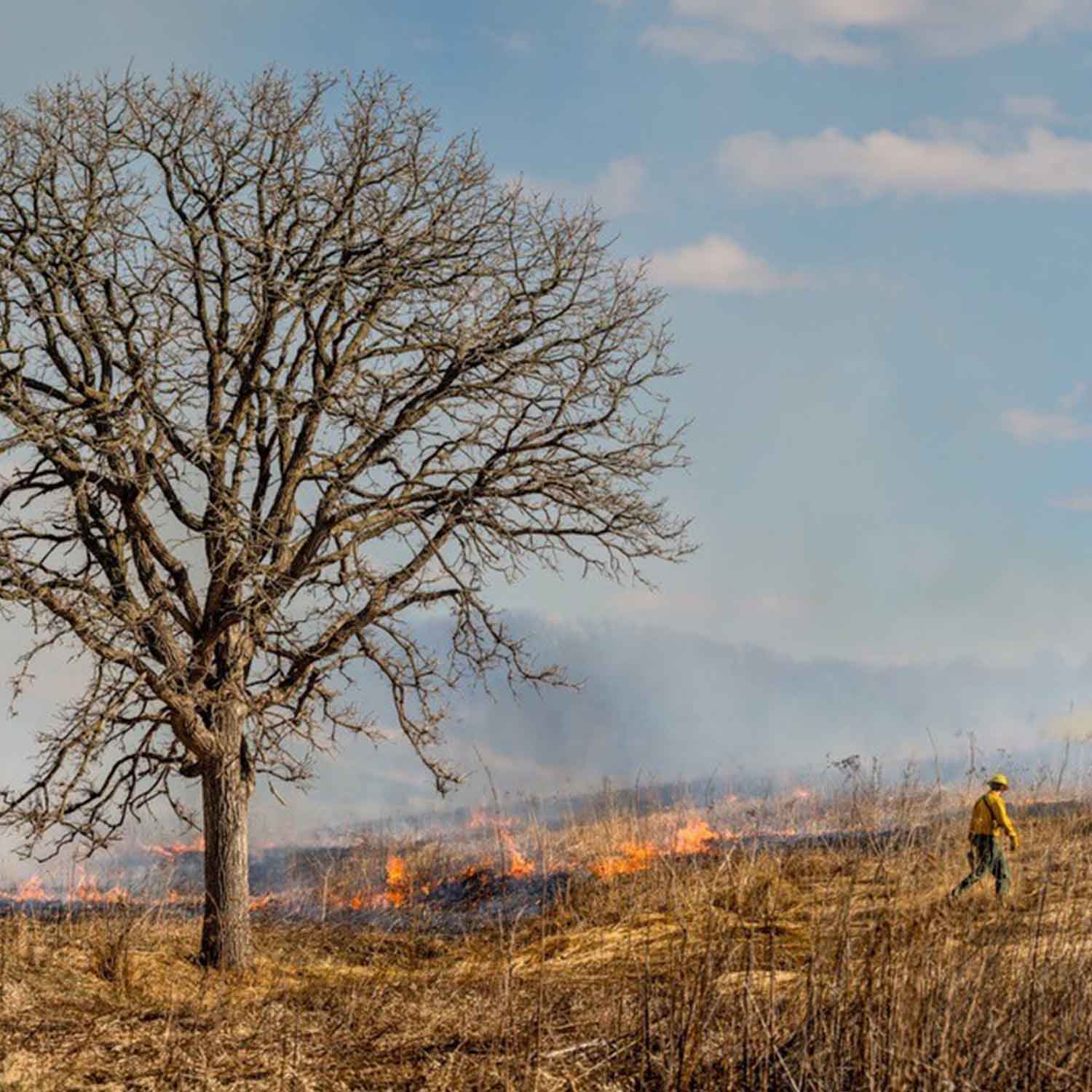
            Burn crew member patrolling a prescribed burn at Shea Prairie. Photo by Jim Wilson.

            A to Z Farm

            A to Z Farm

            A to Z Farm

            This property has mowed lanes and some moderate slopes.


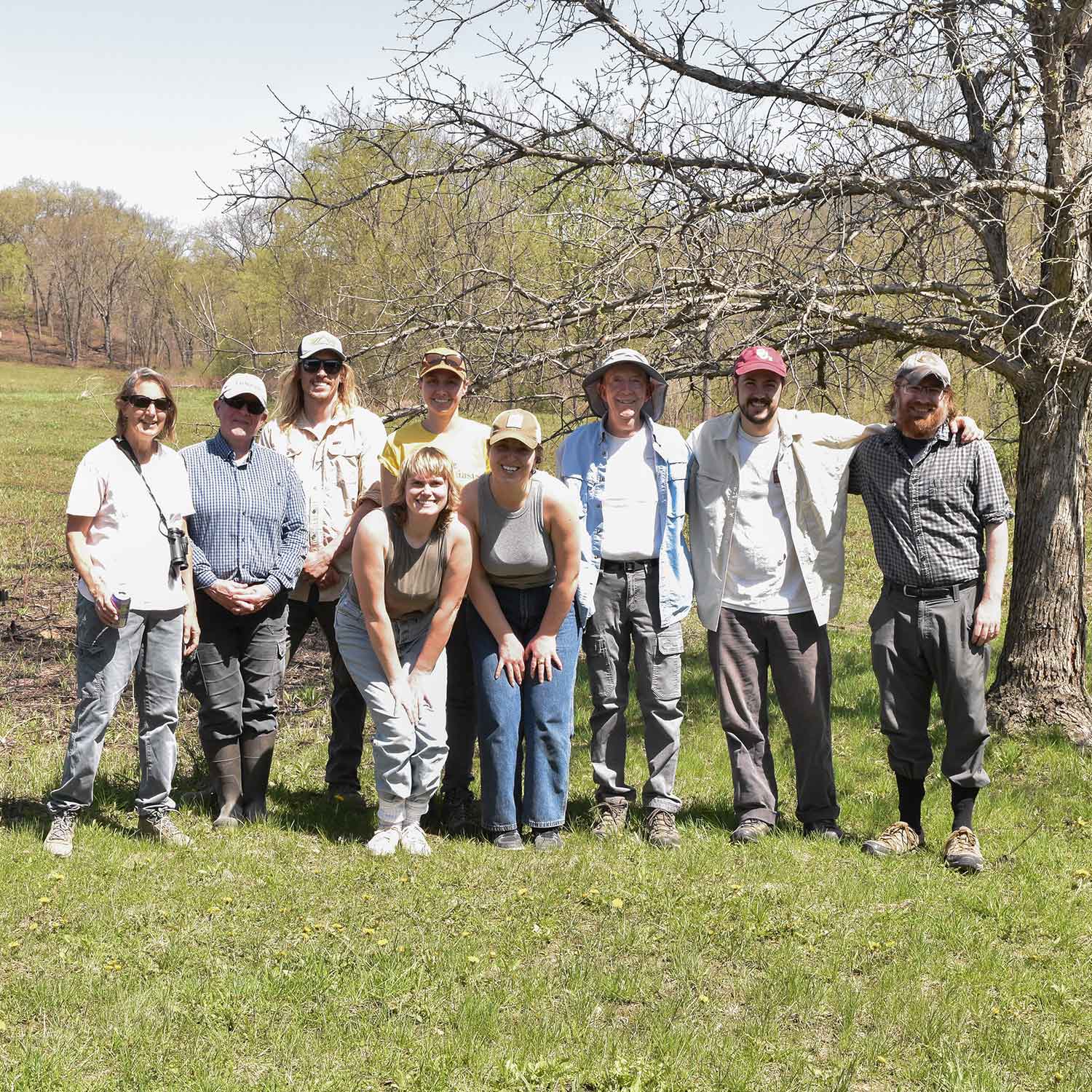
            Interns at A to Z Farm. Photo by Rob Baller.

            A to Z Farm

            Interns at A to Z Farm. Photo by Rob Baller. 

            This property has mowed lanes and some moderate slopes.

            Site Steward

            Connect with the site steward to see how you can care for this rare habitat at an upcoming work party.

            This site is stewarded by The Prairie Enthusiasts Empire-Sauk Chapter.

            Site Steward: Rich Henderson (Email)

            Upcoming Events Here

            No event found!

            More information coming soon!

            Hanley Savanna

            Hanley Savanna

            Hanley Savanna


            Sand prairie at Hanley Savanna. Photo by James Quick.

            Hanley Savanna

            Sand prairie at Hanley Savanna. Photo by James Quick. 

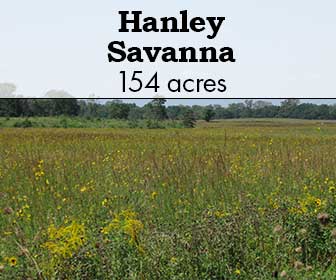
            This site is a 160-acre prairie, savanna and woodland restoration in rural Hanover, IL. This site has transformed from row cropland and white pine plantation to several types of prairie ecosystems, including tall grass prairies, oak savannas, fens, sand blowouts and black oak barrens. The property is relatively flat with mowed trails, making it an easy place to hike.

            Access & Directions

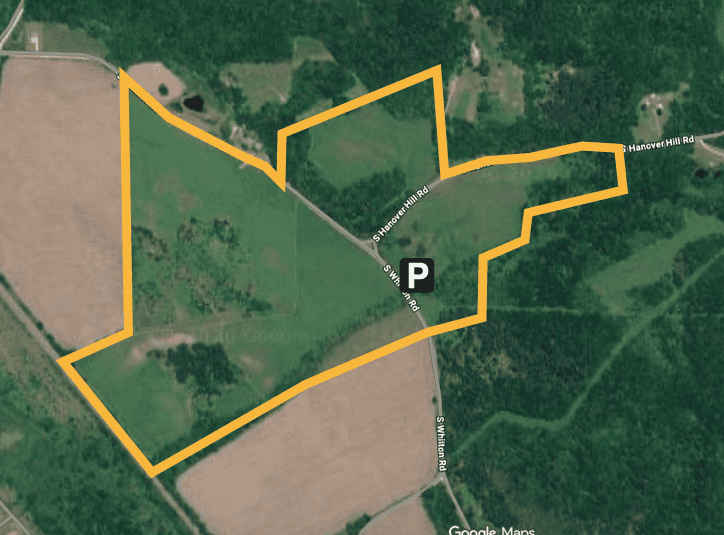
            9417 Whitton Road, Hanover, IL 61041.

            Google Map

            Site Steward

            Connect with the Chapter to see how you can care for this rare habitat at an upcoming work party.

            This site is stewarded by The Prairie Enthusiasts Northwest Illinois Chapter.

            Upcoming Events Here

            No event found!

            How to Enjoy This Site

            Allowed:

            • Hiking
            • Outdoor recreation

            How to Enjoy This Site

            Allowed:

            • Hiking
            • Outdoor recreation


                Staff and volunteers try to identify bees at Hanley Savanna during a spring field trip. Photo by Cassidy Coulson.

                What Makes Hanley Savanna Special

                Hanley Savanna connects the Lost Mound Unit of the Upper Mississippi River U.S. Fish & Wildlife Refuge with the Illinois Department of Natural Resources’ Hanover Bluff Nature Preserve. Altogether, these and adjoining protected areas create the largest protected area in northwest Illinois – about 11,200 acres – with a wide diversity of natural areas from bluff tops down through the Mississippi River.

                Visitors are welcome at Hanley Savanna. Hiking trails throughout the area allow easy access to observe native prairie and savanna plants as well as a variety of grassland and woodland birds. Interpretive signage at the shelter near the intersection of Whitton and Hanover Hill Roads provides details about the history of Hanley Savanna, information about prairies, and a trail map.

                Wood betony at Hanley Savanna. Photo by Sarah Barron.

                How was Hanley Savanna Protected

                In the early 1970s, Jim Lewis purchased almost 300 acres of land from the top of the bluff to the valley below. His farm, a portion of which would become Hanley Savanna, stretched from the railroad tracks to the bluff top.

                In 2003, The Prairie Enthusiasts purchased 110 acres from Lewis, starting Hanley Savanna. The Prairie Enthusiasts purchased an additional 44 acres of land from farmer Gene Roberts and six additional acres from The Nature Conservancy, completing the current 160 acres of Hanley Savanna.

                Staff members and Northwest Illinois Chapter volunteers look at a bee up close on a field trip at Hanley Savanna. Photo by Sarah Barron.

                How You Can Help Hanley Savanna

                The Northwest Illinois Chapter began undertaking the restoration and management of Hanley Savanna’s prairies and savannas in 2003.

                Check out our Events Calendar to see upcoming work parties or contact the site steward to get involved.

                Following a work party, staff members and volunteers gather at Hanley Savanna’s shelter. Photo by Sarah Barron.